Dive Brief:
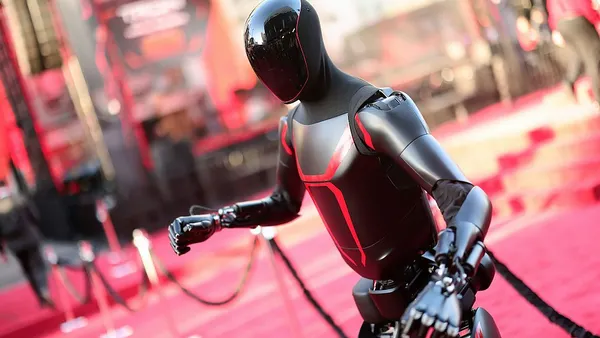
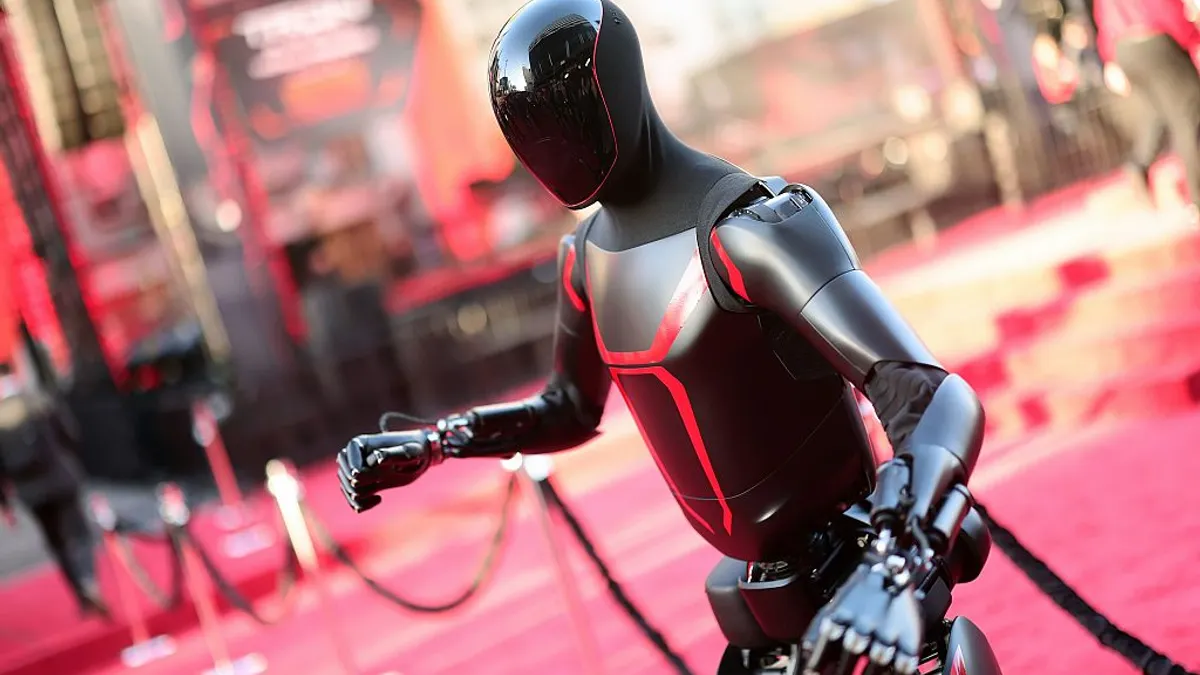
- Tesla has started “early production” of its Optimus humanoid at Fremont, California, with plans to begin customer shipments next year, co-founder and CEO Elon Musk said in a third quarter earnings call last week.
- The electric vehicle manufacturer has installed the “vast majority” of a robotics production line at Fremont that is capable of making 1 million units per year, Musk said. He added that it would probably take “a year, maybe longer” to reach that rate as Tesla works through different production design configurations.
- Early customers would use Optimus for industrial applications, such as dangerous, repetitive tasks, Musk said, but eventually people could purchase the robots for home use as Tesla scales production.
Dive Insight:
Tesla is ramping production as competitors Toyota, Hyundai and others begin piloting humanoids on their factory floors. They are also positioning to be mobility companies that make their own robots, rather than just car manufacturers.
Toyota plans to deploy 400,000 robots as part of a $6.4 billion annual investment plan to automate its assembly lines, the Financial Times reported Monday. The company’s research division has developed a foundational model that it can use for its in-house humanoid Embodied Learning robot for Enhancing Yield, or ELEY, to learn tasks by observing factory workers.
Last month, Boston Dynamics, a subsidiary of Hyundai, opened its robotics center in Savannah, Georgia, where it can test and train Atlas humanoids for use across Hyundai’s automotive factories. The company had said that it will begin exploring use cases for other industry sectors next year.
One of the big challenges these companies face is gathering data and training the autonomous robots to be ready for the real world. While Tesla has a vast fleet of cars to pull self-driving data from, that is not the case with Optimus, Musk said on the call.
“We have to bootstrap it by making the robots and having them do self-play,” he said. Tesla plans to do this by building an Optimus Academy, ranging between 10,000 and 20,000 robots, that can practice a wide variety of tasks. From there, he said the company can use the data in a “flywheel” to improve the robot’s actions and decision making.
Musk equated the robot’s development to that of a toddler. “Initially, they’re sort of wobbly and they don’t know how to do things, and eventually they learn to wipe [themselves], which is a big milestone,” he said.
Tesla plans to leverage its Terafab facility in Texas to supply enough AI5 chips — its next-generation, in-house artificial intelligence processors — for Optimus. The chip will give the robot more computing power versus its current iteration and be integrated with Optimus in April, Musk said. Tesla plans to release a marketing video in the coming weeks showcasing Optimus doing things that are not preprogrammed.
“I’d be stunned if anyone has a robot that is remotely competitive with Optimus when we start delivering it to customers, which is likely to be towards the end of next year,” he said.
While humanoids comprise a fraction of robotics sales worldwide, the segment is growing rapidly as manufacturers look to fill labor gaps and automate production. Nearly 7,000 humanoids were purchased last year, according to the International Federation of Robotics. Comparatively, companies added a total of 603,000 robots, including industrial arms, quadrupeds and self-guided warehouse bots, to their operations during the same period.