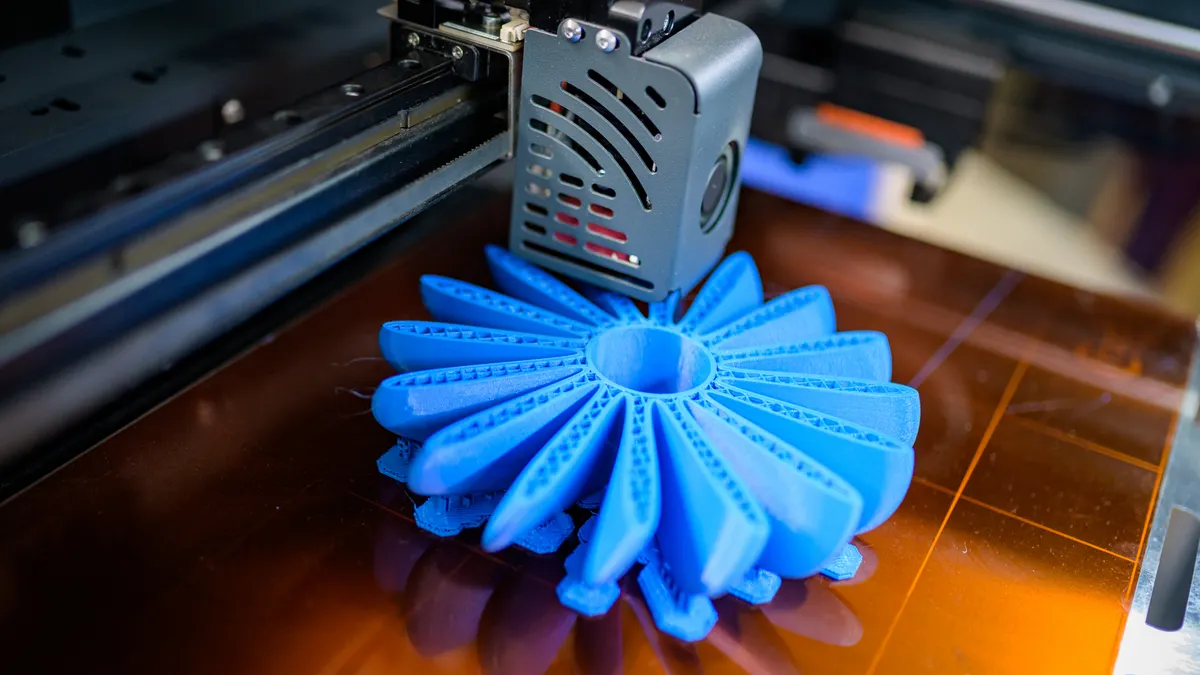
Additive manufacturing, known more widely as 3D printing, has grown beyond just a prototyping process into a critical tool that companies use for making quick and reliable parts and devices.
While federal research and development grants have been effective for companies seeking to integrate additive manufacturing into their operations, workforce and cost barriers remain a challenge, said Brett Conner, chief manufacturing officer at SME.
“Our role at SME is to try to help people overcome those barriers,” said Conner, who became the organization’s first CMO in October. The nonprofit, established in 1932, is focused on educating the North American manufacturing industry about automation, lasers, smart manufacturing and other technologies and tools.
Conner has more than 25 years of manufacturing and leadership experience, recently serving as a senior program manager for additive manufacturing with PM2 Strategies, a contractor for the U.S. Department of Defense. In that role, he worked closely with the Pentagon, military services and defense agencies to drive policy, strategy and investments related to advanced manufacturing.
Conner was also a chief technology officer and co-founder of Freshmade 3D, and early in his career served as a commissioned officer in the U.S. Air Force. He has PhD and masters degrees in materials science and engineering from the Massachusetts Institute of Technology, and is a University of Missouri graduate.
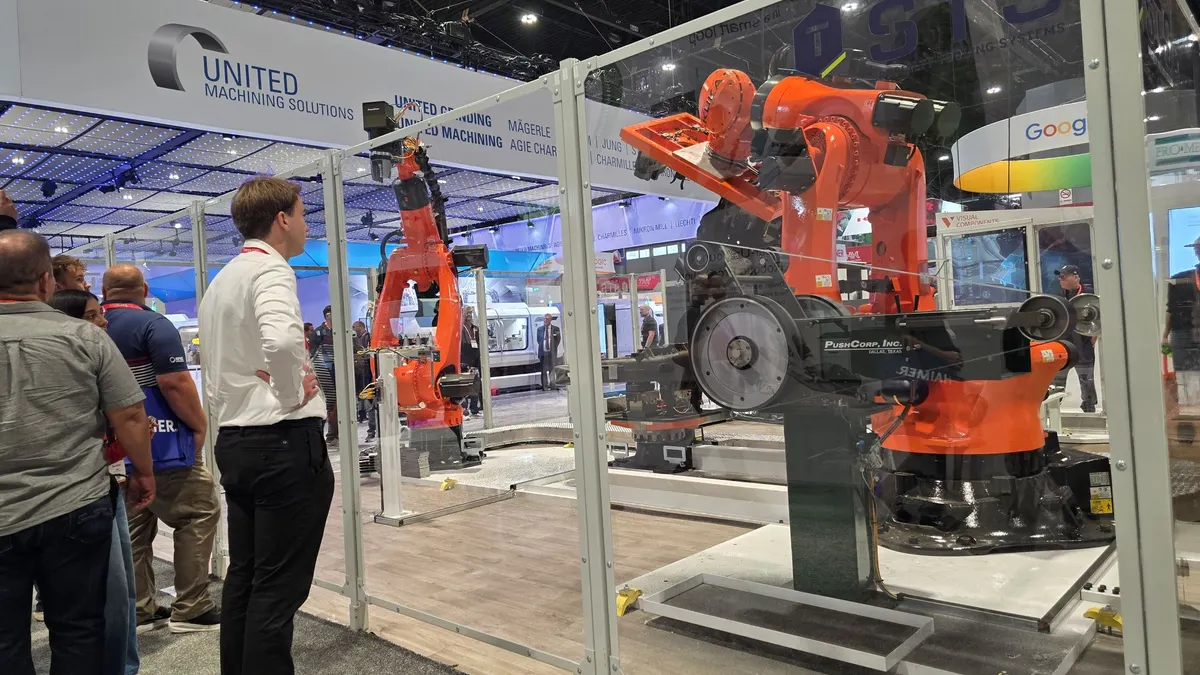
Conner recently spoke with Manufacturing Dive about the state of additive manufacturing, how companies are integrating the technology into their processes and some of the innovations that were recently on display at the Rapid + TCT trade show in Boston.
This interview has been edited for clarity and brevity.
MANUFACTURING DIVE: Why should companies implement additive manufacturing into their operations?

BRETT CONNER: Let's start with definitions first. When we're looking at additive manufacturing, it's a form of manufacturing where you're adding material layer by layer. Let me make that opposed to subtractive forms of manufacturing, like machining, where you take a block of material and you remove material to get to a shape.
Additive manufacturing is 40 years old, so it's been around for a bit, but in the early days the material performance was not acceptable for final finished-part use or it didn't have the structural load-bearing capability. It was good enough for prototyping, but not for use in final parts. And the dimensional accuracies weren't acceptable enough.
Now we've got processes where the material properties are outstanding, and we have a variety of materials that can be used. We have great dimensional accuracies, or we've integrated enough with other processes like subtractive machining where we can get the dimensional accuracies that we need to the point that we can use these things in production.
You're seeing additive manufacturing parts in a variety of applications. Just about every person who's flown on a commercial airplane right now has flown on an airplane that has an additively manufactured part in some way, shape or form, many of which are in the engines. Artemis II … had over 200 additively manufactured parts to it.
Additive manufacturing is used in a variety of surgical implants [and] the invisible aligners that people use for dental work. Each one of those parts comes from an additively manufactured tool in the same shape of the teeth that then form that aligner over. And they're printing 1 million of those a day, so mass customization right there.
So if you have opportunities where you could do mass customization, whether that's shoes or whether that's aligners, if you can use complexity in the design, or use the design freedom of making something layer by layer to make something complex. For surgical implants, the technology can be used to make a geometry that mimics bone — they call it trabecular geometry — so bone will grow into it. Complex heat exchangers, oil coolers, fuel nozzles, things that have fluid flow inside of them, rocket motors and injectors for space launch vehicles — all great opportunities for additive manufacturing
You could take parts that would normally be assembled to make a complex shape and may be fastened or welded together ... and combine them into one object. Other examples, GE Aviation had looked at making an engine where they had like 850 parts and consolidated down to 40 because of being able to do what I just said. If it needs to be made at a point of need, or in the medical world at the point of care, additive manufacturing is a great tool to do that with, and sometimes it's just if you need things fast.
So many manufacturing processes require tooling. So if you need things fast, additive manufacturing is good for that. How an individual company could use it could vary based on the business case and the application, but… you always want to be thinking of having additive manufacturing in your toolbox, because there's some really unique capabilities.
Does it make sense for manufacturers to bring it in-house?
Almost every company has a simple desktop 3D printer that could be used for prototyping, or could be used to make little fixtures and jigs and so forth to use in the manufacturing space. That's an easy win, easy payoff to make those sorts of things.
Getting into more complex systems like metal additive manufacturing, whether you decide to bring that in house and vertically integrate, or whether you want to have a supply chain to work with, largely depends on your business case.
Some companies, like in the jet engine space, will have things that they do in house because they've created a product line that really needs it. Other companies will leverage going to a contract manufacturer that has additive manufacturing equipment. In that case, you need to be aware of design for additive manufacturing to make sure you're getting what you want, and also the quality assurance. How to inspect these things, and also to provide an adequate product definition to your contract manufacturer. So there needs to be a good working relationship there between the two if it's going to be outside.
What challenges are keeping companies from leveraging additive manufacturing?
Sometimes you get into high, high cost of capital equipment or high cost of materials, so sometimes that can be a barrier to entry or finding the right business case. Workforce is always a challenge to make sure that you have a skilled workforce that can fully take advantage of the technology. Certain high-criticality applications will require a process to qualify the materials, the machines, the process, the operators and ultimately the suppliers.
Say you are qualified to make medical or aerospace equipment, and then there's on top of that a certification, which is when FDA will certify something like a surgical implant or the FAA will qualify or certify something that will go in a commercial airliner, etc. There are costs associated with that.
So generally, qualification, certification, workforce, and then cost of the capital, equipment, cost of materials tend to be barriers, and so our role in SME is to try to help people overcome those barriers.
What types of government support are you seeing?
There are different types of government funding that have occurred over time. Some of them are more research and development focused, and that has come through a variety of agencies, whether that's National Institute of Standards and Technology, whether that's the Department of Energy, and of course, a lot from the Department of Defense for research and development.
There's been some funding in terms of qualification and certification, and trying to overcome those barriers and to move the technology forward, whether that's looking at new AM processes, new AM materials, or new types of application spaces. To support that, there has been more recently some government funding that's been targeted to help companies overcome the capital barrier.
Recent initiatives by the Department of Defense Office of Strategic Capital, as well as the Small Business Administration, work together and create funds that allow for different things like loans and so forth that are enabling businesses to procure capital equipment, make those investments. I think there's some new authorities through the fiscal year 2026 National Defense Authorization Act. It now allows certain defense capital dollars to be used for companies to procure added manufacturing equipment.
I think the R&D funding, overall, has been important to help the industry move forward, and I think that as certain things around qualification, certification and certain barriers come down, and more applications have moved forward, I think that that has helped help the industry grow.
I think some of the challenges to that funding being more effective tends to be either cultural resistance in the qualification or certification process. Program offices are trying to minimize risk because they want to focus on the cost, schedule and performance of their systems to try to to buy things like I'm talking about, like planes or ships. I think that sometimes there's a need for unity of effort across all the agencies of government to support their roles together to support the industrial base.
There have been substantial non-government funds that have gone into the industry, investments that have been made. I think the last year-and-a-half have been rather challenging, and some of those investments have turned out not to pan out as well as initially thought.
Additive manufacturing is not exempt from the fundamentals of manufacturing. At the end of the day, you have to take a product definition, and you have to be able to make that in a stable process with good materials data that can be used for designing qualification approvals. And it has to be done in a matter that's ultimately affordable, where a business case can succeed.
If those things are not in place, it doesn't matter what the technology is; but if those things are in place, we will succeed. I think that the maturing of this industry is really allowing a new focus on those three areas.
SME recently held its Rapid + TCT trade show in Boston. What stood out to you?
The great thing about coming to the show is there's a range of technologies that exist out there.
There's a lot of work around the unmanned vehicle space. We had a healthcare-focused additive manufacturing section to the exhibit floor. New England is known for strengths and innovation in healthcare, so we got to see that in full display. Just lots of interesting things that are going on across the industry, such as small-scale desktop printers and more industrial-grade systems.
It's also becoming more and more apparent since additive manufacturing is a digital technology — taking three-dimensional files that provide process parameters for making something into a physical object — that AI is becoming much more visible in this industry.
Whether that's helping with the new designs that take full advantage of the design freedom of additive manufacturing, or whether that's being involved in developing process parameters and inspection, even getting towards the kind of the holy grail of closed loop control, where you're sensing changes during the process and adjusting it to prevent having defects while you're making it.