As manufacturers increasingly invest in digitization, automation and artificial intelligence, they’re also learning how to manage an exponential increase in data.
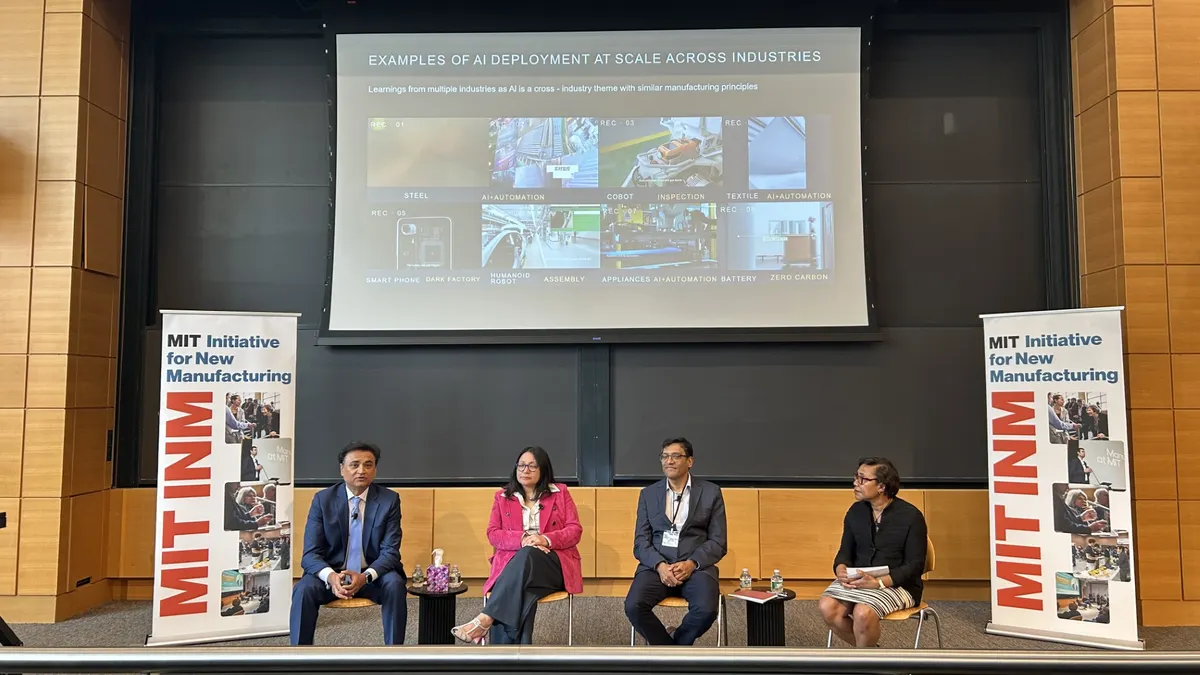
Speakers at multiple panels during a May 6 event hosted by the Massachusetts Institute of Technology’s Initiative for New Manufacturing discussed how they’re thinking about data standardization and analytics. They’re also trying to be strategic about how best to approach this evolution in technical capabilities.
“Automation, AI, analytics ... by themselves, do not create value. I believe they actually increase the flexibility or the domain of what's possible, and they'll only create value when they're applied to a well-defined problem,” said Swamy Kotagiri, CEO of automotive supplier Magna International. “Otherwise, I like to say you're experimenting and you're not transforming."
Automaker Ford is also investing in automation and digitization to gain a competitive advantage. However, Yung Fung, Ford’s managing director and general manager of advanced industrial technology and platforms, cautioned that more data isn’t always useful without the right approach.
"We have a bunch of things that we're trying to land to drive productivity — whether it be robots, AI systems — and everything produces a signal. There's a lot of signal in the factory. Too much data actually in a lot of cases,” said Fung. “The question is are there ways where we could have more connectivity between all those signals.”
Ford and other manufacturers described throughout the event how managing these disparate sources of data is an ongoing task. Carpenter Technology, a global alloys manufacturer, hired its first chief digital officer in 2021 with this in mind.
“Data has always been a byproduct of manufacturing, and that's how it has been treated. We need to start treating data as an asset,” said Chief Digital Officer Shakthi Logasundaram, citing data as “the number one challenge” for the company’s technical operations.
Logasundaram said this goes beyond focusing on enterprise resource planning systems and financial data. He said the company is also tackling the harder task of organizing data from disparate machines and manufacturing processes for which “there's no standard, there's no control” because “every machine is unique, everything is special.”
He said Carpenter chose to pull back on certain technology spending to first focus on standardizing data across the shop floor and fully organizing its system.
“We are taking a completely different approach of scaling up and building an end-to-end data model of our entire organization. And [the] data model is not just going to come from the data that we have collected. We have 240,000 pages of critical process, variable data in paper that we have to digitize,” he said, citing the potential for generative AI to help with this task and agentic AI to help disperse the knowledge.
Biopharma company Amgen has also taken on the complex task of standardizing its data.
“I run into instances where I think I have the right data, and then I go dig into it a little bit more only to find, well, that's not completely the data. There's another set of data over here,” said Arleen Paulino, SVP of global manufacturing. “If you really wanted to leverage the technologies that are in front of us and are coming with AI, your data has to be really accessible and visible.”
Paulino and others also talked about how there can be initial challenges when certain divisions within a company may want to use unique organizational systems for their data, or may be hesitant to share it in general.
Sanjay Sharma, CEO of ArcelorMittal China, spoke about how his company is aiming to “democratize the data” while also navigating regulatory factors.
“Everybody wants to hold the data, and geopolitics makes it even more difficult — transportability of data from one region to another region, that brings certain barriers also,” he said.
This effort also requires an investment in workforce transformation to hire and train data scientists or related positions, Sharma added.
While the required investments and culture changes take time, manufacturers also said they see clear benefits to this digital shift.
Bill Good, VP of supply chains at GE Appliances, said he views this as one way to compete against countries with lower-cost labor, alongside efficient domestic supply chains.
Good said the company has largely retrofitted its older plants to have full data tracking, demonstrating how he can track production metrics at company plants from an app on his phone.
“I literally have visibility to every single assembly line, every piece of equipment in my plants,” he said. “Honestly, for me, I don't need visibility into everything, but my folks do. I often tell people the most difficult problem is the problem you can't see, and data allows you to eliminate the problem. So we have focused tremendously on that digitization strategy.”
Paulino also discussed how Amgen takes a “control tower” approach by delegating data responsibility to different tiers of people. Those on the plant floor focus on information about their respective areas and a plant manager can have sitewide visibility. Certain executives can also look at trends more broadly, while keeping in mind how and when to act on what they’re seeing.
“There's a responsibility also that comes with having access to all of that data. How do you use it in a way that's beneficial and not a hindrance? Because nobody wants me calling them all the time, saying, ‘Hey, I'm watching your run and it looks like it's going off track.’”
As all of this evolves, companies are figuring out how best to manage proprietary data versus data shared with third-party technology providers.
“What we want to keep in house is anything that there is an expertise that we have ... that part of AI we want to keep inside,” said Logasundaram, versus other use cases that are more suited for third-party technology providers. For example, he said when it comes to “predicting machine failures, anyone can do that.”
While data is often thought of as a way to track the performance of certain equipment, it can also take many other forms.
"The secret sauce for any plant ... is the conversations that go to problem solve and understand and triangulate the context. That goes into the ether,” said Ford’s Fung, adding that “it's not captured in a database, it's not captured in a report" because the people that are working don't have time to do it.
"How do you start to capture that which is more powerful than sometimes a raw dataset because it has context to create your semantic anthology?” he asked. "That's something we're also exploring and working on. Because we have scale, we have a ton of data. We're not harnessing all that context.”