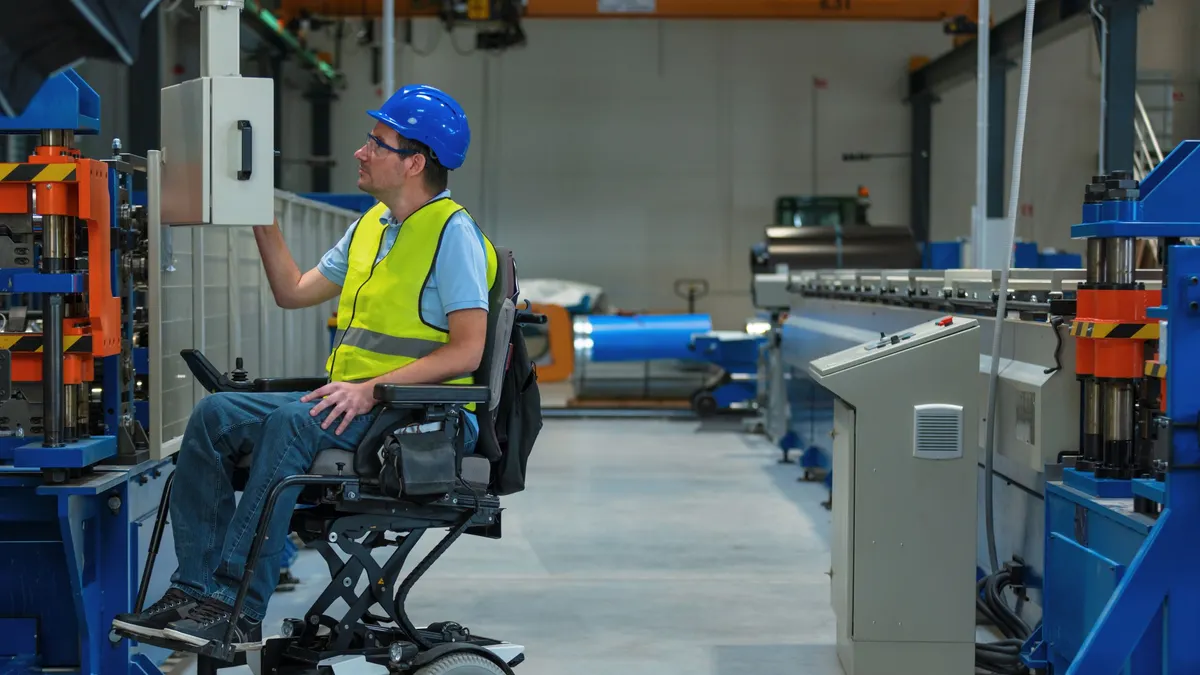
More manufacturers should expand their recruitment strategies to include people with disabilities as they navigate worker shortages, experts said during a July 22 Employer Assistance and Resource Network on Disability webinar.
The number of open jobs in the manufacturing sector has remained consistent for about 10 years, said Jordan Morang, director of workforce innovation and policy at the Manufacturing Institute.
May job openings in manufacturing increased about 32% to 529,000 compared with 401,000 openings during the same period last year, according to the U.S. Bureau of Labor Statistics’ job openings and labor turnover survey data released June 30. The employment index remained in contraction, registering at 49.7%, up 1.1 percentage points from May’s figure of 48.6%, according to the Institute for Supply Management’s Purchasing Managers’ Index June report.
The openings have “kicked sectors into gear” on workforce development, prioritizing training, hiring and employment as manufacturers recognize they need a strong workforce to be “economically viable,” Morang said.
But, attention has shifted from “hiring as many folks” as manufacturers can, to adopting a slower hiring pace and focusing on recruitment, retention and upskilling, he said. The industry has moved away from preparing individuals and relying on academic coursework. Instead, the emphasis is now on assessing valuable skills and credentials.
“I don’t want to suggest that manufacturers weren’t thinking about that by any means, but it’s very nice to recognize that as a workforce development ecosystem,” Morang said.
The manufacturing industry has a great opportunity to take the lead in implementing skills-based hiring, possibly setting the example for other industries, said Ellice Switzer, LPC extension associate at Cornell University's Yang-Tan Institute on Employment and Disability.
Skills-based hiring is also a good way for job seekers with disabilities especially to help “break that paper ceiling” and provide them access to careers that may be inaccessible due education or experience requirements, Switzer added.
“We’ve seen great candidates can really get lost when employers rely too heavily on those types of indicators to reach new talent,” Switzer said.
The number of workers with and without disabilities in manufacturing and production
Charging ahead in skills-based hiring
One particular case Morang noted is the Manufacturing Institute’s Heroes Make America program, which prepares military veterans and spouses for manufacturing careers.
Veterans are almost uniquely qualified to take jobs in manufacturing, Amy Thomas, national director of the Heroes Make America program, said in a 2023 interview with Manufacturing Dive.
“If you look at safety, maintenance, communications, logistics, I mean, these are all experts coming out of the military with these qualifications that they learned in the military,” Thomas said.
Additionally, many veterans have service-connected disabilities.
“I think skills-based hiring allows us to strip everything away from what a candidate walks in the door with, outside of the skills and opportunities that they bring to the job,” Morang said. “And I think that with disability employment it is ultimately very useful because it shows most directly that this is what I as a candidate can bring to your organization.”
Manufacturers can expand their skills-based hiring talent pool by focusing on the regions their operations are in, such as reaching out to schools and local community programs. “The regional focus is essential in manufacturing,” Morang said.
Manufacturers can also partner with workforce development systems that work with job seekers with disabilities on the state and local level, Switzer added.
One example of a company utilizing regional partnerships is New York-based engineering and contract manufacturer Fala Technologies, which makes industrial equipment for the semiconductor, aerospace and green energy technologies sectors.
Fala provides certified apprenticeship traning for various trade skills, including CNC machinists, toolmakers, wwelders and industrial manufacturing technicians. The company also offers pre-apprenticeship and internships program that involve hands-on training.
In an effort to expand opportunities to people with disabilities, Fala sought out regional organizations such as the Resource Center for Accessible Living. The partnerships enhance Fala’s recruiting, provide extra training as well as support. Fala’s efforts help jobseekers with disabilities gain the pre-requisite skills needed to finish their apprenticeships.
“Manufacturers are very competitive, and always competing for talent,” Morang said. “So finding one that will buy into what you're offering, I think is the key.”