


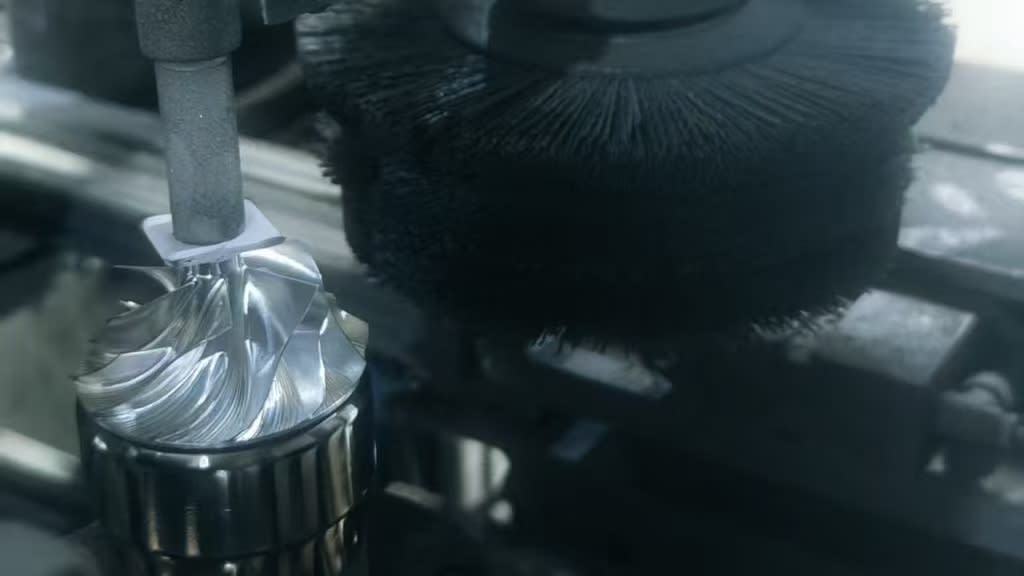
Deburring and edge radiusing are secondary operations, but they add 8% to 12% to the total cost of producing a precision component. One turbocharger turbines the problem keeps growing: blad curvatures get steeper with each generation, trailing edges get thinner, and the abrasive brushes on these lines either wear out early or leave burrs in the root.
The standard tooling logic for delicate parts pairs stiff filaments with fine grit, Dynamic testing on the machining line pointed the other way. Hard filaments deflect off the thin aerodynamic contours instead of cutting into them, and fine abrasives clog quickly once micro debris loads up.
LG Brush documented the results in its lates field test data and deburring case study. Reversing the two parameters solved the finishing bottleneck:
- Filament Diameter: 0.8 mm (hard) → 0.6 mm (flexible) — Eliminates bristle deflection and follows 3D contours.
- Abrasive Grit: 240# (fine) → 120# (aggressive) — Prevents wheel loading and lowers heat buildup.
- Spindle Speed: 2,000 RPM — Unchanged, seamlessly matching automated cycle targets.
- Tool Life: Baseline → +25% increase — Directly reduces tool wear and changeover downtime.
CNC spindle setup had to change. The gain came from bristle compliance and chip clearance alone.
For plants running automated lines, the lesson is concrete: match the filament to the actual part geomtry, and consumable costs move. In this case, that match was worth 25% more tool life.
Shanghai Longguang Industrial Brush Co., Ltd, an industrial brush manufacturer, established in 2004 in Shanghai China. With continuous development, it has established a number of subsidiaries and has advanced production equipment and supporting production technology. In order to meet the high quality and stability requirements of our customers, Longguang has continuously introduced high-advanced brushing equipment.