Dive Brief:
- Softbank Group is back in close talks with ABB to recover a robotics acquisition that was blocked by China’s regulators last week.
- The global technology investment company said Friday that both parties are “working constructively on the transaction” and will announce any decisions that require disclosure.
- On Nov. 4, China’s Office of the Working Mechanism for Foreign Investment Security Review notified Softbank that it had prohibited the acquisition of ABB’s robotics business in China, forcing the companies to regroup on the details of their $5.4 billion transaction.
Dive Insight:
While next steps are uncertain, industry experts are expecting a carve-out deal or compromise to salvage the acquisition of ABB’s robotics business, Bloomberg first reported.
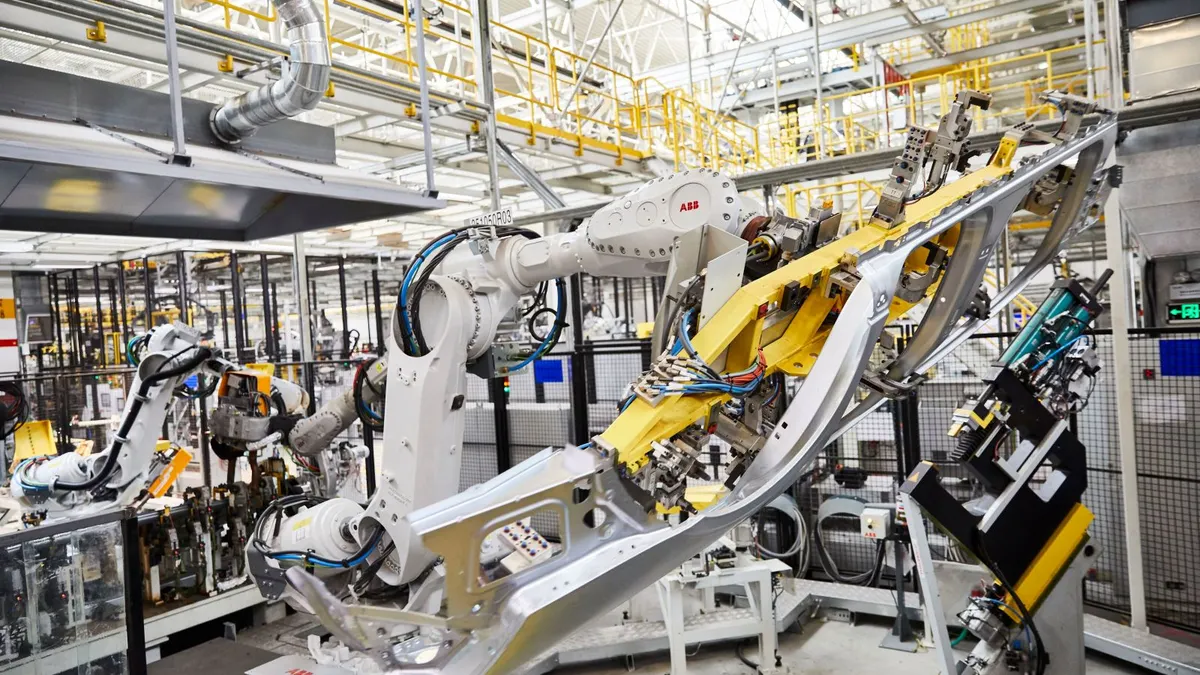
ABB is the world’s leading manufacturer of robotic arms, alongside Fanuc, Yaskawa and Kuka, according to the Association for Advancing Automation. ABB’s robotics business generated $1.7 billion in revenue through the first nine months of the year and posted a net loss of $23 million.
China accounts for about 30% of ABB’s robotics revenue and is home to the segment’s fully-automated 721,000-square-foot factory in Shanghai, said Erik Nieves, founder and CEO of Plus One Robotics, a physical artificial intelligence company that develops warehouse robots.
“There was a lot of subsidy that went into that, and I’m sure China would feel some sort of way about that going into foreign hands and then getting no benefit from it,” he said.
ABB, a Switzerland-based manufacturer of electrification equipment and automation products, first looked to spin off its robotics business into a separately listed company in April 2025. It pivoted months later to sell the business to Japan-based Softbank by mid-to-late 2026.
“While they’re having discussions on how to do a carve-out, all options are on the table,” Nieves said about next steps for Softbank and ABB. This could include a potential spinoff or finding another buyer that China would approve.
Softbank and ABB declined to comment on why China blocked its portion of the acquisition.
When the deal was first announced, it was less about how ABB found a “good landing spot” and more about how Softbank wants to “double down on physical AI,” Nieves said.
As robotics become more advanced and autonomous, China, the United States, Japan and other countries are vying to become global leaders in the sector.
The Trump administration over the summer blocked imports of mobile robotic devices, including humanoids and quadrupeds, citing national security concerns. Lawmakers have also introduced bills and added a provision to the National Defense Authorization Act targeting robots from China. Additionally, the administration has considered Section 232 tariffs on foreign imports of robotics, but recently opted for trade negotiations instead.
“We’re supposed to be just like CNC machines, nobody makes a fuss about a lathe or a five-axis mill, and yet six-axis robots somehow have become…sort of this proxy for this wider AI battle,” Nieves said.
“I never would have thought we’d be in this place,” he added.
Softbank is pursuing ABB to expand its AI, robotics and next-generation computing capabilities. The company has invested in more than 30 companies to advance physical AI, according to its latest earnings presentation, including Agile Robots and Berkshire Grey. Softbank has also made big investments in Intel, Ampere and other chipmakers.
Most recently, the company on Tuesday posted a quarterly loss driven by $3.7 billion in data center equipment costs.