Dive Brief:
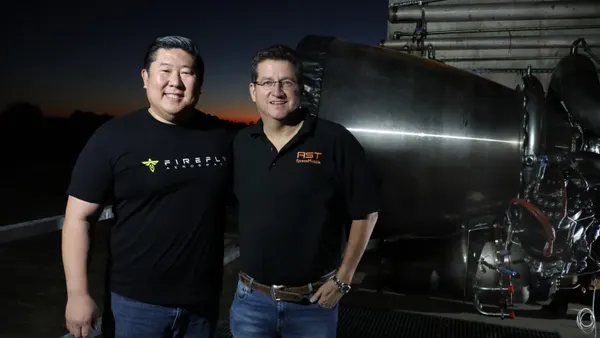
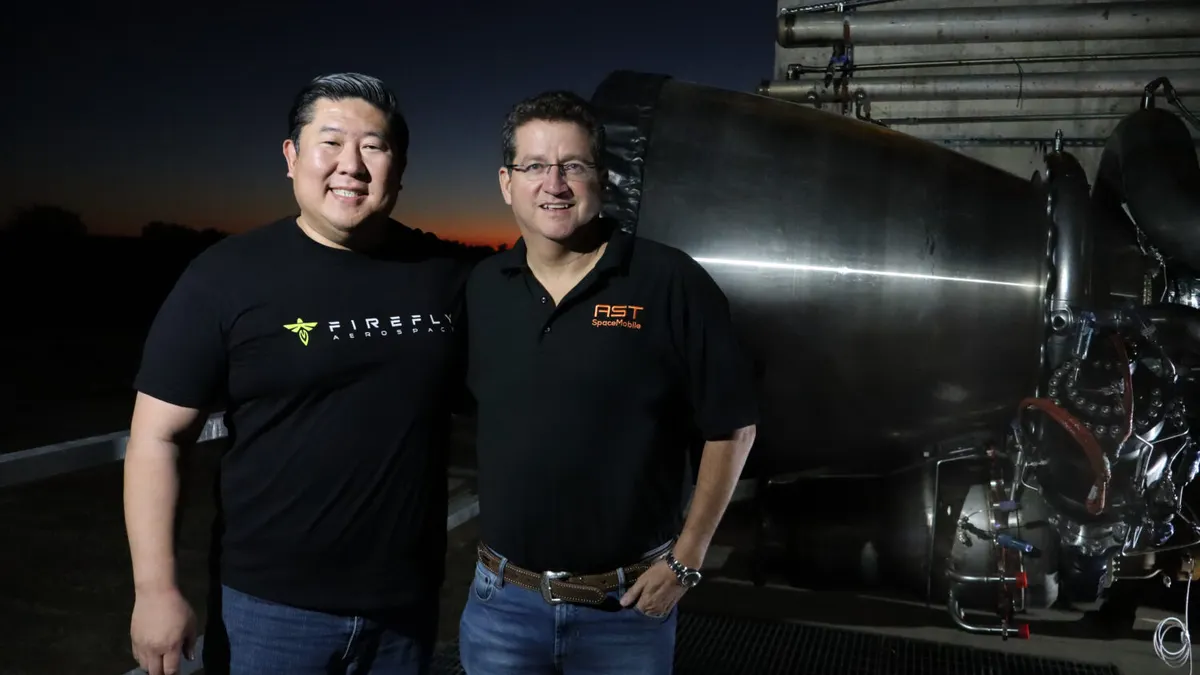
- Firefly Aerospace and AST SpaceMobile have reached a rocket-engine supply agreement valued at over $1.3 billion, according to a Nov. 6 press release.
- Under the three-year agreement, AST will pay Firefly about $800 million upfront for its engine intellectual property, comprising $400 million in cash and 10 million to 14 million stock shares, according to AST’s press release.
- The deal also involves AST paying about $500 million for the first three rocket engines delivered and engineering support services throughout the agreement. Firefly will use the funds to accelerate its launch-vehicle production in Briggs, Texas.
Dive Insight:
The funds will enable Firefly to ramp up hiring, procure long-lead materials, obtain optimal equipment and strengthen infrastructure, including new test bays at its Rocket Ranch site in Briggs, according to Firefly’s press release.
The money will also help Firefly increase engineering capacity to reach key milestones across its programs and “broader technology” strategy.
“This allows us to build and test faster across our launch portfolio, with safety, quality, and reliability built in,” Firefly CEO Jason Kim said in a statement.
Per the agreement, Firefly will deliver 36 rocket engines, including 27 of its Miranda engines and nine of its vacuum-variant Vira engines, to support AST’s new 20-ton heavy-lift rocket, dubbed Blacklift.
Blacklift will be used to deploy AST’s BlueBird satellites in low-Earth orbit. The heavy-lift rocket will be designed for reusability and allow up to five BlueBird satellites per launch beginning in late 2028.
“The Miranda engine will allow us to leapfrog the traditional five-to-ten-year development cycle as we build Blacklift,” Scott Wisniewski, president of AST SpaceMobile, said in a statement. “With this in-house capability, we will be able to better serve our commercial and government customers, across an expanded total addressable market beyond direct-to-device.”
AST SpaceMobile will also target markets including artificial intelligence edge computing, radar, secure communications, internet-connected devices and federal emergency, Wisniewski said.
The Blacklift rocket aligns with AST’s in-house manufacturing capabilities at its facilities in Midland, Texas, of the largest phased arrays ever deployed in low-Earth orbit, the company said.
“It’s a true win-win for both companies: AST SpaceMobile gets control of its own launch schedule, and Firefly gets added funds to rapidly expand our rocket production and reinforce the supply of launch vehicles to address record demand from the industry,” Kim said.
Both aerospace companies have inked additional contracts with the U.S. government over the past week. NASA selected Firefly as a vendor for the agency’s $10 billion Commercial Lunar Payload Services initiative, the company announced Monday. The aerospace technology entity will scale production of its Blue Ghost lander to deliver heavier cargo and critical infrastructure supporting NASA’s Moon Base and Artemis program.
AST nabbed a U.S. Space Force agreement through prime contractor STR in which the supplier will provide “additional phase of technology development to advance sensing capabilities” using its commercially developed space-based technologies, according to a Nov. 5 press release.