


Dive Brief:
-
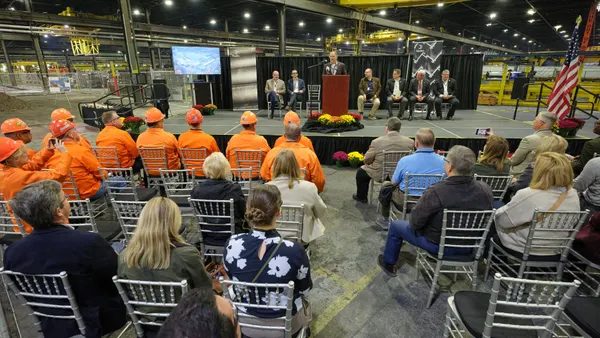
Honda on Monday announced a $3 billion plant for Central Ohio, near its original Marysville plant and positioned “to meet growing customer demand for hybrid vehicles in North America,” per a press release.
-
Intended to accelerate the production of hybrid vehicles and the engines and hybrid systems that power them, the new plant is part of a broader set of investments at Honda operations in Ohio, Alabama and Georgia.
-
The new Ohio plant will offer an annual capacity of 240,000 vehicles, creating more than 2,000 jobs. It’s set to start production in 2029 pending final government approvals.
Dive Insight:
With other projects underway, Honda says it helps create “an integrated manufacturing network for future hybrid and gasoline-powered vehicles,” boosting Honda’s annual U.S. production capacity to about 1.3 million vehicles and its total North American capacity to about 1.9 million units.
After the expansion, Honda’s U.S. production capacity will span plants in Ohio, Alabama, and Georgia, and the new plant and investments will effectively boost Honda’s hybrid production capacity in Ohio by 250%, according to the automaker.
Alongside the U.S. investments, Honda also made a corresponding 166 million Canadian dollar ($118 million) capital investment in Honda’s Canadian manufacturing facilities. It’s part of a broader 867 million Canadian dollar commitment to maintaining the automaker’s workforce of more than 4,000 in Canada and emphasizing “an integrated North American production network.”
Honda confirmed that it plans future investments in its Alliston, Ontario plant to support next-generation hybrid and gasoline models, including the reintroduction of engine manufacturing.
The new Ohio plant will be located between the existing East Liberty and Marysville plants, and Honda said that it “will be one of the most advanced in the world when it comes online in 2029 with leading-edge automation, data-driven technologies, and flexible production systems to improve efficiency, quality and competitiveness.”
The automaker explained in its release that Ohio was selected for this plant due to a multitude of factors, including proximity to its U.S. supplier base, nearby development operations, existing manufacturing plants, and its L-H Battery Company, which started as a joint venture with LG and is now set to supply batteries for hybrids and EVs.
Honda was the first Japanese automaker to build products in the U.S. It started making motorcycles at Marysville in 1979 and started car production there in 1982.
Honda underscored that the new plant is just part of a broader set of investments in U.S. manufacturing that will help expand and strengthen an integrated local production network.
The company pointed to corresponding investments in its Alabama Auto Plant to increase capacity, allowing more flexibility in making the Passport SUV and expanding production of a new V-6 hybrid engine at an adjacent plant.
Honda is also retooling its transmission plant in Ohio to make two hybrid systems for compact and midsize vehicles in North America. That facility will serve as the lead plant for the larger of the two hybrid systems, per the release.
For the new plant in Ohio, Honda pointed to close collaboration with its R&D and manufacturing teams as aspects that will help strengthen Honda's long-term competitiveness in North America. In February, after reporting a $1.7 billion operating loss over nine months amid shifts in U.S. electric vehicle policy, the company confirmed plans to shift automobile and software-defined vehicle development to Honda R&D so that it could respond “flexibly and swiftly” to market changes.
Honda at that time cited “decelerating market growth” for EVs, following on a shift that started in May 2025 when it pivoted toward expanding its hybrid lineup and reducing EV investments by $21 billion.
The automaker confirmed last month that it plans 15 next-generation hybrids by 2030, primarily for North America, while it confirmed several new next-generation hybrids for Acura.