

Global biopharmaceutical company Pfizer plans to build a manufacturing technology center at its research and development campus in Groton, Connecticut, according to the state’s nonprofit economic development corporation AdvanceCT.
The facility will be about 220,000 square feet and will produce clinical active pharmaceutical ingredients and drug products that support Pfizer-sponsored clinical trials around the world, AdvanceCT said in a news release.
Pfizer plans to spend $650 million on the facility over the next five years. Construction is expected to begin in the second quarter of 2027, with operations scheduled to start in mid-2031, the Hartford Business Journal reported. The state has not provided any financial incentives for the project, John Bourdeaux, president and CEO of AdvanceCT, told The Journal.
“Pfizer has a long and proud history of scientific innovation in Groton, where many of the discoveries that advance our pipeline begin. Building on that legacy, the new Manufacturing Technology Center will advance our ability to support clinical research and the development of new medicines for patients around the world,” Groton Site Head Raja Mangipudy said in a statement.
Employees working at other parts of the Groton campus will transition to the manufacturing technology center, bringing related operations under one roof, per the news release. In 2025, Pfizer was the town’s second largest taxpayer and employed about 4,000 people there, according to Groton’s Annual Comprehensive Financial Report for the fiscal year ending June 30 of that year.
“This $650 million investment is a bet on Connecticut: on our workforce, our research base, and the decades of work that made southeastern Connecticut a home for science,” Bob Duff, the Connecticut Senate majority leader, said in a statement. “This is a long-term commitment to the people already working on that campus and to the whole region around it.”
According to Pfizer, the company’s Groton campus was established in 1959 and spans 175 acres with about 2.2 million square feet of lab and office space.
Other investments
Other manufacturers announced facility investments recently, including Lonza and Hydro.
Lonza
Switzerland-based Lonza announced plans to acquire five contract development and manufacturing organization manufacturing sites in the U.S. from Merck KGaA in Darmstadt, Germany.
The acquisition, valued in the “low- to mid-triple-digit millions Swiss francs,” expands Lonza’s U.S. CDMO manufacturing footprint from four to nine sites and adds end-to-end development and manufacturing capabilities that complement the company’s global network, per the news release.
“The acquired network supports customers from clinical through to commercial in attractive growth areas such as antibody-drug conjugates and other bioconjugates, viral vectors for cell & gene therapies and advanced drug-delivery technologies,” the news release said.
Lonza added that the acquisition, combined with other investments in Vacaville, California, and Bend, Oregon, will make the company’s U.S. CDMO network more comprehensive and competitive. The agreement will add about 1,100 employees to Lonza’s global workforce and increase its U.S. employee base to more than 6,000, the company said.
The deal will be funded with cash and is expected to close in mid-2027, Lonza said.
Hydro
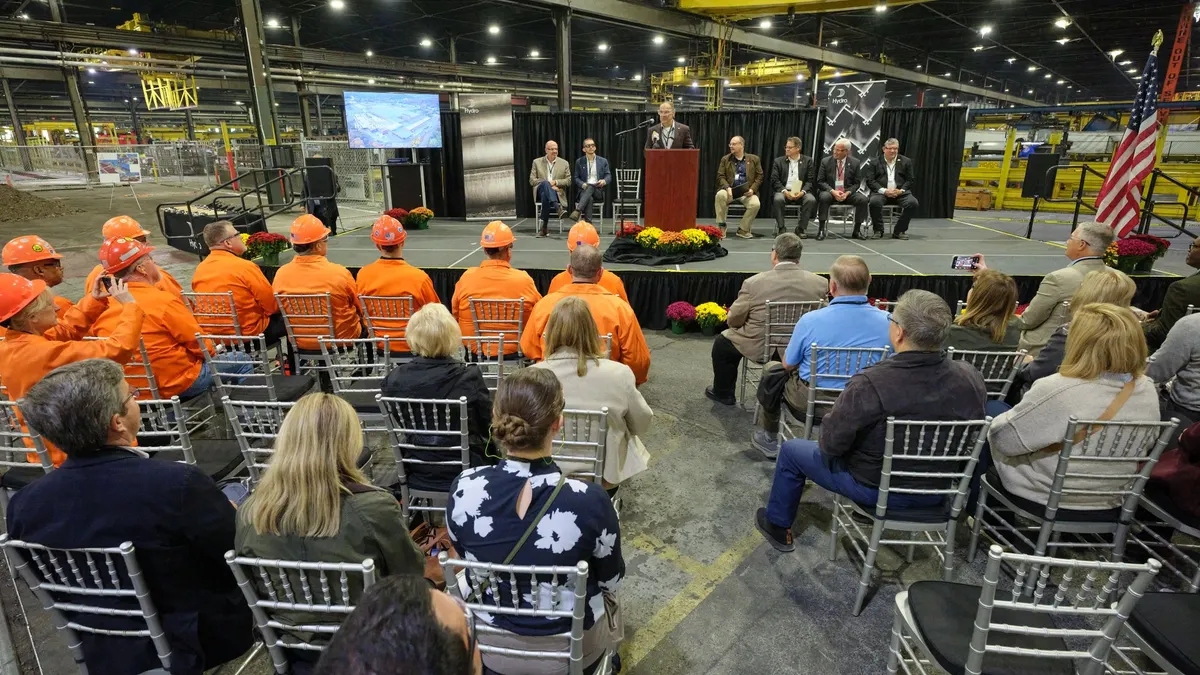
Aluminum and renewable energy company Hydro broke ground on a new 5,900-metric-ton indirect extrusion press line at its Cressona, Pennsylvania, facility.
The $53.5 million investment will increase the company’s production capabilities and broaden Hydro's North American manufacturing footprint, according to a news release. Operations are expected to begin in the first quarter of 2028.
According to Hydro, the investment will replace outdated 1950s-era equipment with “advanced automation, increased energy efficiency and best in class safety performance.”
“This project will improve efficiency, enhance product quality and expand our indirect extrusion capacity to serve the growing needs of our key customers,” Mike Hammer, vice president and general manager of Hydro Extrusion North America’s Industrial and Distribution Region, said in a statement.
According to the company, the commercial transportation, automotive and electrical markets are driving increased demand for indirect extrusions with “consistent dimensions, superior grain structure, and consistent mechanical properties.” Hydro’s expanded indirect extrusion capacity will help meet this demand, per the news release.
Norway-based Hydro has almost 6,000 United States’-based employees working at 19 production sites in 14 states. Although the company plans to invest more than $800 million over the next five years, it expressed concerns about U.S. tariff policies.
“Extrusion presses and other specialized equipment produced only in Europe are currently subject to elevated and frequently changing tariffs that increase costs and drive uncertainty,” Hydro said.