Dive Brief:
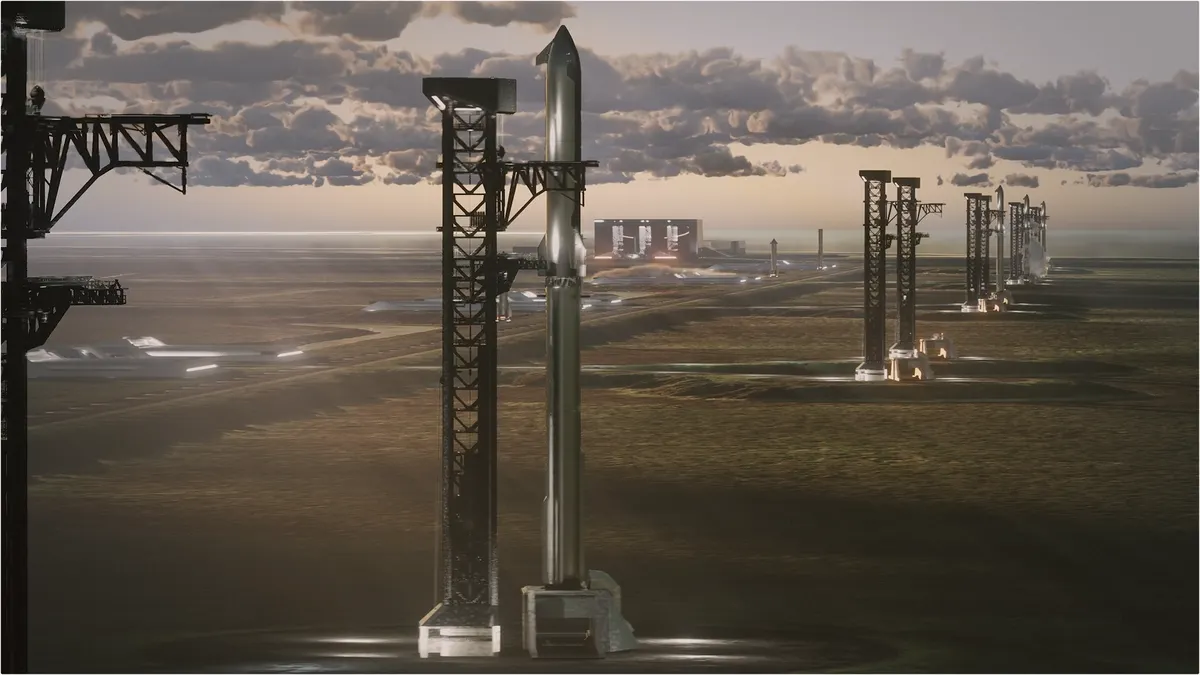
- SpaceX plans to spend $100 billion to build its largest spaceport in Pecan Island, Louisiana, which will be used to launch its reusable Starship spacecraft, the Louisiana Economic Development agency announced Aug. 25.
- The site will include five launch complexes, each of which will have two launch pads and a propellant farm, per the press release. The spaceport will also include a propellant production facility, power generation, vehicle processing and residential housing for SpaceX employees and their families.
- The project is expected to create 3,000 direct jobs over the next 10 years, with an average annual salary of $92,600. LED also estimated that the project will establish over 8,100 indirect jobs. Construction is anticipated to begin in 2027 with the goal to launch the first Starship in 2029.
Dive Insight:
SpaceX’s Starship is currently in development and will be designed as a reusable transportation system that will carry crew and cargo to Earth’s orbit, the moon, Mars and beyond, according to its website. The spacecraft is also being designed to carry more than 100 metric tons.
Additionally, the spacecraft manufacturer joined Source Louisiana to reach out to local suppliers, according to the press release. The website connects local businesses with contract and vendor opportunities related to major development projects. The state encourages Louisiana businesses to register, verify and update their profiles so they can be considered for SpaceX contracts.
The site where SpaceX will build its fourth launch facility was previously owned by oil and gas titan ExxonMobil. The company was one of a number of oil and gas entities that have been in a legal battle with local Louisiana governments for more than a decade for allegedly polluting the coastal marshes, the Times-Picayune/NOLA.com reported Aug. 19.
ExxonMobil reached a settlement with the Louisiana government and coastal parishes on July 31, according to a securities filing. ExxonMobil denied the allegations and said the settlement does not constitute an admission of liability or wrongdoing, the oil and gas company stated in the filing.
A 2025 Times-Picayune and The Advocate analysis found that Louisiana lost over 1,900 square miles of land since the 1930s due to oil wells once sitting on solid ground and now sitting in open water. The report found more than 3,600 wells that were drilled on land and now are under water, 610 that are lost and more that are possibly undocumented.
Specifically, the Vermilion Parish lost an estimated 95 square miles of land between 1932 and 2015. The region is expected to lose up to 360 square miles more through 2070.
“That's actually some of the first work that you will see happening on site is getting access to the property so that we can get equipment in to start restoring the wetland and making sure that we stop the erosion on the shoreline,” Bobby Peden, vice president of Starbase test and launch at SpaceX, said in a video posted on X.
Still, the upcoming spaceport is vulnerable to severe storms and hurricanes. The Vermilion Parish has a high natural disaster risk score of 61%, according to an assessment by software developer Augurisk. The region has declared 43 disasters over the last 20 years, most of which were related to hurricane incidents.
“In order for us to build our infrastructure, to bring the launch pad, to bring the rockets here, we're going to have to literally shore up the shoreline,” Sheila McCorkle, vice president of Starship legal and regulatory at SpaceX, said in a video posted on X. “It's going to be a historic coastal restoration in partnership with Pecan Island and the state and Vermillion Parish to bring the marsh back to make sure we have proper storm protection.”
SpaceX will also host town halls and community events in the surrounding area to give residents an opportunity to learn about the company and ask questions, according to the press release.
The company has been meeting with the Louisiana Department of Wildlife and Fisheries, Coastal Protection and Restoration Authority and other adjacent state agencies to address potential impacts to wildlife, fisheries and their habitats, the LED said in the press release. Additionally, the rocket maker has been working with location conservation groups and experts to find ways to avoid and mitigate potential impacts to the state’s wildlife and habitats.
The new spaceport project comes days after President Donald Trump signed a National Space Transportation policy memorandum on Aug. 20 that aims to incentivize the private sector to help develop U.S. space transportation infrastructure, with the goal of facilitating more than 1,000 launches and reentries annually by 2030.
The new policy will also help expedite permitting and environmental reviews, develop new cost recovery transparency policies and implement a space transportation industrial base strategy, according to a fact sheet.