Dive Brief:
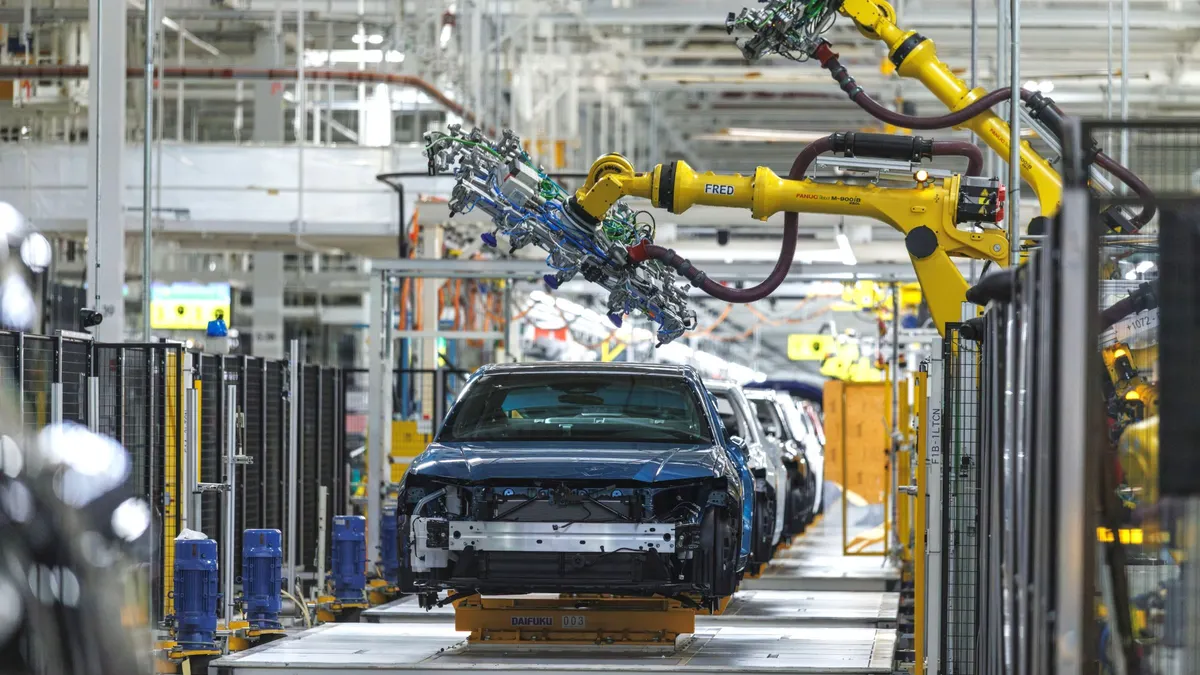
- Robots purchased by North American companies in the third quarter reached 10,989 orders, marking a 24.8% increase over last year, according to data released by the Association for Advancing Automation this week.
- They were valued at $723.5 million, up 26.1% from the same period a year ago, data show. Manufacturers across industries, including semiconductor, biopharmaceutical and metals, had “substantial increases” in orders as capital poured into the U.S. market for facility automation and expansion.
- Collaborative robot orders increased 56% versus last year and comprised 16.7% of all units purchased during Q3. The quarter also marked a return to growth for the automotive sector, which saw declines in robot orders during the first half of 2026.
Dive Insight:
Robot orders were the highest they’ve been all year for North American companies, according to the automation industry association, known as A3. This happened as manufacturing activity continued to improve over the summer despite input cost and trade challenges.
“What stands out in the third quarter is not simply the magnitude of the growth, but how broadly it was distributed across the market,” Alex Shikany, A3’s executive vice president, said in a statement.
The semiconductor and electronics industry saw the highest growth in robot orders at 97.6% versus last year, according to Q3 data. Automotive components followed at 90.4% and plastics and rubber at 67.7%. Life sciences and metals also saw strong gains at 38.7% and 37%, respectively.
Automotive original equipment manufacturers increased their robot purchases by 7.5%, marking a turnaround after a 25% decline in orders during the first half of the year, data show. At the same time, food and consumer goods purchases declined 23.7%.
The industries making the most robot orders are largely the same ones supported by federal policies that unlocked project funding or pressured companies to reshore manufacturing to the United States.
Factors like the CHIPS and Science Act and increased demand for weight-loss drug production are driving a lot of the recent investment in robotics, Alex Coleman, a principal analyst at A3, said on a Business of Automation podcast Friday.
“If you’ve looked at any of the headlines in the last year, or the last six months and have read a story, any story, about the U.S. economy, it’s really being captured in automation here,” Coleman said.
Collaborative robots, or industrial robotic arms that work alongside humans, made up a significant chunk of orders during Q3. Orders reached 1,831 units valued at $63.8 million, data show. Through the first nine months of 2026, cobots accounted for 43.8% of life sciences orders and 36.9% of semiconductor and electronics orders.
A3’s data cover industrial robots, which do not include automated mobile robots nor humanoids, a spokesperson confirmed via email Friday.