Technology and geopolitical trends have changed a lot since advisory group MassMEP was founded 30 years ago. Back then manufacturers were navigating issues such as Y2K and offshoring. Today, it’s all about artificial intelligence and domestic production.
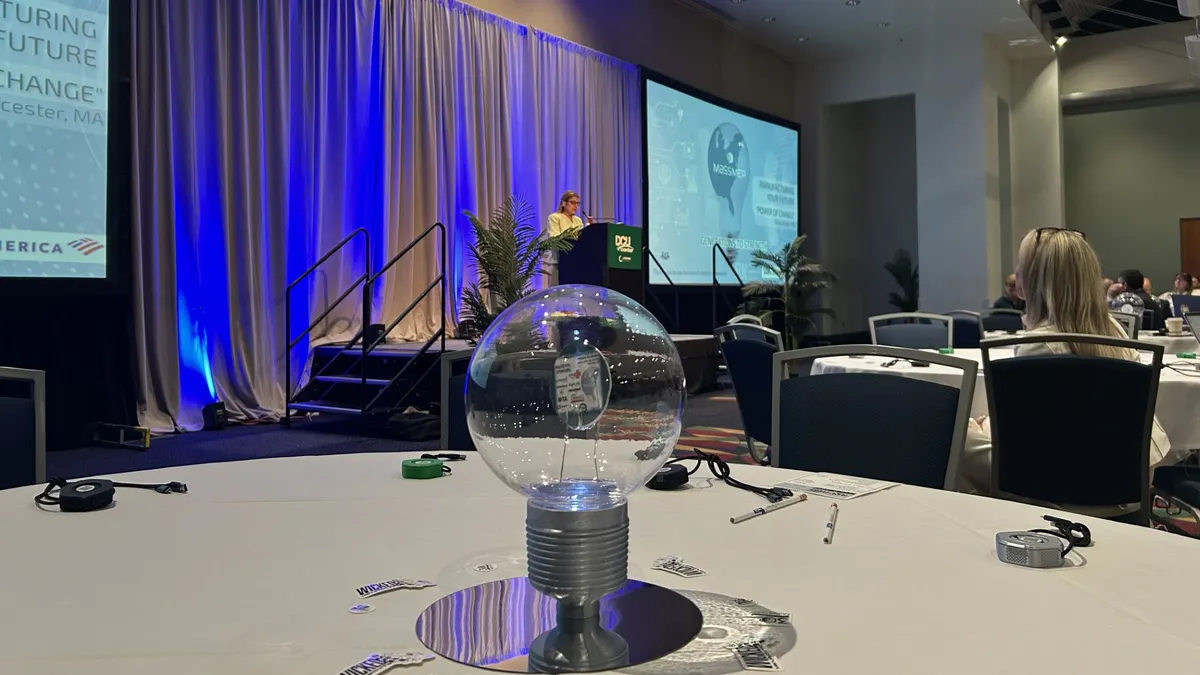
“People questioned whether manufacturing had a future in Massachusetts. Costs were high, global competition was intense, companies were leaving the U.S. to manufacture elsewhere, and many believed innovation and production would separate, that ideas would stay here, but that manufacturing would happen somewhere else,” said MassMEP President Kathie Mahoney during remarks at an event in Worcester on June 2.
“Massachusetts manufacturing has proven them all wrong, because manufacturing has always been a part of the DNA of the commonwealth,” she said. “What's exciting is not just that manufacturing survived, but it has evolved.”
Mahoney cited a litany of manufacturing milestone innovations from the state, such as interchangeable parts, sewing machines, the telephone, microwave technology, jet engines, modern computing and most recently the spacesuits worn by astronauts on Artemis II.
“Manufacturing is not a legacy industry to be ignored. It is the industry building the future,” Mahoney said.
Today, manufacturing accounts for an estimated 8% of the state’s gross domestic product with companies in aerospace, semiconductors, medical devices, specialty foods, plastics, metals and other materials.
According to recent MassMEP surveys, an estimated 72% of manufacturers in the state are planning capital investments and about 60% are launching new products or services. MassMEP has helped clients generate $1.8 billion in sales and create or retain nearly 15,000 jobs over the past five years.
The group helps manufacturers apply for government grants, navigate tariffs and other supply chain issues, adopt new technology and more.
This comes at a time when state-level Manufacturing Extension Partnerships, which are part a national network that started in the late 1980s to help enhance the productivity of U.S. manufacturers amid global competition, are under scrutiny. The Trump administration continues to propose funding cuts, though the issue has faced pushback from lawmakers in both parties.
Turbulent tariff policies and cuts to renewable energy projects, which are a growing part of the state’s economy, have also been financially challenging for local companies.
In the meantime, Mahoney said her group is focused on helping manufacturers navigate the issues at hand. The event’s keynote speaker was a Harvard professor who walked through the capabilities of AI. Other sessions focused on technology adoption, workforce development, defense contracting, access to capital and more.
While many of these topics have new elements, they’re also evergreen. Mahoney recalled similar advanced manufacturing themes coming up as priorities across multiple gubernatorial administrations, noting that “as technology advances, manufacturing advances.”
Manufacturing Dive spoke with her at the event about the group’s evolution, its state legislative priorities, how members are approaching AI adoption and more.
The following interview has been edited for clarity and brevity.
MANUFACTURING DIVE: The space has changed a lot in the last 30 years, including technology needs. MEPs were designed to help small- to medium-sized manufacturers adopt technology. Have those needs changed as the technology has gotten more complicated in that time?
KATHIE MAHONEY: No, just the product that is delivered. Obviously, we weren't thinking about AI or even robotics 30 years ago. It was all about process improvement, continuous improvement. The Toyota methods were coming out.
So it was all about building that foundation, which is still what we see today. It’s more about the people and how do you integrate everything. I do see the integration of AI as very similar to the integration of Lean [Six Sigma] in the sense of, are people going to lose their jobs. But it's more about working smarter, not harder, which I think is still a term that can be used with AI. It's a tool and it can help companies be more efficient.
Did job losses play out as some people thought with the adoption of Lean?
For a lot of companies it didn't. I'm not going to say every company it didn't.
We have a simulation that we do about a manufacturing facility, this is just a model for conversation. You buy a 5,000-square-foot facility, but you're only using [2,000]. As the equipment comes in, and as you grow, you may have put the equipment in the open space.
Once the facility is full that may not be the best space for all of the equipment. So you may walk 100 steps, whereas if you redesign the facility and make it more efficient — which is what Lean does, it looks at the cellular flow and the waste within the process to make the process more efficient — you only walk 10 steps. And then you can make more products in that same space.
We hear a lot of talk about robotics and AI. At the same time, we hear plenty of small and medium companies don't want to do it yet. Either they don't have the bandwidth or they don't have the capital. What are you seeing in Massachusetts on that front?
Anecdotally, it's the same. It's a lot of they don't know what they don't know. It's how do we implement the technologies in the most efficient way for each facility, and it may not be the same for every facility. You may need sensors on your machine for one, whereas another you may want to measure the weight of a product.
That's where the MEP centers are so valuable and so unique versus a traditional consultant.
All of our employees that go and do the training and the work within the manufacturing facility have a manufacturing background. So they have all been there. They understand it, they've done the work.
The first thing that we do is listen. It's what is your problem, what do you want to achieve, how do you want to achieve it, have you thought about what the impact on the employees is going to be, have you thought about this training versus this training? And then we also bring in other resources within the ecosystem — several [groups] that were here today — and figure out how do we help them improve.
The concept of MEPs in general is being discussed right now, in terms of funding and effectiveness. Have you seen this national conversation happen before?
It has, whether it was a blue or red party in the White House. It's a conversation that comes up, and it's up to us to show the value of the program, which I think we do.
How do you work with counterparts in other states on these efforts?
Someone from the Oregon MEP came to see what we're doing here today. We're collaborating on a couple of projects together. There was someone here from the New Hampshire MEP. We're going to a Maine MEP event next week.
The beauty of New England is that we're geographically close and we can get together on a quick basis, so we have a very strong relationship with all the other centers. We collaborate on regional grants a lot because our supply chains don't stop at the border, so we have those opportunities for us to move forward to help the region, not just the state of Massachusetts.
Are there ways the state and/or federal government could do more to support your members?
One of the key requirements for anyone in the defense industry is CMMC — cybersecurity maturity model certification. It means you have to get cyber secure, and it can cost a lot to do that. There's an initiative now, the Shield Initiative, that the state has put together. Along with the Mass Wins Act, there's some money in there to support defense.
So the state is putting the right pieces in place. We just have to get [the Mass Wins Act] across the finish line [in the legislature].
Also, free community college and the apprenticeship program, the Workforce Training Fund Program that they have and their initiatives around the K-12 program to build awareness on different careers have been a tremendous help.