Manufacturing companies have spent about $32 billion in training and upskilling their employees through internal and external workforce programs, according to a new Manufacturing Institute survey report released on the week of April 15.
The investments are an estimated 22% increase from the National Association of Manufacturers’ affiliate’s initial survey conducted in 2019, which reported $26.2 billion.
When the nonprofit conducted the survey seven years ago, it was to help MI measure manufacturing firms’ spending on their existing workforce as it advocated for various policies at the state and federal levels to address the industry’s labor needs, President Carolyn Lee said in an interview with Manufacturing Dive.
After the COVID-19 pandemic and other key events, MI decided it was time to update its findings.
The new survey, conducted from Jan. 22 to Feb. 6, provided MI “a clearer understanding of just what manufacturers are doing to ensure that their workers have the skills needed to be successful at their jobs,” according to the nonprofit’s website.
Time and money on specific training programs
One of the key findings that surprised Lee was the amount of time manufacturers spent training their existing employees, both internally and externally, which increased from 42.9 hours in 2019 to 47.6 hours.
“One thing that we advocate for in the Manufacturing Institute is that employers need to lead investments in especially specialized training that is specific to their operations,” Lee said.
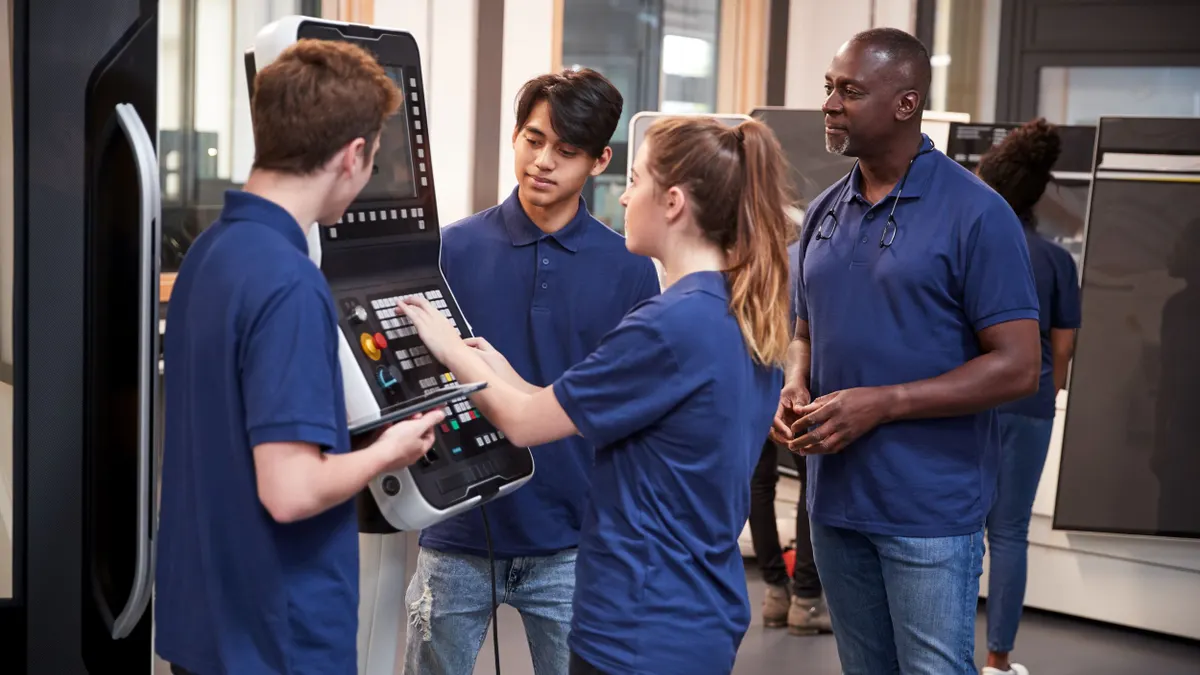
An example of how MI advocates for employers to take the lead in training and leverage common resources is through the maintenance technician apprenticeship program of MI’s training nonprofit, the Federation for Advanced Manufacturing Education, Lee said. The curriculum consists of industry core standards agreed upon by employers in the FAME chapter, and apprentices attend facilities to receive additional training on specialized equipment.
The MI survey also found increased investments in technology training programs, Lee said. Some companies use virtual and augmented reality training to help improve safety, reduce risk and allow employees to use newer technologies which were just coming online in 2019, Lee added.
These types of training technologies are now more common, especially because they don’t put employees at risk, Lee added.
A rise in apprenticeships
MI is also seeing a “great uptake” in apprenticeships, Lee said. Nearly one-third of manufacturers said their companies use apprenticeship programs, according to the survey.
There were 97,500 registered apprentices in the advanced manufacturing industry in 2025, a 20% increase over the past five years, according to Apprenticeship USA.
However, many manufacturers participate in non-registered, or employee-based, apprenticeships, according to the survey report. Approximately 15% of students enrolled in MI’s FAME program are registered apprenticeships, which are validated and approved by the U.S. Department of Labor or a state agency.
Despite the increased investments and time, manufacturers still face challenges in training and upskilling their employees, the report stated. About 69% said training could interrupt work hours, 65% said scheduling and about 48% cited costs.
One way MI addresses these challenges is by bringing manufacturers together to learn how to overcome those obstacles, particularly the smallest manufacturing firms, Lee said.
“[They] come together and figure out, how do you work on scheduling so that you can have it during work day, but not interrupt your production schedule?’” Lee said. “How do you fit it in? Because we know this is important, and so that's something that I look forward to having some more learnings and some best practices that then we can share with the rest of the manufacturing sector later this year.”
In May, MI will hold its FAME National Conference in Florida, which will provide attendees opportunities to workshop certain topics such as leveraging new technologies and strengthening recruiting efforts.
Still, MI’s report stated that these obstacles will persist. What manufacturers can do, however, is consider and prioritize “lifelong learning.”
“There's so much rapid change in technology and exciting developments happening, particularly in the space of advanced manufacturing, that we can't say it's one and done,” Lee said. “When you you're done with your program, you're not like, ‘I'm gonna hang up my pencil. I don't need that anymore. We need to continue.”