Dive Brief:
- Hyundai Motor Co., known for its lineup of cars, SUVs and electric vehicles, is laying the groundwork to become a physical AI and technology company with its recent takeover of robotics maker Boston Dynamics.
- Hyundai opened its Robot Metaplant Application Center in June and plans to expand the site more than tenfold by the end of the year, Jose Antonio Muñoz, Hyundai’s president, CEO and internal director, said at the company’s investor day on Wednesday. It is also investing in an unspecified robotics manufacturing facility.
- Boston Dynamics became a wholly-owned subsidiary of Hyundai following the latter’s acquisition of Softbank’s remaining shares in July. Hyundai is expected to begin U.S. production of Boston Dynamics humanoids and other robots in 2028, with an annual capacity of 30,000 units.
Dive Insight:
Hyundai’s Robot Metaplant Application Center simulates real factory conditions, trains manufacturing robots, collects data and runs testing and verification before commercial production ever begins, according to the company.
It is located within the Hyundai Motor Group Metaplant America facility in Savannah, Georgia, where the company makes all-electric vehicles. Muñoz said the automotive business, which makes up nearly 80% of Hyundai’s revenue, will help fund the company’s future as it builds out the autonomous vehicles and robotics segments.
“We are transitioning to a physical AI and technology company,” he said. “We will be building, deploying, even financing robotics at scale.”
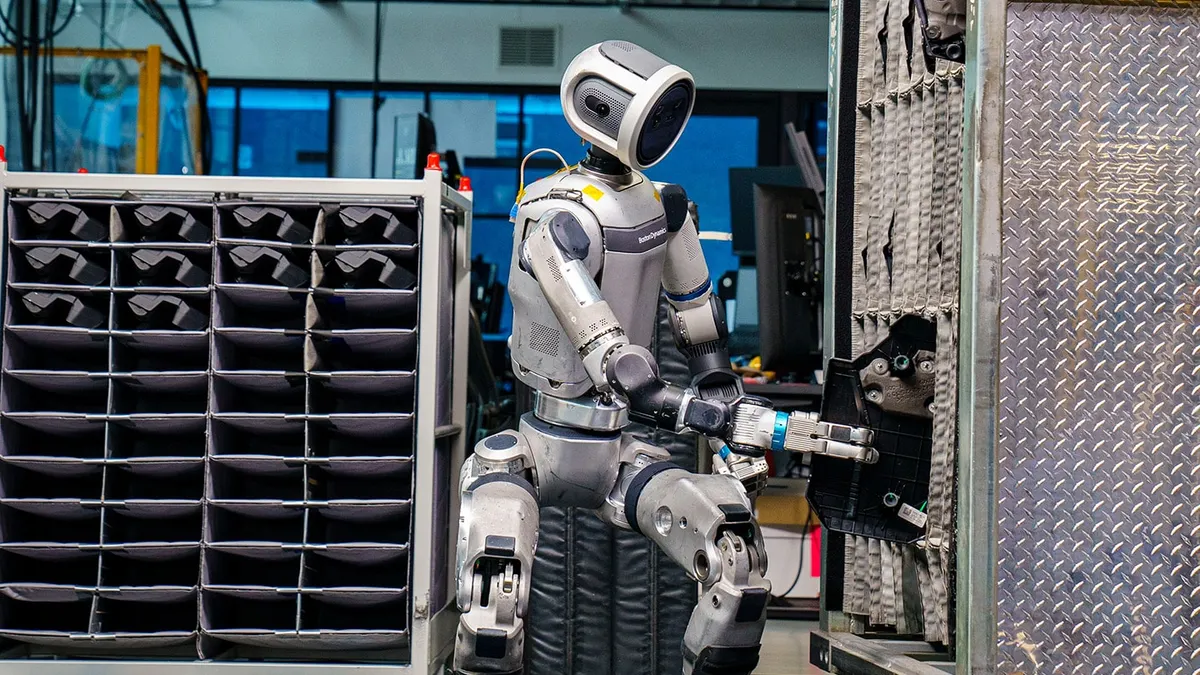
Hyundai’s interest in robotics has been bubbling for years. It bought a controlling 80% stake in Boston Dynamics from Softbank in 2021 for $1.1 billion. The companies have since worked together across Hyundai’s factories to scale production and integrate Atlas humanoids and Spot quadrupeds for industrial inspection. Boston Dynamics also makes Stretch mobile robots for case handling and other warehouse-related tasks.
Hyundai recently agreed to purchase Softbank’s remaining shares in Boston Dynamics for roughly $325 million, South Korea newspaper Maeil Business first reported in July. The automaker plans to deploy Atlas at Metaplant America in 2028 for parts sequencing tasks and expand to component assembly by 2030.
Beyond robotics implementation, Hyundai is also looking to scale commercial production. The company is investing in a U.S. robotics manufacturing facility, with the first 25,000 unit orders already guaranteed by customers, Muñoz said.
“We are actively looking for opportunities,” he said, adding that the site location is not yet final. He suggested that there will be more details at a later date.
Earlier this year, Hyundai committed to build in the U.S. more than 80% of the vehicles it sells domestically by 2030. Muñoz said the same is true for robotics.
“We cannot do that without more capacity,” he said.