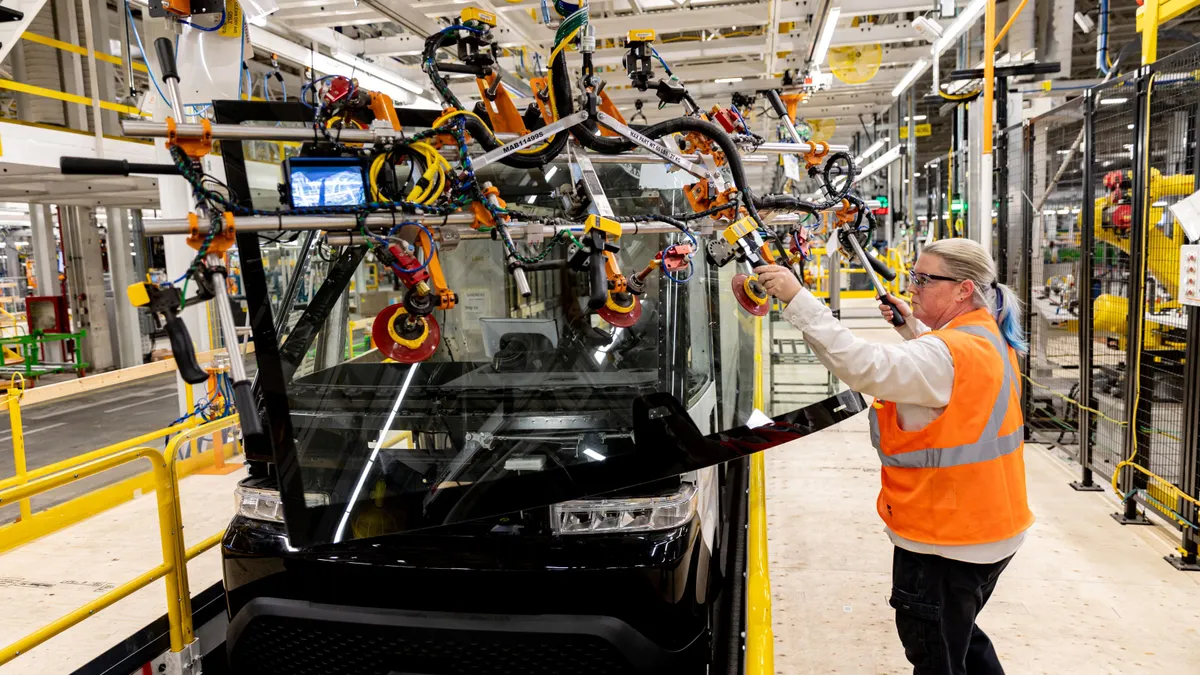
BOSTON — With growing cost, operational and competitive pressures, automakers are starting to expand automation into areas that have historically depended on operator experience and judgment, an analyst said at Rockwell Automation’s industrial automation fair this week.
Automation is embedded into the fabric of the automotive industry. Manufacturers already leverage these systems for repeatable, predictive functions such as stamping, body, paint, welding and final assembly.
However, automation is becoming an even more important part of the automotive manufacturing process as companies look to drive earnings growth, according to Greg Faler, the principle mobility analyst and strategy lead at the Center for Automotive Research.
“Some of that is through the productivity gains that are enabled by automation, by smart manufacturing data, by AI,” Faler said during a session at Rockwell’s event in Boston on Tuesday.
Faler and his team identified several areas where artificial intelligence, machine learning and automation are reshaping manufacturing across the automotive, tire and battery industries in a white paper released this summer in partnership with Rockwell. He updated attendees on the findings this week, including where they are seeing early returns on investment.
AI is already having a profound impact on organizations across design, engineering and testing. For example, Faler said, manufacturers are able to run tests on electric-vehicle battery chemistries in a matter of days that previously would have taken months or years.
He added that companies are looking to migrate siloed data into more accessible systems that can unlock valuable insights on the floor.
“We’re seeing real impact from both starting automation around labor productivity, and now we’re starting to see tangible evidence around some of the other benefits [and impacts] of AI,” Faler said. “It’s almost like smart automation in ways that we haven’t seen before.”
AI and machine learning are improving areas such as predictive maintenance, inspection accuracy and system performance across operations, according to the report titled “Smart Manufacturing in Automotive: Deployment and Impact.” Some manufacturers reported reductions in unplanned downtime by up to 50% and throughput gains of up to 7%.
Faler said a separation is emerging between those who have implemented traceability technology and those who haven’t. While he did not disclose ROI specifics, he said early evidence shows it opens organizations to significant risks if they fail to adapt with their competitors.
“As you implement these technologies…you need to be on equal footing or similar footing as you respond in your quotes,” Faler said about purchasing decisions.
Additionally, there is a growing digital divide between larger and smaller companies. Faler said automakers’ purchasing is getting more sophisticated, and small and medium-sized suppliers need to have important data insights to defend themselves and push back against certain benefits of scale.
With expanded automation and AI integration, fewer factory jobs are needed. Lear, a supplier of automotive seating and electrical systems, is looking to downsize its production workforce with increased automation. Faler said Lear demonstrated to investors recently that it could operate a facility with 350 employees instead of the typical 650 workers for a space of that size.
At the same time, companies are looking to upskill workers for more technology-driven roles and reshore operations that were not feasible before, Faler said.
Part of what is driving smart manufacturing adoption is pressure to compete with China. Automotive parts suppliers from China hold 13% of global revenue, versus 20 years ago when the country barely cracked the world’s top 100 producers list, according to management consulting firm Bain & Co. China is also the world’s dominant carmaker, which produced nearly three times as many autos as the United States in the first quarter of 2026, according to the International Organization of Motor Vehicle Manufacturers.
“The next frontier…I think needs to be some additional process changes by companies,” Faler said, including the addition of digital twins and data uniformity.
“The internal processes of many of the companies are still playing catch-up,” he said.