Dive Brief:
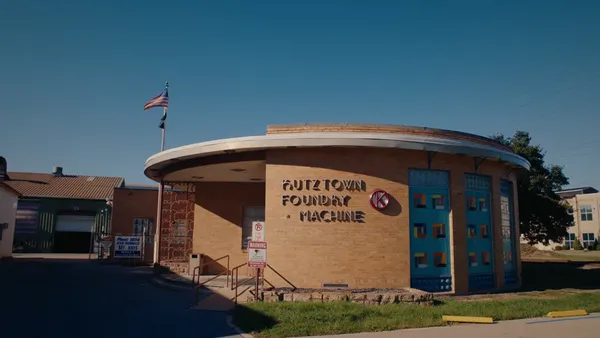
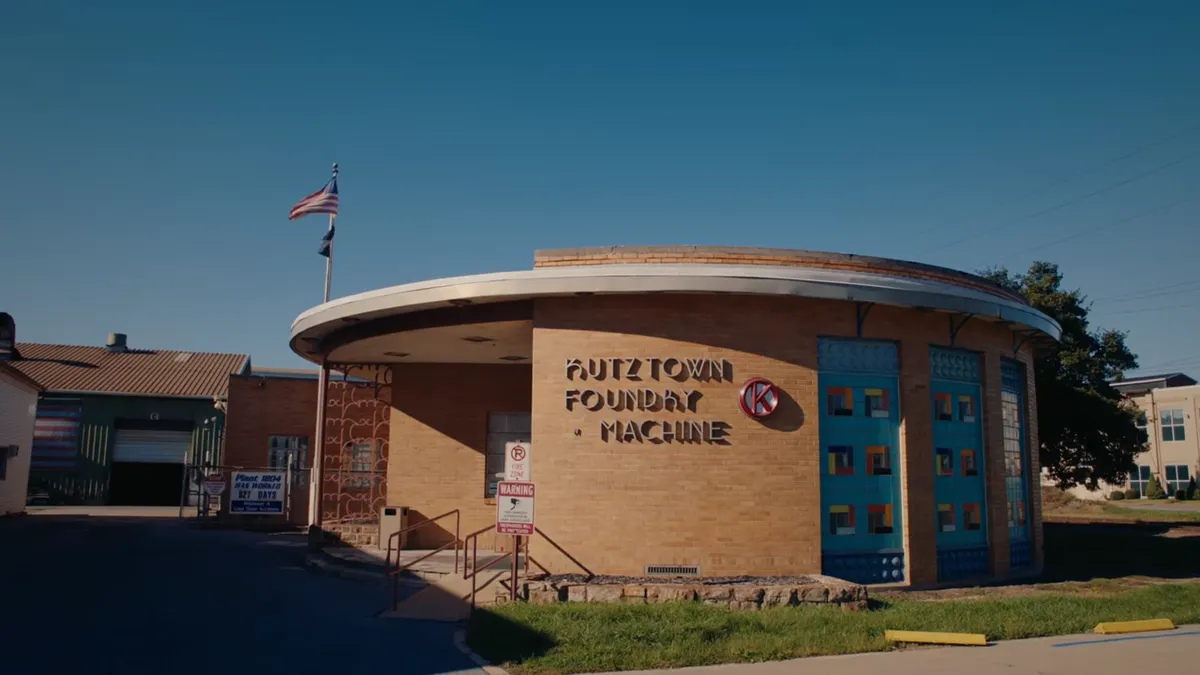
- Defense automation startup Hadrian will spend $300 million upgrading and expanding the manufacturing capacity of a facility acquired from metal caster Kutztown Foundry & Machine in Pennsylvania, according to a press release.
- The money will be used to implement advanced software and automation to the facility’s operations in Kutztown, as well as construct a new factory at the site.
- The foundry will serve as Hadrian’s Factory 6 and produce steel castings specifically made for defense and the U.S. Navy programs, such as the U.S. Navy's Columbia- and Virginia-class submarines.
Dive Insight:
The 160-year-old Kutztown Foundry & Machine is Hadrian’s first acquisition, CEO Chris Power said in a video posted on LinkedIn Monday. Hadrian did not disclose the investment to acquire the company and the foundry.
“What Kutztown looks like in 10 years should be the most advanced foundry and casting facility in the world,” Power said. “Over time, it’s about taking the brilliance here and taking it into the 22nd century and then scaling it across this site. It's going to be brutally hard work, but really important work.”
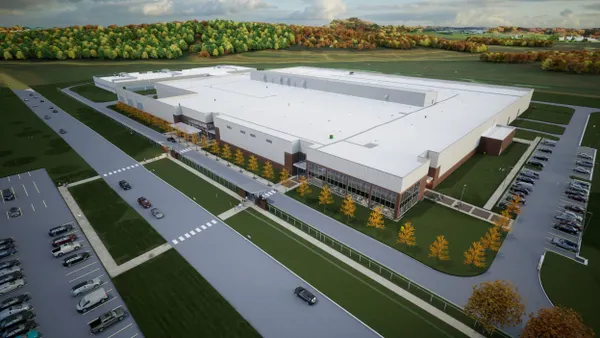
The joint efforts between the Kutztown facility and Hadrian’s advanced manufacturing facility in Cherokee, Alabama, aim to decrease pressure on shipyards, according to the press release. The startup opened the $2.4 billion Cherokee facility in March, which was funded with $900 million from the U.S. Navy and makes critical hardware for the naval service’s Columbia- and Virginia-class submarine programs.
It will also speed up submarine deliveries as well as support “hundreds of manufacturing jobs,” though Hadrian did not disclose how many jobs will be backed.
“It’s really about treating the workforce like they are the most important thing because they're actually getting the job done,” Power said. “They’ve got great health insurance. They've got a stake and ownership in the company, and we are ramping them as fast as possible in terms of going to scale.”
Steel cast and forged products are especially critical to the defense industry and are used in almost all platforms, most subcomponents and machine tools and other production equipment, according to a 2022 National Defense Industrial Association presentation. Between 1984 and 2018, the U.S. lost 1,600 foundries and more than 4,400 metal casting facilities, displacing more than 324,000 workers.
With the increased domestic production capacity for steel castings made for the Navy’s requirements, the factory will help alleviate the submarine production constraint and boost the submarine industrial base.
“There are only really four or five small businesses left that can do this sort of stuff, and they're all bottlenecked,” Power said. “They’ve been underinvested in so we bought Kutztown, which is our first acquisition.
Limited U.S. production capacity and long lead times have led to major bottlenecks. However, The Navy’s Submarine Industrial Base Program released a marketspace health assessment in August that found a “more complicated picture.”
“In many marketspaces, qualified industrial capacity already exists,” according to the agency. “The challenge is ensuring that capacity can be used effectively and consistently.”
If a risk is identified, the Navy’s SIB program will take immediate action with a “targeted investment” or alternate sourcing options, stepping in before the risk increases and impacts the delivery schedule.
“For example, targeted investments are already delivering measurable impact across the industrial base,” the agency’s program said. “A foundry modernization initiative reduced overall lead times by 20% while increasing casting capacity by 50%, directly alleviating a critical production bottleneck.”
The Kutztown foundry acquisition is part of Hadrian’s domestic manufacturing capacity expansion plans. In August, the defense startup raised $1.37 billion in equity financing, enabling Hadrian to expand its U.S. footprint, including establishing new factories and building out research and development.
Later the same month, the company closed a $360 million revolving credit loan facility, allowing it to further invest in the advanced manufacturing infrastructure, machinery and related hardware to help reach its production goals.
Hadrian also expanded its partnership with Lockheed Martin in October to integrate its Opus software platform into the prime contractor’s missiles and fire control facility in Grand Prairie, Texas. Opus’ incorporation aims to scale manufacturing capacity to support Lockheed’s missile programs deemed essential for the Department of Defense’s Arsenal of Freedom, an effort to rebuild the defense industrial base under the agency’s Acquisition Transformation Strategy.
The seven-year agreement builds on a memorandum of understanding the two companies signed in December 2025.