Dive Brief:
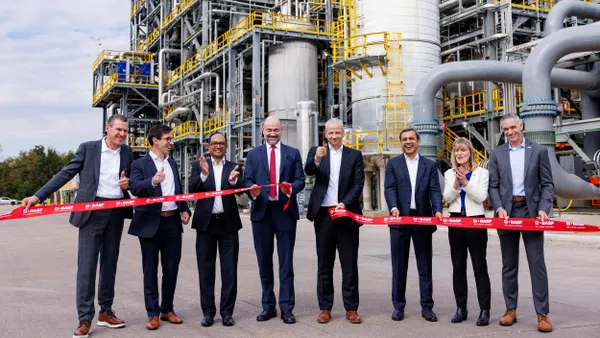
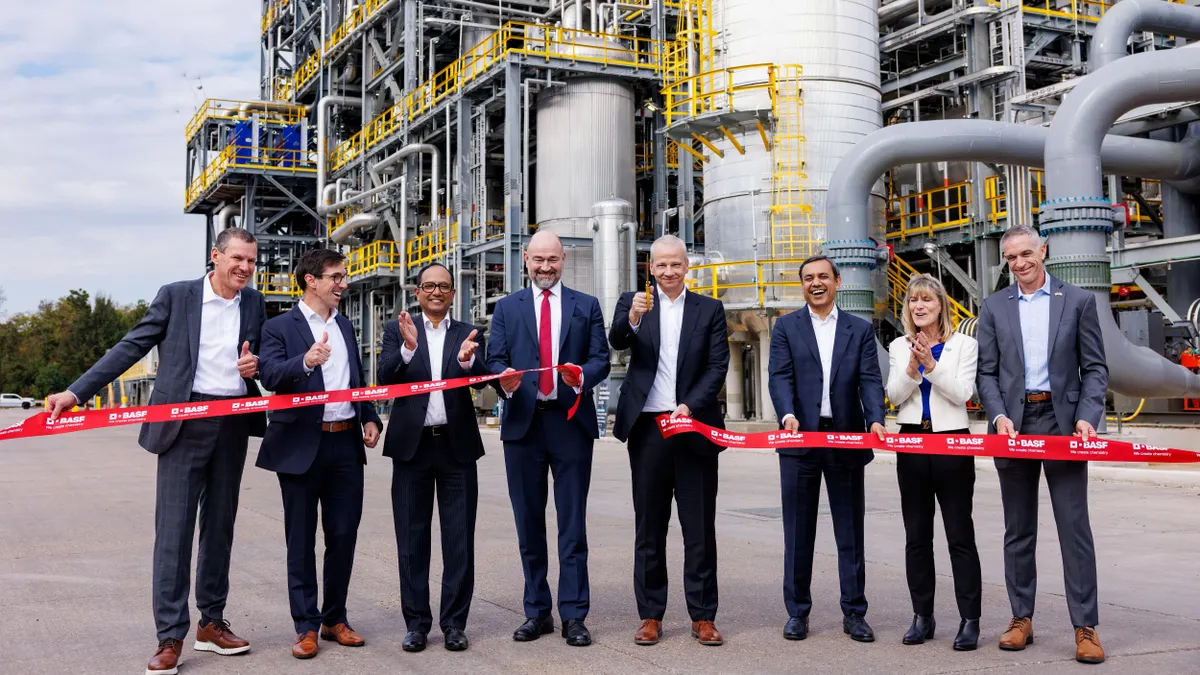
- Germany-based BASF opened its new $1 billion methylene diphenyl diisocyanate facility at its chemical site in Geismar, Louisiana, on Wednesday. It’s the entity’s largest single investment made to date in the U.S.
- The expansion nearly doubles the annual MDI production capacity to about 600,000 metric tons, making it BASF’s largest MDI producer in North America, according to the press release. MDI is a key raw material used to produce polyurethanes.
- The additional capacity will support BASF’s customers in various polyurethane-based industries including construction, appliances, transportation, automotive, footwear and furniture.
Dive Insight:
The United States is one of BASF's “most important markets” and a key pillar of its global business, Markus Kamieth, BASF’s chairman of the board of executive directors, said in a video about the new facility.
“It is a clear statement of confidence in the future and our ability to grow alongside our customers. It also reflects the strength of our regional footprint and our commitment to serving the North American market for years to come,” Kamieth said.
The MDI unit at Geismar was 10 years in the making. BASF initially announced its Geismar expansion plans in November 2016.
However, the chemical firm did not begin construction until 2018. The buildout was done in three phases, according to the press release.
The first phase, completed in 2020, added a new MDI synthesis unit and decommissioned an older unit. The second phase expanded several existing upstream units which began operations in 2021. The final phase added new upstream units and a splitter.
“This significant investment reflects our confidence in the continued growth of the polyurethane market and ensures that our customers benefit from a highly reliable, competitive and locally integrated supply source for years to come,” Ramkumar Dhruva, president of BASF`s global monomer division, said in a statement.
The Geismar site, which also produces other substances such as ethylene oxide, hydrochloric acid and surfactants, is the largest in North America under BASF’ Verbund strategy. Verbund is a German term that means combine, association or integrated system, according to the German translation site, Langenscheidt.
The Verbund concept originated at BASF’s headquarters in Germany. The strategy aims to locate production facilities, energy flows and logistics “closely connected to safe resources,” according to a video on BASF’s YouTube channel. BASF has seven Verbund sites and approximately 230 additional production sites worldwide.
The Verbund idea helps the chemical company save energy and resources, mitigate emissions, decrease logistics costs and use coordination. “The by-products of one plant can be used as the starting materials of another,” according to BASF.
In July 2025, BASF’s Geismar site received President Donald Trump’s support as part of the administration’s deregulatory efforts. The Geismar location was one of several chemical manufacturing facilities that was approved for a two-year exemption from two emissions standards finalized in 2024. Both U.S. EPA rules fall under the Congress-mandated Clean Air Act’s National Emission Standards for Hazardous Air Pollutants, or NESHAP, compliance monitoring legislation.