As the war with Iran continues, the United States is facing a weapons shortage. The Department of Defense is pushing contracted energetics manufacturers to ramp up munitions production to replenish the stockpile.
Additionally, DOD is requesting a record $1.5 trillion for fiscal year 2027 to help ramp up weapons and military equipment manufacturing. The proposal includes an estimated $8.4 billion for U.S. Army-owned ammunition plants in Tennessee, Missouri, Iowa, Virginia and Pennsylvania to procure “various ammunition cartridges to fulfill combat and training requirements,” according to the agency's weapon system budget request.
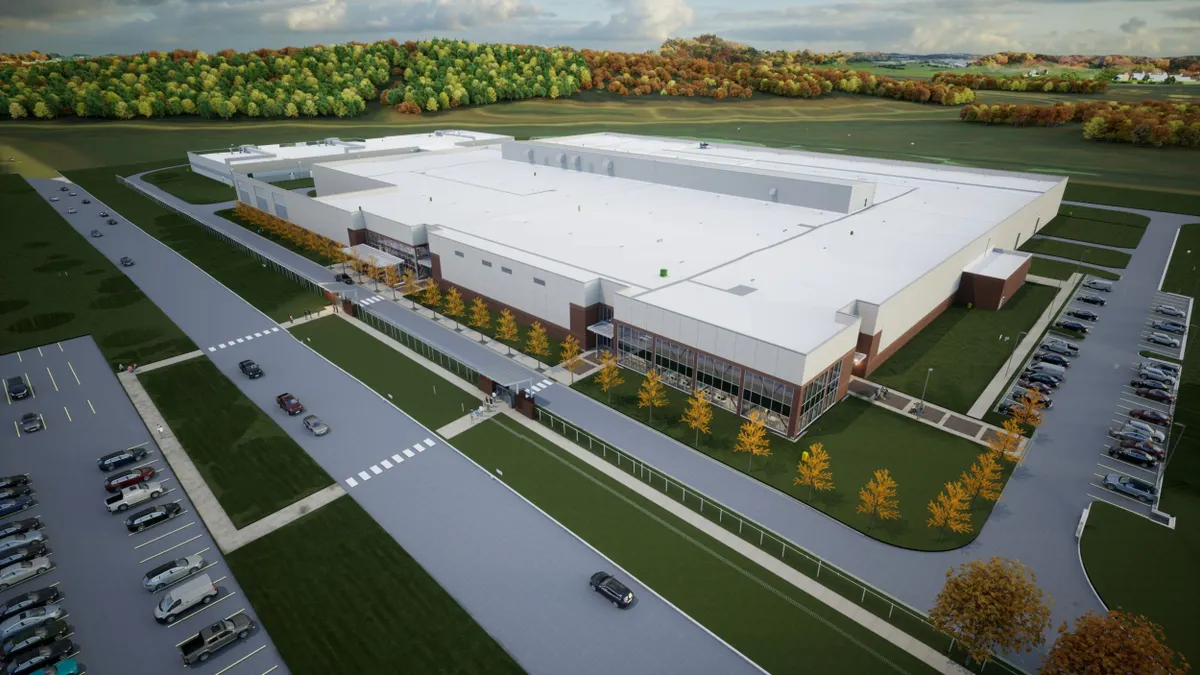
Another $382.3 million would be used for the Army’s Next Generation Squad Weapon program to secure and manage various new rifles and 6.8 mm ammunition, the latter of which will be made at a new manufacturing facility at the Lake City Army Ammunition site in Independence, Missouri. Olin Corp.'s Winchester business will produce and distribute the 6.8 mm ammunition.
The Lake City Army Ammunition Plant has been operational since 1941 and produces small arms cartridges including the 5.56 mm, 7.62 mm and .50 Caliber for the Army, U.S. Air Force and Marine Corps, U.S. allies, as well as federal, state and local law enforcement.
The Army broke ground on the 6.8 mm production facility there in February 2025 and says it will “play a vital role in advancing” modernization priorities. This includes a mix of new and repurposed equipment, according to the Army’s press release from April.

Engineering and construction firm Burns & McDonnell is under contract with the Army Corps of Engineers, Kansas City District, to help with planning, programming and design of the Lake City facility, Andrew Mashek, vice president and DOD projects director, said in an interview with Manufacturing Dive over the summer.
Manufacturing Dive also spoke with Tyler Keel, an engineering, procurement and construction project manager at Burns & McDonnell. Both engineers discussed the safety, security and other factors that go into designing and modernizing an energetics manufacturing facility such as Lake City.
This interview has been edited for length and clarity.
MANUFACTURING DIVE: What kind of requirements do you mull over when designing a manufacturing facility for energetics, such as ammunition?
TYLER KEEL: There's a lot of state and local regulations just generally around building facilities. The International Building Code, for instance. But then beyond that, there are sometimes codes and sometimes best practices that are employed, depending on whether it's federal property or private property, such as the Unified Facilities Code, which is used on federal property in dealing with energetics or other similar hazards.
There are a couple of codes called the DoD Contractor Safety Manual, and then there's a similar one that's direct for the federal government that dictates the minimum standards that need to be adhered to for the operators and the facilities. It's not just a standard for construction. It's a standard that the operator has to adhere to while they're using the facility as well.
ANDREW MASHEK: It's not just the codes, but it also depends on who you're designing for or what the facility is. For example, say it's inside the fence, as in working on a military installation. If it's got energetics or explosives, you could have additional design reviews, meaning like DDESB, Department of Defense Explosives Safety Board. You know it's one thing just to have a distance or a setback, your quantity-distance arc away, but it's another if it's a unique facility with energetics and you're doing protective construction. You still need that additional review.
When it comes to designing and building an ammunition facility, what are some obstacles that you encounter, and how do you overcome them?
KEEL: It’s different from other manufacturing designs for other industries. Let's take the food industry or even the general aerospace industry. In those situations, there are risks and hazards during the manufacturing process, from dust to welding. But their products are ultimately meant to be safe.

This is different because ultimately those [energetics] products are meant to be lethal at some time, so you are planning that there are high-hazard activities going on in there. There are some design principles that from the top, you try to limit exposure to the least number of people. We see a lot of automation in those where we're trying to remove as many people as possible so that there are activities that are taking place while people are hundreds of feet away.
Some activities even are illegal to be performed and attended, but you have to be hundreds of feet away when they're going on. That means restrictions on personnel being physically present near certain hazardous operations. Some energetics processing activities, including certain mixing operations, may require remote operation to limit personnel exposure. Remote operation does not mean the process is left unmonitored.
The requirements depend on the material, process, equipment and governing safety provisions. Where those provisions allow, a documented hazard analysis can help establish whether personnel may be present and what protective measures are necessary.
MASHEK: But when you're designing some of these more complex energetics manufacturing type buildings, you've got to think of it not only just in terms of how you want to lay it out the design, but how are you going to construct this? As Tyler said, there's a lot of related and non-related personnel. Not often are you just building these facilities in a big green site with no other campus, no other facilities, no other personnel around. You got to think about how we're going to sequence this construction.
It could be both ways: Are we protecting the construction workers who are trying to build this new facility in an adjacent environment, or are we trying to limit the amount of downtime for the adjacent facilities that are still trying to be up and running and produce while this facility is getting done? There's a lot of sequencing, a lot of phasing, a lot of thought about who's related, who's not related.
Oftentimes, it depends on what you’re doing. From your [net explosive weight], you're going to have a QD, or a quantity-distance arc. If something goes wrong, what's the safe distance from the building? But that's not always your solution because you may not have acres of land to give you that safe space, that distance buffer. That's when you get into protective construction, meaning we're going to do thick concrete reinforced walls and floors and ceilings, and how do we vent it? How do we keep the pressures within if something were to not go as planned?
There have been a lot of calls from the federal government to ramp up weapons production. Do you have to pivot and modify the facility designs to meet the DOD demand?
KEEL: There's just a lot more equipment, automation and integration. Andy said it well earlier in that a lot of the munitions that are being made, some of those processes kind of go back to World War II or before. There is equipment involved, but it's pretty rudimentary, and it's a matter of figuring out how to put several pieces of equipment together.
I would say similar to the food industry, or automotive even, there are sometimes conveyor lines. When you think about a 155 mm round, which is one of the biggest, I'll say, manufacturing gaps that our country has right now, those are on integrated assembly lines that are all in one building or a series of buildings but involve fewer touches.
A lot of it is figuring out how we can pull people out so there are continuous processes. One that we see a lot in munitions, especially, is X-ray or nondestructive testing. That is often a limiting factor in the rate of production, and there are automated ways to pull munitions in and out of X-ray chambers. Figuring out ways to make those faster and more repeatable, so that you can have the most X-rays done in a period is often something that we see that gets sped up.
MASHEK: If you can automate, you can be more efficient, and you can produce at much larger scale faster, right? What everyone needs right now is to produce. But this information also most certainly creates a safer environment to remove the personnel or limit the amount of personnel that are in contact with the energetics.
What other safety details do you consider when it comes to developing, designing or upgrading a facility such as an ammunition plant?
KEEL: Contrasting it with an airplane manufacturing facility that could be of almost infinite size and go on multiple levels, these energetics facilities must have significantly more exits. The building has to be a lot narrower so that people can get to those exits quicker.
In instances where people have to have an equipment platform or mezzanine, we will typically provide an egress slide so that they can rapidly get to a safe place. You'll see all of these energetics buildings that have playground slides, and it's kind of humorous, but it's so that if something's going wrong, someone can get away as quickly as possible.
MASHEK: We always say, “Volume is your friend when you're dealing with energetics.” I don't have my quantity-distance arc, and I've got to do protective construction. I need to use volume, which can also help that pressure, right? You’ve got to think of it in terms of how it's going to come out if something really goes wrong, and how do you control that and balance it with cost-effective solutions? We don't want to go with crazy thick walls if we can increase our volume to capture that pressure.
What security measures are considered when designing an energetics facility?
KEEL: Yes, there are a lot of physical security parameters, especially when you get into research and development programs or into final assembly of some of these goods.
There's noise prevention so people won't be able to hear what's going on inside with a listening device. A lot of times, it's various levels of security, like fencing, but prevention from any sort of intrusion, even if someone did get onto the plant or manufacturing facility.
MASHEK: Cybersecurity obviously is very relevant if we're doing automation. That's smarts and parts right now.
What is a less-understood fact that people should know regarding energetics facilities?
KEEL: One thing that is a little bit different than traditional manufacturing is there's really one customer. It's the United States, and anybody the United States says that you can sell to. The customer demand signal is just so much different than if it's a utility who's building a power plant or if it's a food facility processing beef.
The United States might not use any missiles for years, other than in a testing sense, and then there might be a 12-month period where they are using them at alarming rates and drawing down the stockpile. That is very challenging for manufacturers to design to that level of flexibility.
Another thing I would share is, if you think about it from the outside, you would think, “There can only be probably a few missiles.” And that's not how it works. The United States military is a trillion-dollar machine that has all of that and more, and they've got every kind of variant. It is a huge product variety, just lethal things that are used for enemies who are far away, because you use something different if they're five miles away versus 50 versus 500. And there's all kinds of variants if they're shot from an airplane or a helicopter or ground mounted or from a submarine.
MASHEK: These facilities can be very complex, and it really takes a great partnership and relationships with the end users and and your clients just to kind of talk through. Especially early on and throughout design, and especially into construction, and into making sure that this is all going to go right.
What advice would you give to energetics manufacturers or companies that want to get into energetics manufacturing?
KEEL: I would share that the amount of pre-planning and upfront design and estimating that has to be done as a business case is often far in excess of what operators and owners expect.
Sometimes operators will want to project in weeks of time based upon a limited amount of criteria, and then be shocked when not all of the criteria was considered or their business case did not support the level of safety and regulatory requirements. Often we see that is because a lack of upfront planning was done of scoping exercises and technical design meetings to get to a level where all of the scope is considered at the right level of safety.