CHICAGO — As manufacturers look to automate and reconfigure their operations, advanced technologies are allowing them to solve problems faster and at lower cost. Rather than wait weeks or longer for the parts they need, many are leveraging additive manufacturing and microfactories for the job.
For decades, companies relied on just-in-time delivery and manufacturing. But the COVID-19 pandemic and ongoing geopolitical issues have largely upended supply chains, extending lead times and raising costs, said Francesco De Stefano, CEO and co-founder of Caracol, a robotics company focused on 3D printing and large-format additive manufacturing.
“Forging [and] casting takes forever,” he said. “The navy submarine base is waiting months to get a component…Imagine when something breaks down on the field and you can produce it straight away, instead of actually waiting for it.”
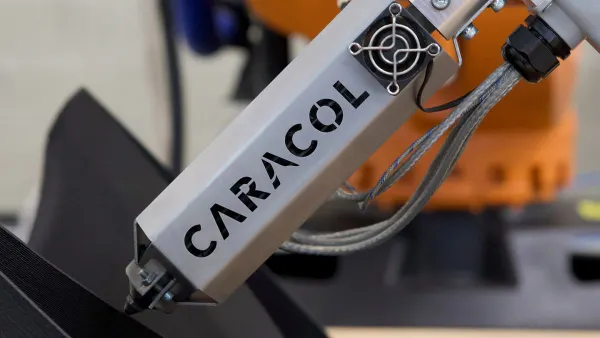
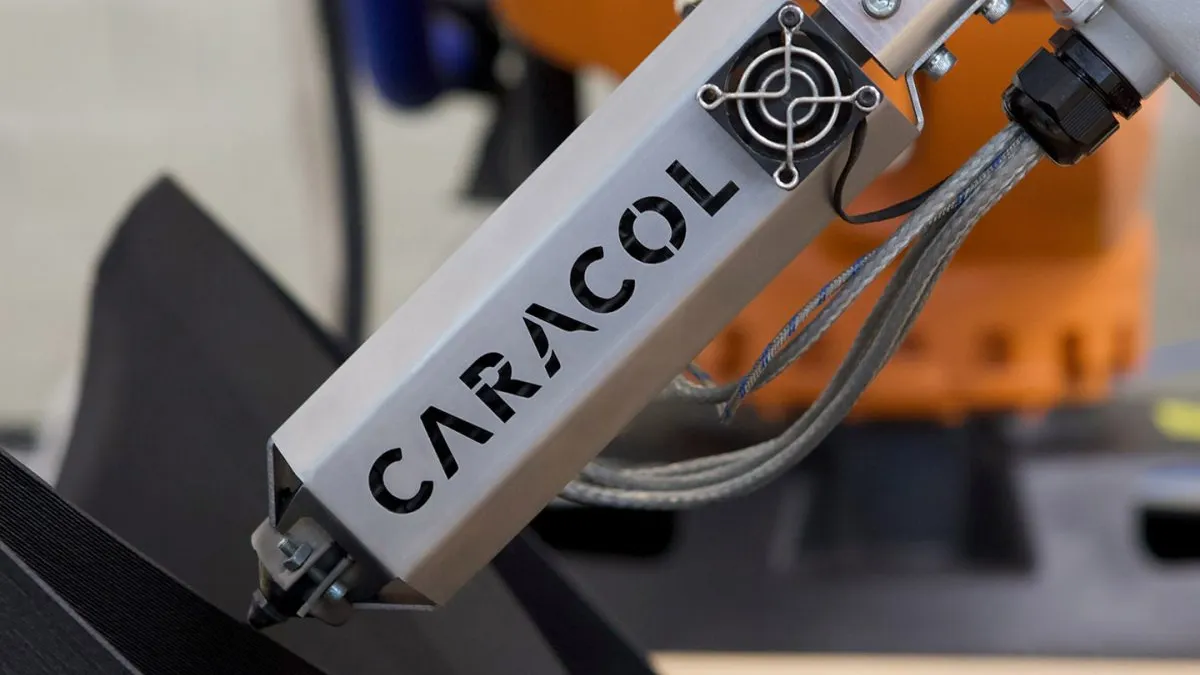
Caracol sought to leverage robotics and additive manufacturing technology to bridge that gap in the market. Its robotics create physical objects made of polymers, composites and metals from 3D models. Currently, they are used as a high-mix, low-volume solution for civilian and military applications, including large parts for boats, vehicles and drones.
Microfactories, or small, highly automated facilities that usually produce goods on demand or in small batches, have come to leverage additive manufacturing innovations to be more agile compared to traditional large-scale assembly plants.
At the International Manufacturing Technology Show in Chicago, the Association for Manufacturing Technology, the Department of Energy, Oak Ridge National Laboratory and other collaborators, demonstrated how they could manufacture quadcopter airframes every four minutes using a fully-automated manufacturing cell. The demo comprised a mix of digital engineering, artificial intelligence, connected production systems and additive manufacturing.
Compact, nimble systems like that are what De Stefano and others believe to be the future of manufacturing. Caracol has headquarters in Milan and Austin, Texas, where it opened its U.S. production center last year.
“I see smaller factories, but distributed in a concept of network of factories instead of larger factories,” he said. “The large factory will be split up in more capsular networks of smaller factories connected to each other.”
The global market for microfactories that are modular, or made of interchangeable production units, is set to more than double in size to $12.8 billion by 2030 compared to 2024, according to BCC Research in Boston. North America is the leading microfactory adopter — more than 35% of market share — driven by strong reshoring policies that aim to reduce dependence on overseas supply chains and consolidate production regionally.
Another growth driver is the low barrier to entry from a cost standpoint, said Brett Conner, chief manufacturing officer at the Society of Manufacturing Engineers.
“I don’t need to buy a big rolling mill or a huge assembly line or anything like that,” he said. “If you have an idea of how things are going to scale over time, you can buy what you need now and then build up as demand materializes.”
There also has to be the right use case. When companies are dealing with low-mix, high-volume, such as automotive manufacturing, microfactories may not be the best solution, Conner said. But they are valuable in high-mix scenarios like fabrication of military parts.
Microfactories are also attractive because they are built digitally from the ground up, he said. As more of these small, automated factories come online, worker skills and expectations are going to change.
“Hybrid skills is what you’re going to see,” he said, where workers know a mix of robotics, machining and post-processing.
“I think that these types of facilities will improve the perception of manufacturing,” Conner said.