Dive Brief:
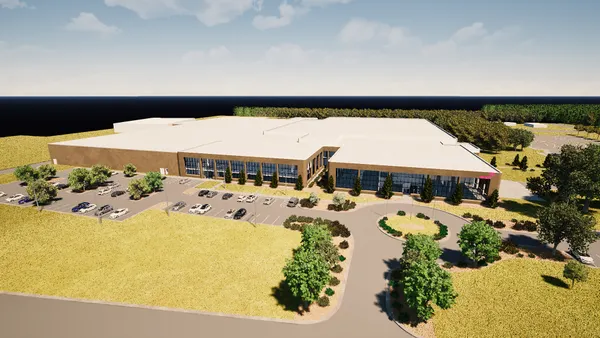
- Hanwha Defense USA plans to spend $2.2 billion to establish its new advanced manufacturing campus in the U.S. Army Pine Bluff Arsenal installation in Arkansas, the company announced Monday.
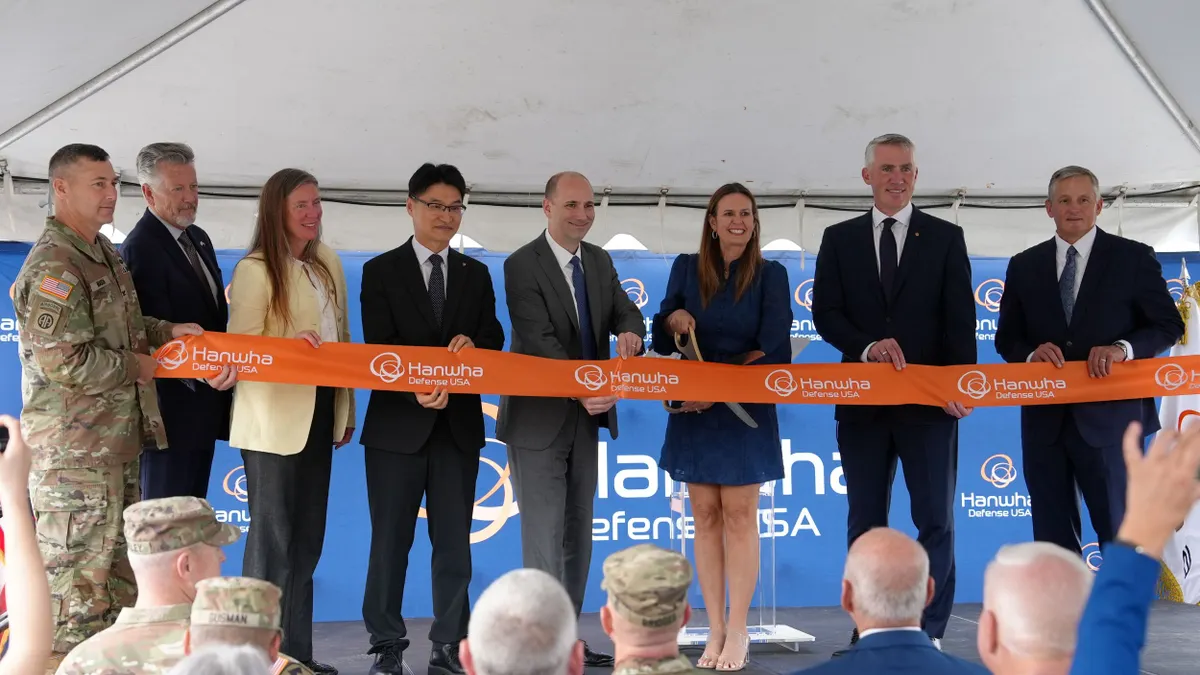
- The project, the company’s first munitions facility in the U.S., will create nearly 400 jobs with an average wage of over $50 an hour, Gov. Sarah Huckabee Sanders said at the opening ceremony of Hanwha Defense’s new administration headquarters at the Pine Bluff Arsenal on Monday.
- The facility will produce propellant charges for 155mm artillery and base bleed units, according to the press release. Construction is expected to be completed by 2030, with operations to begin the following year, Hanwha Defense spokesperson James Hewitt said in an email Tuesday.
Dive Insight:
Hanwha Defense plans to onshore and produce energetic materials to boost the U.S. munitions speed and range, CEO and President Michael Coulter said at the event Monday.
Hanwha Defense’s new U.S. headquarters will oversee local operations, and the upcoming manufacturing campus will support the “Arsenal of Freedom,” Coulter said. The Arsenal of Freedom is the Department of Defense’s approach to rebuilding the defense industrial base under its New Acquisition Transformation strategy.
The company aims to scale automation to ensure safe manufacturing and improve quality.
“The idea is to transform Pine Bluff Arsenal into a modern asset that advances both national defense priorities and U.S. Army priorities, including readiness that protect America's warfighter,” Coulter said in his remarks. “Hanwha Defense USA stands ready to build what the Army needs to fight future wars [and] transform into a more modern, more lethal force, whether that’s munitions or artillery.”
In August, the Army awarded Hanwha Defense a firm-fixed-price agreement to provide the military branch with up to 18-wheeled Self-Propelled Howitzer Systems for rapid prototyping, testing and operational experimentation with participating soldiers in the field over an estimated four-year period. The initial value of the contract is $100.3 million, with the potential to increase to $262.9 million, according to the Aug. 18 press release.
The Army initially announced it had awarded an “enhanced use lease” to Hanwha Defense to build and operate a new munitions facility at Pine Bluff Arsenal back in January. At the time, Hanwha had planned to invest about $1.3 billion toward the facility and create 200 jobs.
“Upon selection of the Pine Bluff Arsenal site, and working with our customers to best support their needs, our planned investment has increased to more than $2 [billion],” Hewitt said.
The enhanced use lease program enables the Army to tactically lease underused property to companies or organizations that can benefit the military branch’s installations, according to an U.S. Army Corps of Engineers presentation.
The program allows use of available Department of Defense assets limited to the needs of the military. Additionally, the EUL program allows the military to receive income on leased property, which can be used to finance new construction projects.
PBA was established in 1941 and manufactured and assembled incendiary grenades and munitions, according to the Army installation’s website. The site’s capabilities later expanded to production and storage of pyrotechnic, riot control and chemical-filled munitions.
Currentyly, Pine Bluff Arsenal is a key supplier for M18, M83, and M8 smoke grenades, according to DOD’s Aug. 31 press release. The site focuses on the design, manufacture and refurbishment of smoke, riot control, incendiary munitions and chemical and biological defense items.
Additionally, the site performs testing and evaluation on chemical and biological items and houses textile production, according to a fact sheet.
The installation houses about 13,500 acres and has 667 buildings, with a capacity spanning 1.1 million square feet of storage, according to an Army brochure.
In late August, the DOD announced plans to invest about $19 million in Pine Bluff Arsenal for production and facility upgrades to improve smoke grenade and smoke pot manufacturing. The Army also committed $13.7 million to support the facility refurbishment.