Dive Brief:
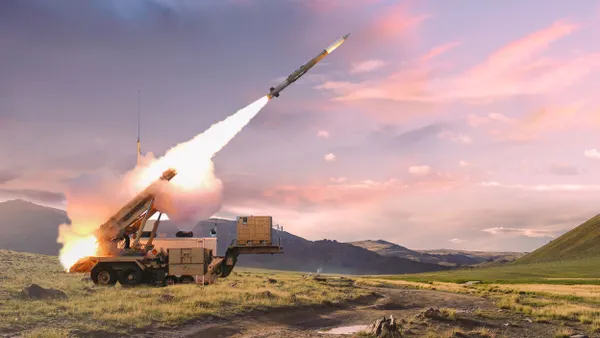
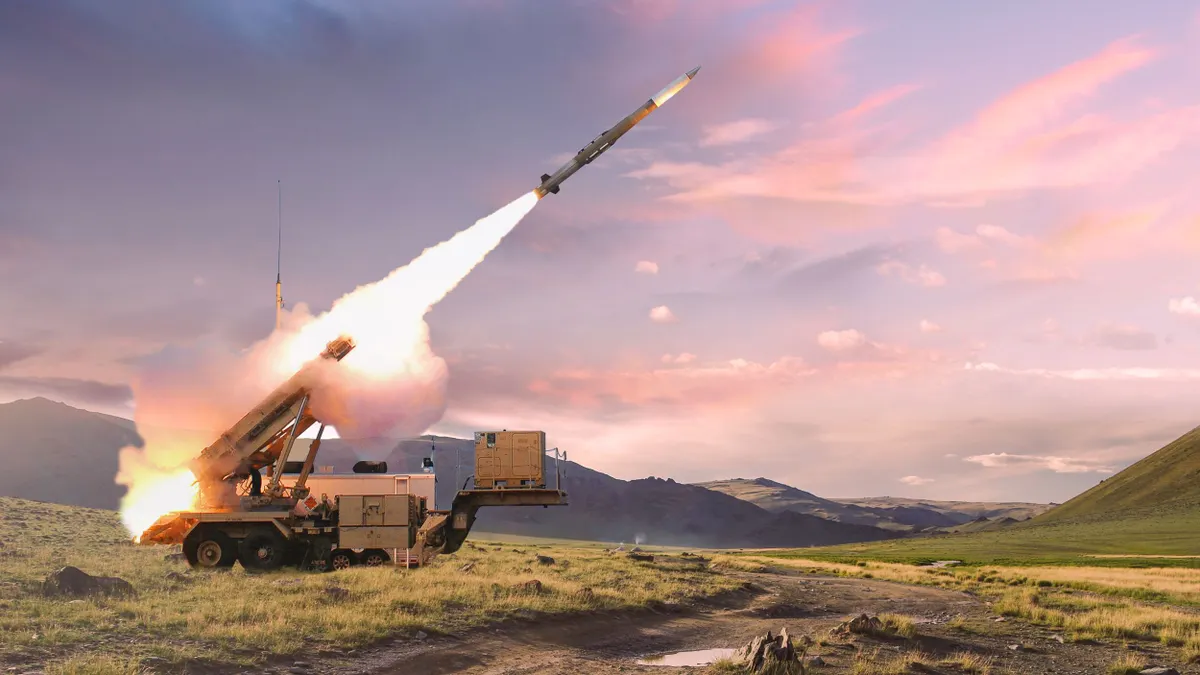
- GM Defense delivered its first batch of housing components for Lockheed Martin’s Patriot Advanced Capability-3 Missile Segment Enhancement system on Aug. 28, the weapons maker announced Friday.
- While GM and Lockheed initially announced their collaboration in June, they signed a contract agreement on Aug. 6, according to the press release. GM delivered the components 22 days later. The value of the deal was not disclosed.
- Lockheed and GM intend to build on the collaboration by implementing commercial practices across the munitions programs as well as expanding capabilities for other defense systems for the U.S. and its allies.
Dive Insight:
The automaker used its casting and machining capabilities and precision-fabrication expertise to meet the defense specifications, which gives the company the “ability to manufacture with quality at scale,” Stephen duMont, GM Defense’s president and CEO, said in a statement.
“Our partnership with GM Defense is a concrete example of how we’re merging world-class commercial manufacturing with defense supply chain and production practices and rapidly translating that into battlefield readiness for the United States,” Tim Cahill, president of Lockheed’s missiles and fire control segment, said in a statement.
PAC-3 components usually take months or years to produce, Lawrence Stoklosa, managing director at accounting services firm UHY Advisors, said in a Sept. 19 LinkedIn post.
Stoklosa pointed out how the automotive industry spent decades to create capabilities to quickly scale production, boost quality and consistency and streamline complex supply chains. Automakers also constantly improve their manufacturing processes and aim to reduce costs.
“Those capabilities are increasingly important to the defense industry,” Stoklosa said.
However, the real test will be the next batch of components and whether GM can accelerate production of the PAC-3 MSE interceptor, according to a Sept. 19 analysis from global analytical publication Tomorrow’s Affairs. That’s when it will “become clear how many casings GM can reliably ship each month, whether quality remains consistent and how many parts pass receiving inspection without rework,” TA added.
Lockheed has been signing contract agreements with the Department of Defense and other companies as it works to accelerate production of the PAC-3 and its other weapons systems. In July, DOD upped Lockheed’s PAC-3 MSE contract from $4.7 billion awarded in April to an additional estimated $53.9 billion, bringing the total value to $58.6 billion.
Earlier in September, Lockheed awarded L3Harris Technologies a multiyear $4.7 billion contract to produce the propulsion systems for the PAC-3 MSE. The agreement will back large-scale production of the missile interceptor’s advanced two-pulse solid rocket motor, the Lethality Enhancer and Attitude Control Motors.
Lockheed also nabbed another DOD agreement on Sept. 17 that will help expand production capacity of its air-to-air AIM-260 Joint Advanced Tactical Missile. The funds will back Lockheed’s munitions supply chain including manufacturing capacity, workforce and production efficiencies, according to the agency’s press release. The JATM is produced by Lockheed in partnership with the U.S. Air Force and U.S. Navy.
GM’s delivery and Lockheed’s new deals come amid a reported U.S. weapons shortage, which President Donald Trump has denied. A Defense Department inspector general report released Sept. 14 found that U.S. forces used about $22.3 billion worth of munitions between February and June, pointing to the country’s war with Iran. Another $3.7 billion was due to equipment losses.
Additionally, a Congressional Budget Office report found that as of Aug. 1, the Iran war cost DOD about $38 billion. The amount includes the costs of replacing used munitions and lost equipment.