Dive Brief:
- California Gov. Gavin Newsom signed a measure into law on Sept. 27 that increases the state’s oversight of reactive chemical storage facilities and improves its emergency response preparation.
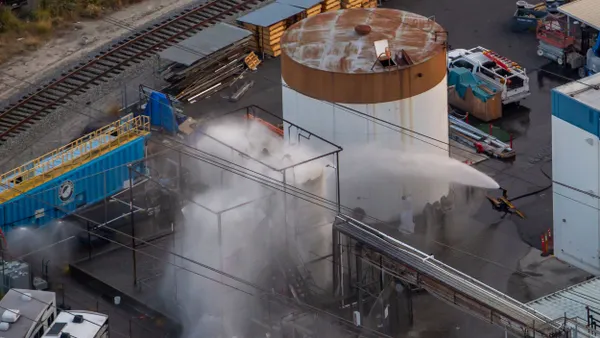
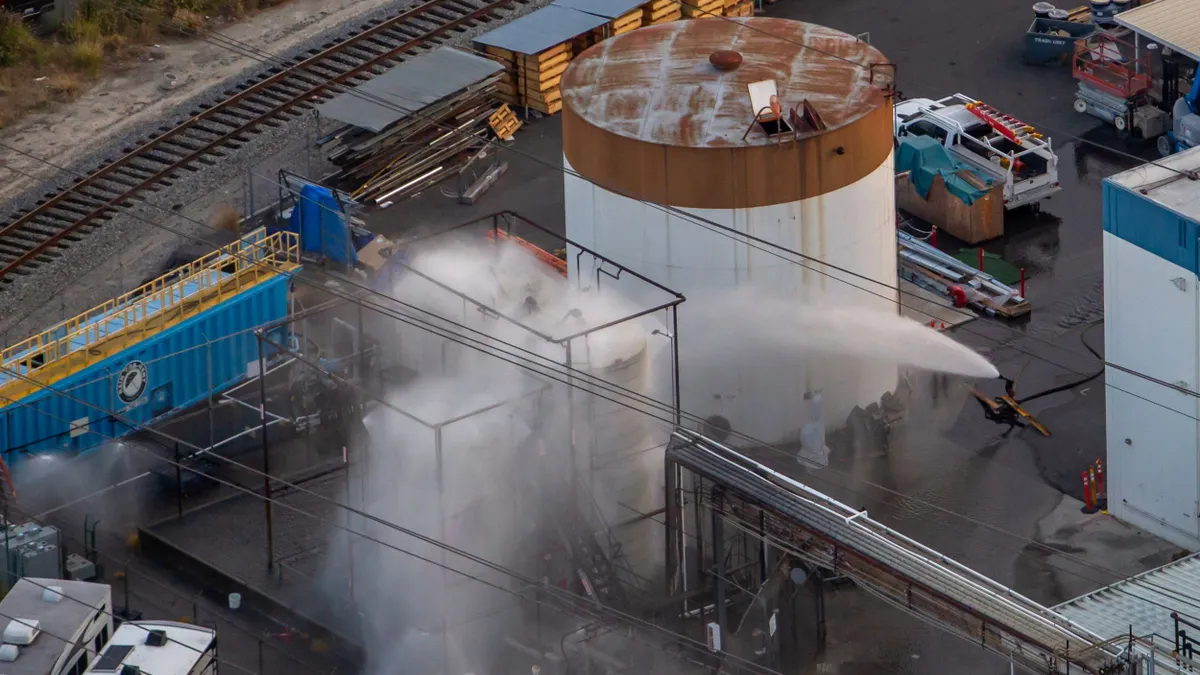
- The new law comes four months after a storage tank containing up to 7,000 gallons of a flammable liquid at GKN Aerospace’s Garden Grove, California, component facility overheated and emitted toxic vapors, according to a state assembly floor analysis. The incident triggered an evacuation order for about 50,000 residents in the area.
- While Senate Bill 883, the Preventing Chemical Explosions Act, was introduced in January, it was substantially reworked and amended to address chemical safety following the GKN chemical leak.
Dive Insight:
Requirements Under SB 883 include prohibiting new “high risk” facilities from being located close to homes. It mandates a public notice of a proposed new hazardous storage site and gives residents an opportunity to give their input before local officials approve the proposition.
The hazardous chemical stored at GKN’s Garden Grove plant is monomer methyl methacrylate, or MMA. The substance is used to manufacture acrylic materials, coatings, composites and specialty components such as aerospace and medical technologies, according to the company’s community update website.
GKN’s Garden Grove facility manufactures aerospace canopies as well as cabin and flight deck windows for commercial and military aircraft and spacecraft. The site also produces cabin windows for Boeing’s 737 and 787 commercial aircraft.
MMA is used to make one of GKN’s more prominent components, the canopy for Lockheed Martin’s fighter F-35 jet model. The coatings help maintain low observability characteristics, helping reduce the jet’s detection and provide safety to the pilot and equipment, according to a 2018 GKN backgrounder.
Exposure to MMA can irritate the skin, eyes and mucous membranes, according to the National Library of Medicine. It can also impact a person’s neurological and respiratory systems.
When the substance reaches high temperatures it can lead to an explosion due to polymerization. The new law now brings facilities that store significant quantities of MMA under the California Accidental Release Prevention program, which focuses on preventing accidental releases of hazardous chemicals deemed a risk of causing immediate harm to the public and environment. The program also works on minimizing damages if chemical leaks occur.
While SB 883 was introduced in January, it was substantially reworked and amended to address chemical safety following the GKN explosion.
“We were incredibly fortunate that the situation was brought under control without an explosion or reported injuries, but we cannot rely on good fortune to keep our communities safe,” California Sen. Tom Umberg, the author of SB 883, said in a statement. “SB 883 addresses the gaps this incident exposed and puts stronger safeguards in place to help ensure it never happens again.”
The law faced opposition from many state and national trade groups, such as the American Chemistry Council, Supply Chain Federation and the California Manufacturers and Technology Association.
The trade associations were concerned about some of the terms and provisions, such as “reactive chemical storage facility,” that were not defined, according to an August state assembly analysis.
“[How the] bill requires certain measures to be in place (e.g. backup cooling system for reactive chemical storage) before a new building permit for a new reactive chemical storage facility is approved,” the trade groups stated. “It may be more appropriate to see the results of any investigation into the incident before identifying specific remedies or requirements that may or may not be focused on addressing the root cause.”
GKN reached an agreement with the Orange County district attorney in August to resolve claims from the chemical leak. The company will pay up to $100 million for the over 50,000 Orange County residents who were forced to evacuate the area surrounding the Garden Grove facility, according to the DA's press release.
The DA is also negotiating with GKN to complete the settlement to include a safety plan and independent monitoring of the facility.