-400x400.jpg)
A machine can detect signs of failure before production stops. The harder question is whether that warning can reach the systems and people are able to act on it.
The Infosys Manufacturing Tech Index: AI Pulse reveals both the progress and the execution gap: 75% of manufacturers have embedded AI into their enterprise strategy, but only one in five manufacturing AI initiatives meets its business objectives.
This challenge is not unique to manufacturing. The Infosys AI Business Value Radar 2025 found that 19% of AI use cases across industries achieve all business objectives, while another 32% partially meet them. The same research links AI success to changes in operating models and data structures. For manufacturers, success depends on connecting AI to the systems, people, and decisions that run the factory.
The next breakthrough will therefore happen where information technology (IT) and operational technology (OT) converge. This IT/OT seam is where enterprise systems meet production technology, giving AI the context to support operational decisions. It also creates the foundation for physical AI, which embeds intelligence into products, equipment and other devices that can interpret conditions and act in the physical environment.
AI must work in the physical reality of manufacturing
An AI recommendation can influence production schedules, maintenance, quality controls, energy use, material movement, safety, or delivery commitments. These decisions require context from multiple systems.
No single system provides that context. Production lines generate telemetry from machines and sensors. Enterprise systems contain information on demand, cost, inventory, and suppliers. Maintenance systems record asset health and work orders, while quality systems capture defects, deviations, and inspection results. AI recommendations become more reliable when these signals are connected, contextualized, governed, and secured.
IT systems support enterprise planning and decision-making. OT systems run machines, production lines, control systems, and shop floor processes. When the two remain disconnected, AI can identify a pattern without knowing whether the proposed response is feasible, safe, or economically justified.
Manufacturers are already applying AI in operationally sensitive areas. As per the Infosys report, nearly 60% of manufacturers use AI in cybersecurity and OT systems, while nearly half use it in production and quality. However, the supporting data, platforms, and plant-level expertise often remain fragmented across systems, factories, and functions.
Connected intelligence enables physical action
To turn intelligence into impact, manufacturers need a shared operating view that brings together plant floor signals, enterprise data, engineering context, cybersecurity controls, and operational workflows. The value becomes tangible when connected data changes a production decision or triggers a physical response.
Predictive maintenance models need machine data linked to production schedules, maintenance history, and parts availability that enables manufacturers to cut downtime and improve yield. Digital twins need current operational data to simulate changes reliably and are increasingly paired with predictive maintenance to support real-time production adjustments. Computer vision systems need quality standards and process context to distinguish defects from acceptable variation. Agentic systems need trusted inputs, operating rules, and connections across factory floor, enterprise, and supply chain systems, with clear conditions for human intervention.
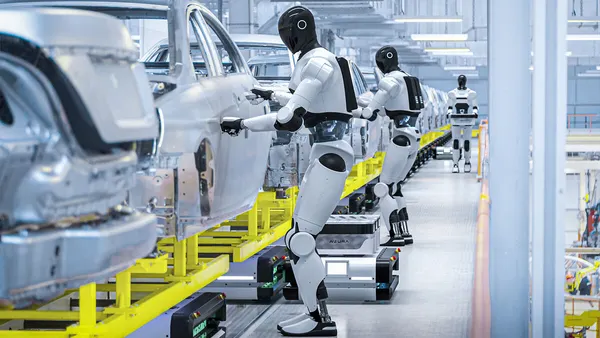
Together, these capabilities support physical AI. Combining sensor data with digital twins, computer vision, robotics, autonomous systems and edge intelligence allows systems to interpret operating conditions and act in real time. The action could involve adjusting equipment, directing an autonomous mobile robot, identifying a quality defect, or initiating a maintenance workflow.
This progression from insight to physical action increases the importance of IT/OT integration. AI systems need reliable operational data, clear decision rights, cybersecurity controls, and human oversight when their decisions can directly affect production.
Cybersecurity must be built into the architecture
Our research identifies cybersecurity as both the leading AI use case and the largest barrier to scale in manufacturing, with data readiness ranking as the second-largest barrier (Figure 1).
Figure 1. Top AI scaling barrier by percentage of respondents

Source: Infosys
Recent events show how quickly digital disruption can reach physical operations. In September 2025, Jaguar Land Rover (JLR) said a cyber incident had severely disrupted its retail and production activities and led the company to shut down systems. JLR later extended its production pause while forensic investigations and recovery efforts continued.
For manufacturers, such interruption can travel beyond one system or plant. Production delays can affect suppliers, inventory, logistics, dealers and customer commitments. As factories connect more equipment and decisions to enterprise systems, a local digital failure can become an operational problem at network scale.
Five practical steps
The deeper AI moves into physical operations, the more manufacturers need to plan for the moment when a model, data feed or connected system fails. That preparation has to begin before AI is given greater influence over production. These five steps help manufacturers build the foundation to scale AI with confidence rather than exposure.
1. Build a converged data foundation
Connect operational telemetry with enterprise, maintenance, quality, and supply chain data. Establish clear data lineage and ownership, then strengthen the data path before scaling a use case.
2. Establish joint IT/OT ownership
Give plant engineering, operations, cybersecurity, and IT shared accountability for uptime, yield, quality, safety, and productivity. Technology provides the capability, but engineers, operators and plant leaders determine whether it improves performance.
3. Build resilience into the architecture
Establish security, monitoring, recovery, model governance, and controls for human intervention controls before AI influences critical physical processes. Keep accountability for operational risk clear as systems gain autonomy.
4. Sequence use cases by data readiness
Start where data is reliable, outcome is measurable, and operating conditions are well understood. Early successes can establish reusable patterns for integration and governance patterns.
5. Fund convergence as core infrastructure
Treat IT/OT convergence as shared infrastructure, with a dedicated budget that supports reuse across AI initiatives. This creates a common foundation and prevents duplicated integration work.
From promise to performance
Manufacturers are still developing the systems, data, governance and operating models required to scale AI. Progress will depend on connecting AI to the constraints, decisions, and accountability that shape shop floor performance.
Physical AI expands what connected intelligence can achieve. It also raises the requirements for a secure, governed and resilient IT/OT foundation. The next manufacturing breakthrough will arrive when AI can interpret factory conditions, recommend an appropriate action and operate within boundaries that people trust. That future starts where enterprise intelligence meets the shop floor.