Dive Brief:
- Sila Nanotechnologies signed a multiyear offtake supply contract with Panasonic Energy Corp. of North America with a potential value of more than $1 billion over time, according to a press release Wednesday.
- Under the agreement, Sila will provide its patented silicon-carbon anode material, Titan Silicon, which Panasonic will use to power its battery cells for electric mobility applications.
- The two companies will also work together on intellectual property as they further cement and expand their business partnership, according to the press release.
Dive Insight:
The agreement follows a $1.4 billion loan commitment from the Department of Defense’s Office of Strategic Capital that Sila received in August, as well as $300 million in private equity funding that the materials maker secured in July.
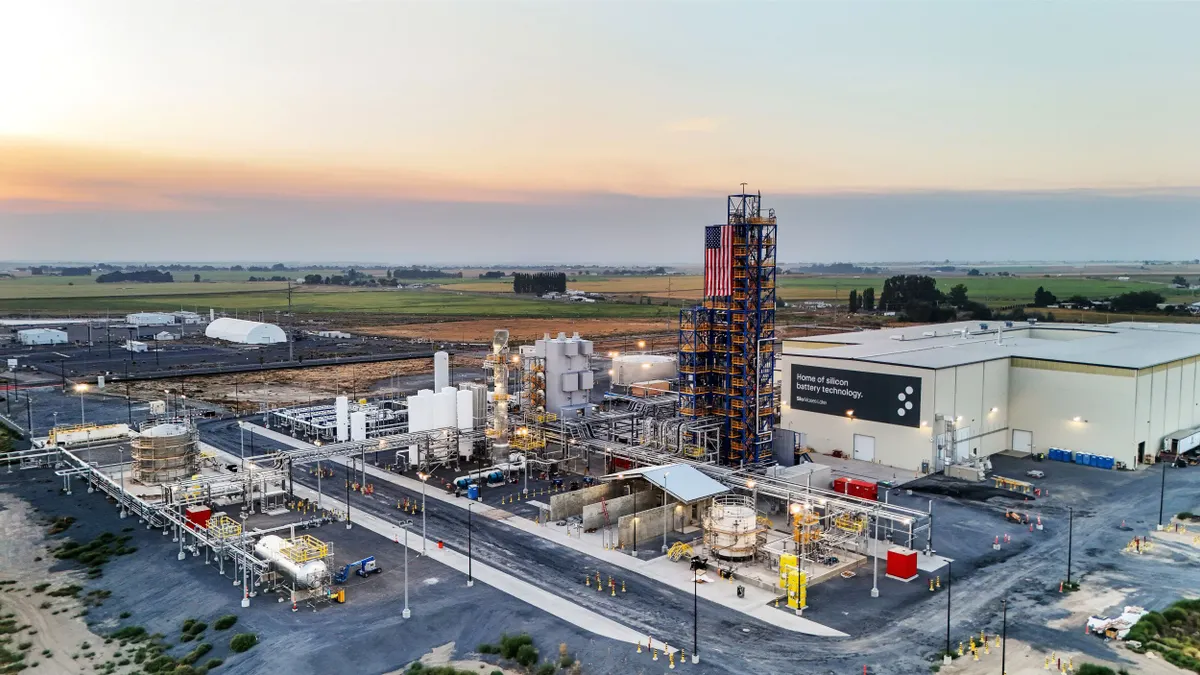
The combined capital backs Sila’s expansion of its Moses Lake facility and accelerated domestic production of its Titan Silicon technology.
The financing also supports construction of a lithium-ion battery cells manufacturing plant. The site will produce battery cells based on specific industry requirements, such as industrial, agricultural and military drones, according to the Aug. 7 press release. Sila did not immediately respond to questions about the battery cell facility.
Sila and Panasonic’s joint efforts aim to fortify a domestic battery supply chain in North America, especially as federal officials such as Treasury Secretary Scott Bessent’s call to revamp the supply chain process.
Sila’s Titan Silicon products are designed to charge faster and last longer than competing products, according to the company, and they can be tweaked depending on the client’s needs and requirements.
The company’s patented design also offers its automotive and defense customers a choice between partial or full graphite replacement. The U.S. has not produced graphite since 1989, according to the U.S. Geological Survey’s 2025 data.
In addition to batteries, graphite is used in other applications including steel casting, lubricants and insulation products. However, China is the global leader in natural graphite, producing about 82% of the world’s supply, according to the Geological Survey. Under U.S. law, China is deemed a foreign entity of concern because the country is “owned by, controlled by, or subject to the jurisdiction or direction” by its government, according to a Department of Energy regulation.
China has also been revamping its export policy involving critical minerals and components. China’s Ministry of Commerce announced Nov. 9 an extended pause of certain export controls, including graphite, set to end Jan. 10.
Some U.S. agencies are taking measures to domesticate critical components and materials. Under the National Defense Authorization Act for fiscal year 2026, the Department of Defense would be prohibited from purchasing batteries for weapons and support systems made with materials from foreign entities of concern beginning Jan. 1, 2028.