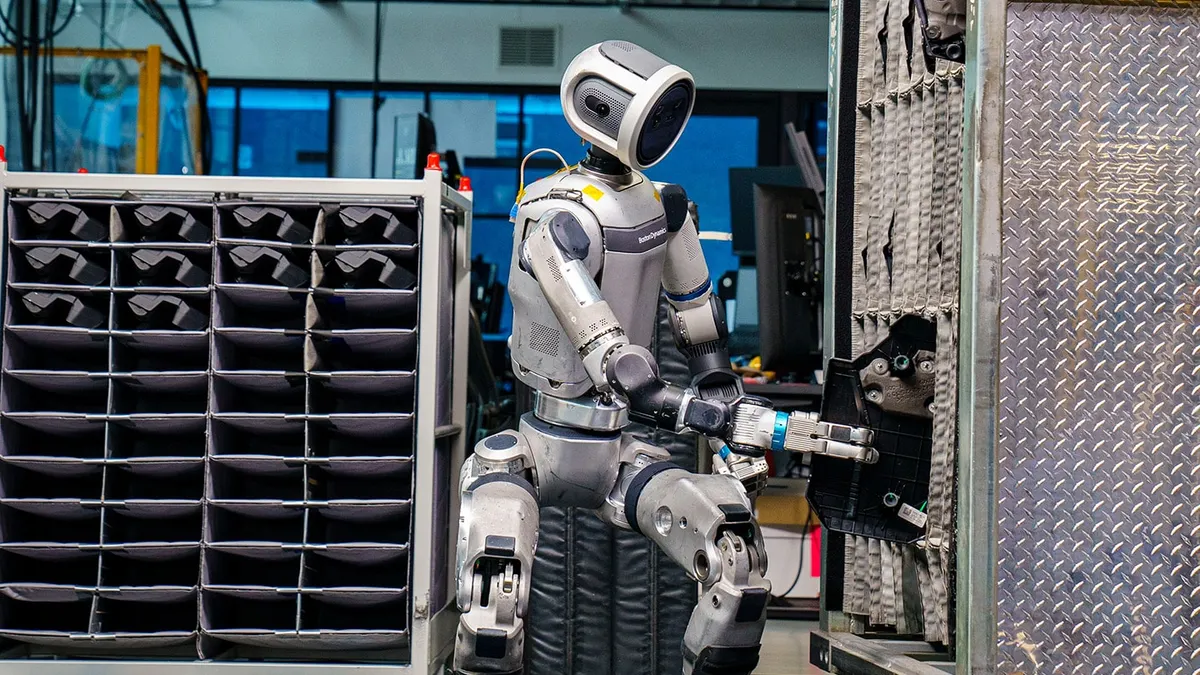
As manufacturers increasingly turn to robotics and automation, the vast majority of products are made overseas in more cost-competitive regions, such as China and Japan. To accelerate innovation and manufacturing in the United States, lawmakers are looking into ways to help U.S. companies catch up.
Standard Bots co-founder and CEO Evan Beard on Wednesday participated in a roundtable discussion hosted by the U.S. Department of Commerce’s National Telecommunications and Information Administration about robotics and industrial policy.
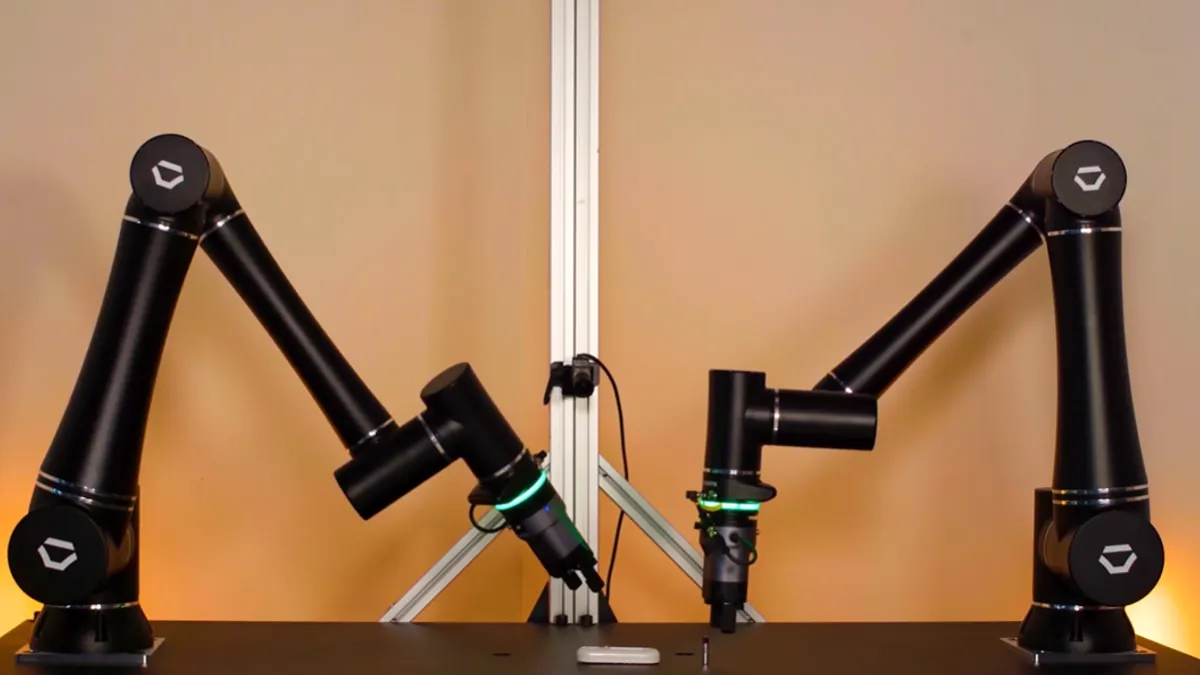
Standard Bots is a maker of robotic arms for industrial applications. Founded in 2011, the Glen Cove, New York-based company develops software, firmware, electronics, vision systems and mechanical parts, according to Pitchbook. It has received investments from Samsung Next, Amazon Industrial Fund and General Catalyst, among others.
In addition to Standard Bots, Beard founded technology-based media company A-Plus and software developer Gridtech, according to his LinkedIn page. He has a bachelor’s degree in computer science and economics from Duke University.
Following his conversations in Washington D.C., Beard spoke with Manufacturing Dive about recent automation and artificial intelligence trends, what’s next for his company and how the U.S. can advance robotics and industrial policy to improve manufacturing competitiveness.
This interview has been edited for clarity and brevity.
MANUFACTURING DIVE: Can you tell me a little about the latest with Standard Bots and where you produce your robots currently?

EVAN BEARD: We're doing final assembly in New York right now, but we're moving to be fully made in America, hopefully within the next year. We’re focused mostly on this new way to train robots, where you show them what to do. And just by showing them, it's learning and it's training the robot, collecting training data, training a model, deploying it.
It makes it so much easier to deploy so many manufacturing jobs, because these models can handle the variability. We’re actually bringing this to market and making it so anybody, like the average worker, can train a physical AI model. That’s a little bit different than pretty much everyone else. The whole idea here is then it can do the job autonomously after that.
That’s really interesting. What is your design and sourcing strategy like?
So there are parts coming from outside the U.S. We don't ever plan on making bearings or chips, but almost everything else we design ourselves. We're not currently designing the part with gear teeth on it, but almost everything other than the bearings, chips and the part with the gear teeth, we have vertically integrated the design.
Some of it we're sending out of the country. Job shops here can be brutal, and one of the things we've been talking about is we have to get competitive as a country in terms of manufacturing. Like we could deal with the 20% price difference, but it's often five to 10x. But what we do believe is that by vertically integrating the manufacturer, by bringing these things in house, we're going to be casting our own metal parts and heat treating and milling and powder coating all in our facility. And so by vertically integrating, we actually think we can be cheaper than China.
How would that work exactly?
Part of that is you're setting up your machines to just run your parts all day long. And the other part is, we're automating it. We make five sizes of actuators, and we're going to just be running those all the time. And so we can get really efficient. Whereas job shops in China are still making it, packaging it up, shipping it to the place that anodizes it. Then they’re unpacking, inspecting the shipping, another thing that happens to it, then it comes back to the U.S.
It’s touched and packed and unpacked so many times, versus we can just do it in a row with robots like handing it off. So that’s the direction we’re moving. We think we can be cost competitive with anybody, anywhere in the world. That’s happening over the coming months to bring back the metal part manufacturer and then there’s a couple other components we’re bringing back.
Today the vast majority of industrial robots are coming from places like China, Japan, Germany and other global production hubs. How come the U.S. is falling behind here? You mentioned the cost component. What else is contributing to this dynamic?
This came up this week in the meetings with the U.S. Commerce, and one of the participants talked about how the Japanese in the ‘80s had a national robotics strategy. We actually had a lot of robotics companies here in the ‘80s. And what happened was the Japanese dominated the next couple decades in robotics. They now have the biggest company in the world, Fanuc, of course. And 10 years ago, the Chinese said they were going to have a national robotics strategy, and they are now dominating the whole world. They installed 10 times more robots than us over the last year.
So I think what's happening is there are countries that are interfering with the free market, saying that this is a foundational technology that's really important in the future of our country, and we're going to really incentivize this behavior to make these products and buy them. And it's created us falling behind.
If you compare metal part production here versus China or somewhere else, it’s like a five to 10x difference, 10x being low end, and 5x is probably higher volume. But that's the difference in cost for the most part right now, if you just quote parts, and that's the output metric. The input metric is, what are the tools we're installing to be more productive? That's robotics. And other countries are outpacing us 10-to-one right now in terms of how many they're installing.
So the output metric doesn't look that good, and the input metric to catch up looks terrible. This is the five-alarm fire that I think many of us are bringing to the government and saying, hey, we love free markets here in the U.S. But when our competitors are doing things like seriously subsidizing this industry, we need to take action to make sure that we lead. And that there's American leadership in this next generation of robotics and AI so that we lead, not just in the AI models, but also in AI coming to the physical world.
In November, you testified at a hearing before the U.S. Congress Joint Economic Committee about advancing U.S. robotics through a national strategy. What types of policy or incentives should the country emphasize?
One of the things we can do is create these centers of excellence and put them all over the country, but not too many, like one per state. We think the current Manufacturing Extension Partnership is falling short and it isn’t as useful as it could be.
A lot of these people have to raise their own money. They're not fully funded. They're often in the basement. They don't have enough staff, they don't have any equipment. There's a couple good ones. But I want to be able to see amazing machining that a top-quality shop would use. What processes do they have? What equipment do they have? I want a place where I can send my folks for training in powder coating and anodizing and press breaks. All the different operations that I want to run. I can see the equipment, I can talk to experts.
We just have to get better with knowledge sharing. There’s people in this country that know how to do it. Let’s work together and make a nationwide connected center to share our knowledge on how to be great at manufacturing, because it’s been too eroded and we see it. We go to a machine shop and people could do the job a lot better and save a lot of costs, but they’re not. So that’s problem one.
Problem two is training. There just aren’t enough people. Every customer we talk to, it’s one of the top complaints. It’s like, we can’t hire enough good people. We try to hire machinists, but we have to pay them a fortune. And it’s still hard to find anyone.
And then there’s funding. We suggested a loan program similar to a Department of Energy-type of loan program where I can say hey, I want to start up a milling shop or powder coating shop and there’s funding to do that. I think if you want to incentivize robots, some of the ideas I heard this week were offtake agreements where the government says if you can do this, we’ll buy this many. They’re not funding it, but they’re providing the demand signals so that private capital will fund it. Credits for buying American robots is another solution. Being able to depreciate robots as a service. Right now, you can’t under the One Big Beautiful Bill Act.
The government also needs to be clear in its messaging about how robotics can turn things around. We’ve been losing jobs every single year in manufacturing because we’re not cost-competitive. No one wants to pay more for a coffee maker because it's made in America. So we have to be cost-competitive to earn the right to bring those jobs back, and I think the government can.
In this era that we're living in with increased AI and automation, what emerging technologies or trends in robotics are exciting you the most? And how do you see them shaping the future of manufacturing?
The piece that's going to change everything in robotics and automation is training through demonstration. And the reason for that is because you can now just show the robot a task rather than having to procedurally write logic for like, do this and do that.
At Standard Bots, we have a handheld device where you just do it, and it's recording. It records the video and what you did or tells the operation with a VR headset. And then these AI models, because they've seen you do it in the past, they can just do whatever it is. They can't extrapolate out to something very far from what they've seen, but if you show it like a small object and a large one, it can handle the middle sizes on its own.
So that's the magic of it. You're not having to write code. You don't have to figure out a rule-based way to express what to do. It can handle and do these tasks. It reduces the barriers to automate and the cost to automate as well. So this is an enormous change. It's a total difference in how robots are programmed, and it's the main one to be looking out for.