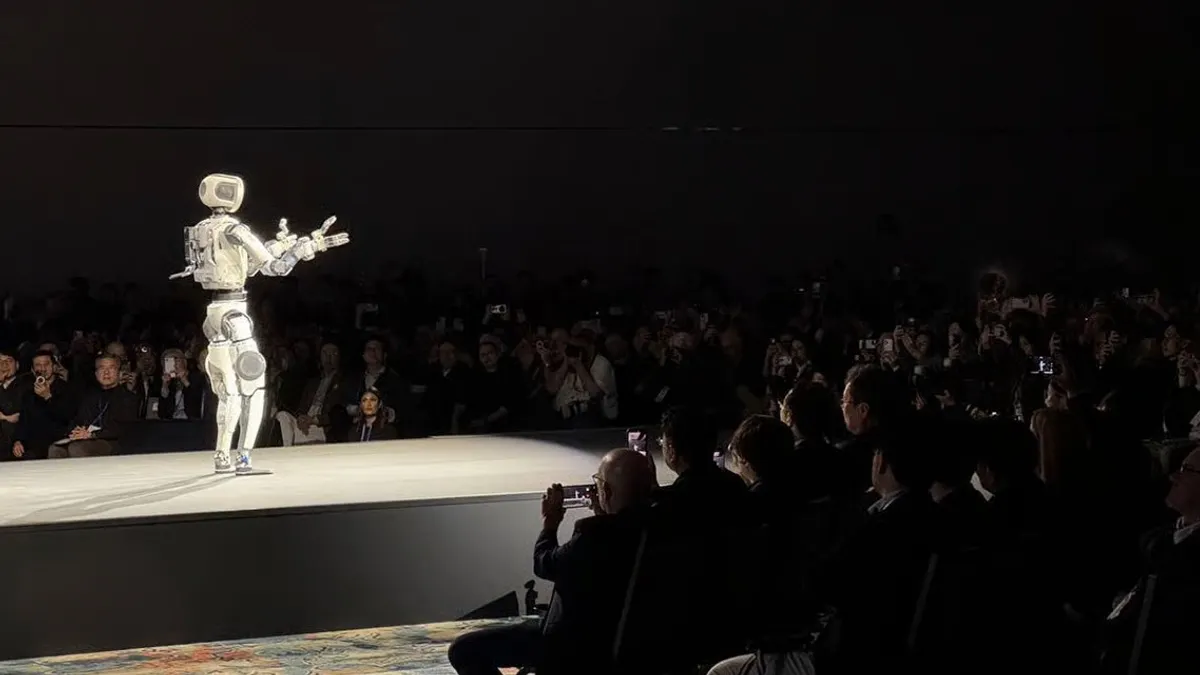
While humanoids are becoming more advanced through breakthroughs in artificial intelligence and modeling, the days of using them at scale in a production setting are still years away.
In fact, these human-like robots are getting a little “too much attention” and becoming more of a distraction for manufacturers, said Andre Marino, senior vice president of industrial automation for North America at Schneider Electric, in a recent interview.
Marino, who has worked at Schneider for 16 years, said more focus should be placed on whether the right robotic form is being used for a certain task. He also noted how companies large and small can lay the groundwork to operate more autonomously and ready themselves for the next-generation of manufacturing.
“The transformation cannot be limited to the 10% of companies at the top,” Marino said. “We need a strong base of small and mid-sized manufacturers because that’s also how you attract more people to the manufacturing space.”
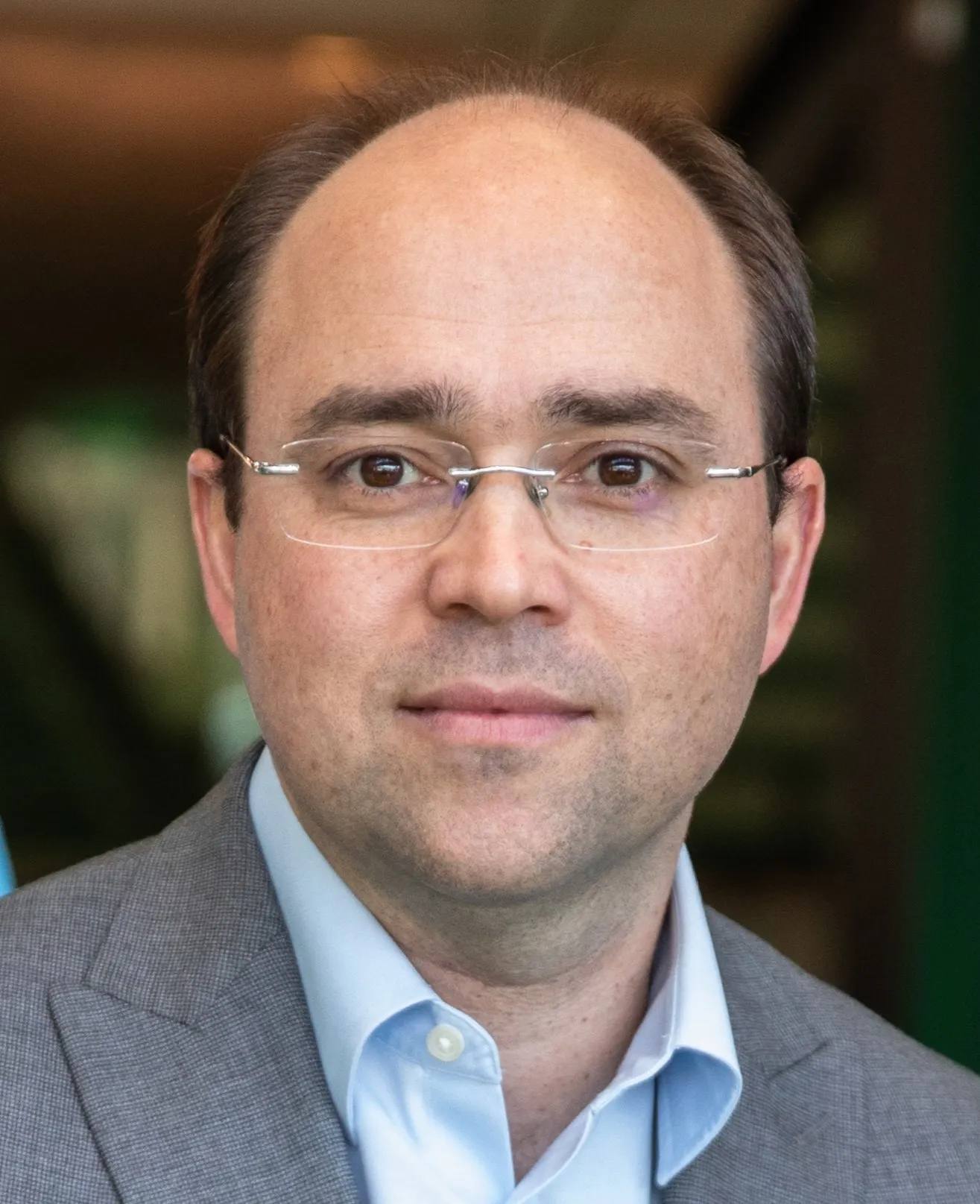
Schneider Electric, based in France, is an energy management and industrial automation technology provider. In addition to circuit breakers, switches and electrical equipment, the company makes data center cooling units and automation hardware such as sensors, motors and programmable logic controllers. It also has a growing software business.
Marino joined Schneider through the acquisition of SoftBrasil in 2010, an industrial automation and manufacturing operations software company that he helped build. He also co-founded LAR Plásticos, a manufacturer of plastic waste recycling and processing products in São Paulo, Brazil. He currently resides in Boston.
Manufacturing Dive recently spoke with Marino about humanoids, agentic AI’s impact on the industry and the benefits of becoming more of a software-defined company.
The following interview has been edited for clarity and brevity.
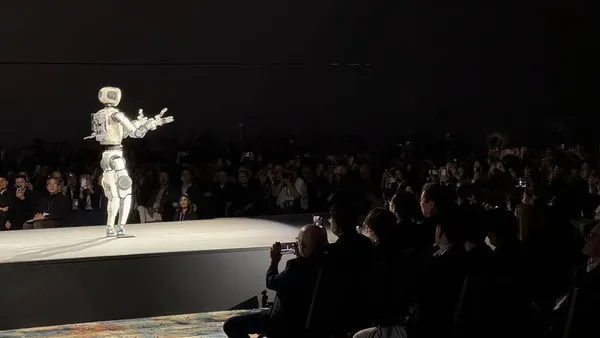
MANUFACTURING DIVE: Humanoids are a hot topic these days. Recently, I saw that a robot sprinted faster than any human before at the World Humanoid Robot Games. At the same event, some robots struggled to hammer nails into slabs of corkboard efficiently. What does that say about where we are in terms of industrial progress?
ANDRE MARINO: It's definitely exciting to see the humanoids, because it mimics us. We have this idea that it's going to replace all the humans on the shop floor. The Olympics, because it mimics a human competing in a competitive game, it attracts attention. When we had the Roomba at home, we were not so excited. It was a robot, but not in the same format. People were not saying, wow, that can really replace us in everything we do.
Humanoids are still struggling to do certain tasks and there’s many things that we need to develop to get to a point where you can replace humans with a robot. But even if we had a lot of humanoids, that doesn’t mean that this will solve all manufacturing issues. Different robots and different form factors will solve different problems.
The large language models we have today are based on written text. Physical models are entirely different. When a robot is pushing someone, it cannot predict what will happen after. Until we get world models that can simulate the real world and how this interaction happens, we won’t see any humanoid safely walking or doing things by itself.
What’s a bit concerning is that people are discussing the form more than the task itself and it should be the other way around. Companies should ask “do I really need a humanoid to solve my problem” and “what’s the problem that I’m trying to solve?”
There are several types of technologies that are further along in development that manufacturers are piloting or starting to deploy at their operations. How does Schneider Electric envision the future of manufacturing?
The next inflection point that we are all talking about is how physical AI and AI, in general, will affect manufacturing.
Historically, we’ve operated in silos of information or systems. We automate them, they work in isolation, they have their own data sets, and people were seeing gains for a few years. Now there’s this new technology — generative AI — that can reason and we can go a little beyond the silos.
Companies can think about agents making decisions and at least get closer to the reality of autonomous plants. They can skip a level from having to click and do something to just supervising. Then once they’re comfortable with supervising, they can have autonomous operations that don’t need supervision anymore because it gets to a point that it’s super good. The autonomy will come when we are comfortable enough with agentic AI.
Now there’s a few steps to getting there. Companies need to have their own data, and it must be structured in a way that they can train their own models. Then they can think about the next level to be an agentic company, which nobody talks much about, but all these large language models are trained on data that’s available through the internet. Industrial secrets are not publicly available. So the models are not trained on real data that can react fast enough to a manufacturing process, they are trained on theoretical data. I’m not saying that’s bad, but it’s not optimized for that specific process.
In order to achieve that future, we need to move from hardware-defined automation to software-defined automation. In other words, we need to decouple the programmable logic controllers and other hardware from the software layer in a way that the data will stay contextualized. Otherwise, you will have a discoordinated plant where you have agents in one silo not understanding the impact of another silo of the plant. Meanwhile, human workers will try to do the coordination on top of it, which could make things worse.
This shift to software-defined manufacturing will empower humanoids and any other type of automation in the plant. Our concern is that this is not being effectively communicated to a lot of small and mid-sized manufacturers. Some big companies are already making the investments and progressing on their digital journeys because they have the resources. But a lot of these smaller companies are not exposed to that thinking process.
Where is Schneider seeing the strongest adoption of this way of operating?
This architectural shift is happening in very critical environments like petrochemical or LNG. We’re also seeing it in food and beverage companies, water, municipalities, data centers, machine builders and pulp and paper companies.
The space that we’re seeing adoption going super fast is water, because they have very old infrastructure and they need to modernize. On the other side of the spectrum, makers of power generators are doing this because of their connection to data centers.
The other benefit to software-defined automation is the labor aspect. It’s super hard to get people out of the university to program logic controllers, but it’s very easy to get people that can program software these days. So when you go for software-defined, you have access to a pool of people that can program in Python and other languages.
In addition to the technological capabilities Schneider offers, the company has been recognized as a leader in plant modernization. In recent years, Schneider turned its Lexington, Kentucky, facility into a smart factory with IOT connectivity, augmented reality and other features. What have been the tangible benefits of doing this and is Schneider looking to do something similar at other U.S. locations?
We see a lot of reduction in manual work and paper work. We reduced 90% of the paper in the plant, which is a huge gain in not only productivity, but safety and traceability. We saw 25% energy savings in terms of cost and output. We digitized the supply chain so we can provide better service and track what we are producing. There is also stronger forecasting to anticipate plant downtime and the factors that lead to that. It’s truly amazing.
Another plant that was recognized a few months ago, was our plant in El Paso, Texas. It’s an engineer-to-order plant. We have many of our factories going through this journey and we operate more than 150 factories around the globe.
More companies these days are asking or requiring their employees to integrate AI tools into their work routines. What does this look like for Schneider from a manufacturing standpoint?
You apply the technology in a way that it’s scalable and not just a cool thing that leads to you doing pilots forever. The problem with all of these technologies is that everyone gets excited and they start to do pilots and they never go anywhere.
On the other hand, some companies have the opposite problem and don’t adopt the technology because they’re scared. The way we escape that is by defining the problem you are trying to solve for. Then after you have a clear definition, then you can start to automate by adding sensors, creating the digital framework and discovering whether agentic AI is the right tool to use.