BOSTON — Rockwell Automation, once primarily known as a maker of programmable logic controllers and rugged hardware that can withstand factory conditions, is repositioning itself as a provider of digital tools, robots and services for manufacturers seeking artificial intelligence-enabled solutions.
As companies upped their operational investments to become more digitally driven after fallout from the Covid-19 pandemic, Rockwell evolved with the times, shifting away from pure hardware sales to software-as-a-service products. It also began adding more predictive analytics, generative AI and machine learning features into its FactoryTalk industrial software.
The company’s latest focus has been digital orchestration, which involves managing multiple AI-enabled workflows in one place. Rockwell introduced its newest software, FactoryTalk Conductor, in late October and offered an exclusive first look of the technology to attendees at its Automation Fair in Boston last week.
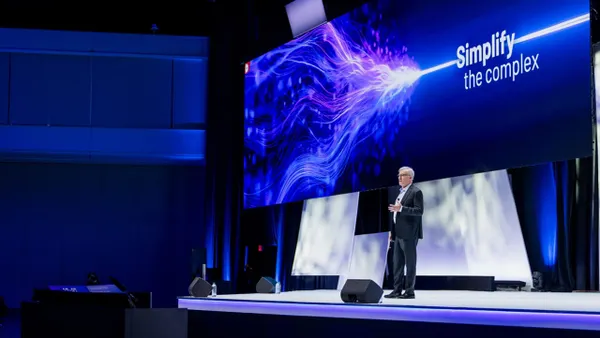
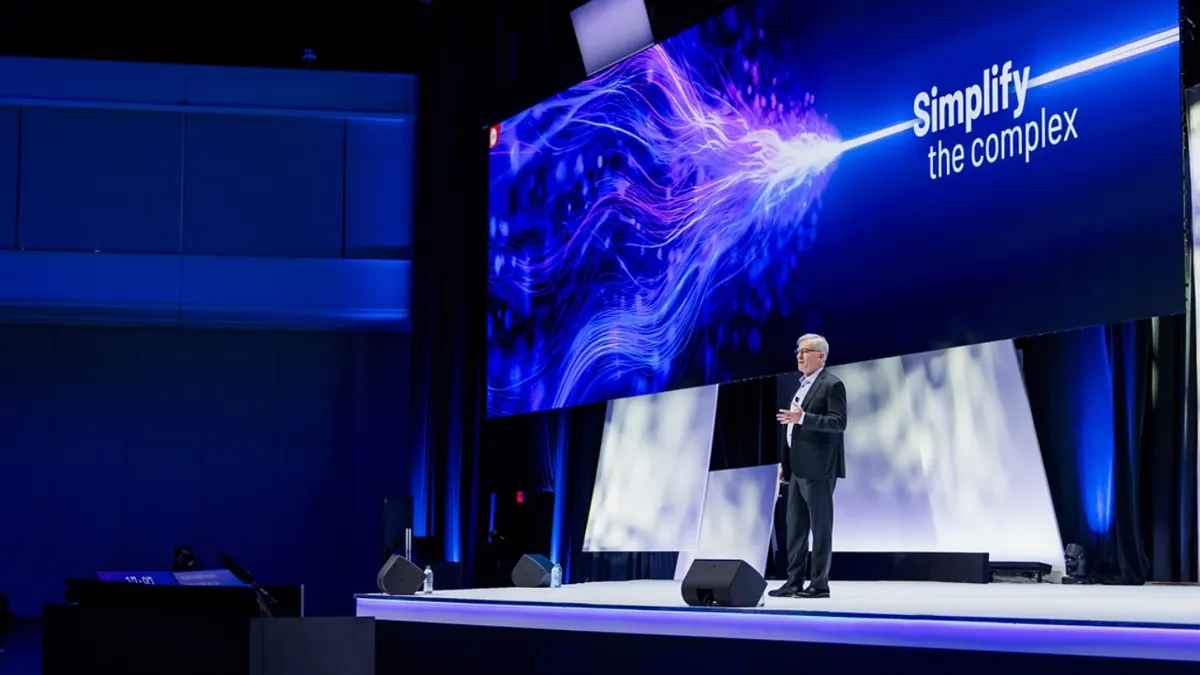
“[It] really has an opportunity to revolutionize the [manufacturing] space,” Rockwell CEO Blake Moret said in a keynote presentation Nov. 17.
More than one-third of global manufacturing operations are already AI-augmented, with adoption expected to reach 54% by 2030, according to Rockwell’s 2026 State of Smart Manufacturing Report.
The company said it designed FactoryTalk Conductor as a way to connect industrial AI technology, workflows and expertise across engineering environments into a single platform. Manufacturers can initiate engineering tasks using natural language and leverage Nvidia Nemotron open AI models within the platform.
Rockwell plans to initially connect its orchestration platform across its industrial software, including Logix Echo, Emulate3D and FactoryTalk Optix, with additional integrations at a later date.
“To be able to have Conductor harness the agents, create the programs for the running of the code in Logix, be able to create the face plates in Optix, it’s something that has to be seen to be believed,” Moret said during the presentation. He teased that customers like Procter & Gamble are “very excited about the opportunities here.”
Rockwell plans to make FactoryTalk Conductor available in the first quarter of next year. The company is also expanding further into digital twins, robotics and computing to support AI-enabled technologies.
Emulate3D
Rockwell last week said it expanded its Emulate3D capabilities, allowing manufacturers to use Nvidia Omniverse, Nvidia RTX rendering and OpenUSD technologies within the simulation software.
Companies use Rockwell’s Emulate3D digital twin software to build, simulate and virtually test its industrial operations before physical changes are made on the shop floor.
The integration with Nvidia and OpenUSD allows engineers to simulate larger, more complex manufacturing systems with more accurate physics capabilities, according to a news release.
Agilox
Rockwell is also looking to expand its autonomous mobile robots business through the acquisition of Agilox, an Austria-based forklift robotics company with its own AI and swarm networking technology.
Rockwell announced the deal last week for an undisclosed amount. The acquisition will more than double Rockwell’s AMR business by combining Otto’s North American market reach with Agilox’s footprint across Europe, according to a news release.
The Agilox transaction is expected to close by the end of March 2027.
Rockwell established its AMR division when it acquired Clearparth Robotics and its industrial arm Otto Motors in 2023.
Edge Computing
Rockwell also announced new industrial computers powered by Nvidia’s graphics processing units to handle AI and machine learning workloads closer to production.
These computers fixed with Nvidia’s Blackwell and Ada chips offer additional processing capacity for advanced machine vision, model predictive control, predictive maintenance and small language models, according to a news release.
Rockwell designed the EdgeAI computers to give manufacturers flexibility in how and where they deploy AI.
“Our vision is to create the future of industrial operations,” Moret said during his presentation.