Dive Brief:
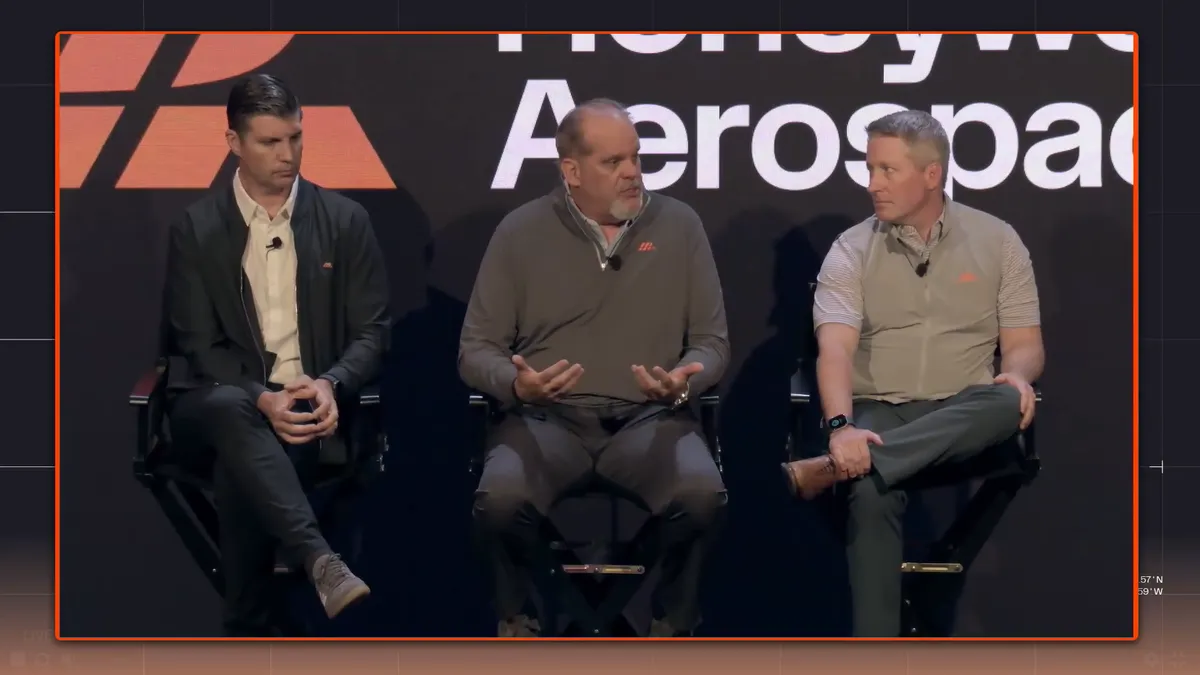
- Honeywell Aerospace plans to generate at least $6.5 billion in earnings and $4 billion in cash flow by 2030, executives unveiled at the company's investor day on Wednesday.
- To meet its goals, the Airbus and Boeing supplier will focus on scaling and strengthening its manufacturing operations and supply chain, as well as releasing at least 40 retrofit, modification and upgrade products, according to a presentation.
- Honeywell Aerospace is scheduled to finalize its spinoff from Honeywell on June 29 and will have a listing on the Nasdaq stock exchange under the ticker “HONA,” according to a June 3 press release.
Dive Insight:
Honeywell Aerospace projected its cash flow in the second half of 2026 will be between $1 billion to $1.5 billion, CFO Josh Jepsen said during the investor day event.
“We think that’s a good jumping off point,” Jepsen said. “[In the] first half, there’s a lot of noise spin…, but we think that’s a good base point for where we go from here in absolute dollars.”
Regarding the aerospace supplier’s manufacturing, Honeywell Aerospace is focusing on innovation, speed and scale, CEO Jim Currier said.
“That means we’re looking at the entire way we manufacture our products going forward,” Currier said. “The focus is really around manufacturability and how do you do that at scale.”
While Currier is “comfortable” with the company investing in technologies across the business, Honeywell Aerospace is “actually now doubling down and tripling down on the manufacturing scale.”
“That means designing slightly differently, innovating slightly differently,” Currier said. “That’s what we'll incorporate.”
The company has begun implementing some steps prior to its investor day. In April, Honeywell Aerospace announced plans to expand F124 jet engines manufacturing at its Phoenix Engines campus. The aerospace supplier will add on-site assembly to the location, which will service the Beechcraft M-346N aircraft, a candidate for the U.S. Navy’s undergraduate jet training system.
The Navy is seeking a replacement for its T-45 training jets with a new combination of aircraft and simulators. It aims to procure more than 200 aircraft and is expected to award a contract by 2027.
Additionally, the company agreed in March to invest $500 million to ramp up production of its navigation systems, actuators and electronic warfare solutions.