Dive Brief:
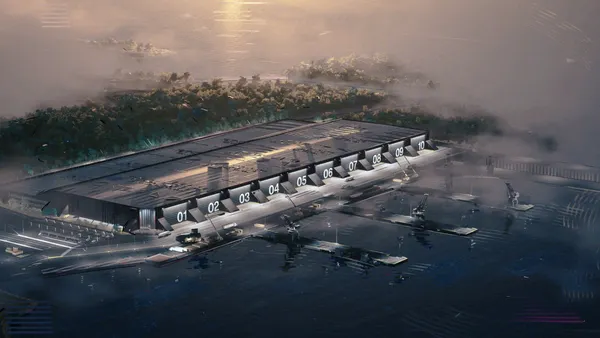
- Anduril Industries and the U.S. Navy announced Tuesday their plans to spend $6.6 billion to build a software-run shipyard within the Port of Baltimore in Maryland.
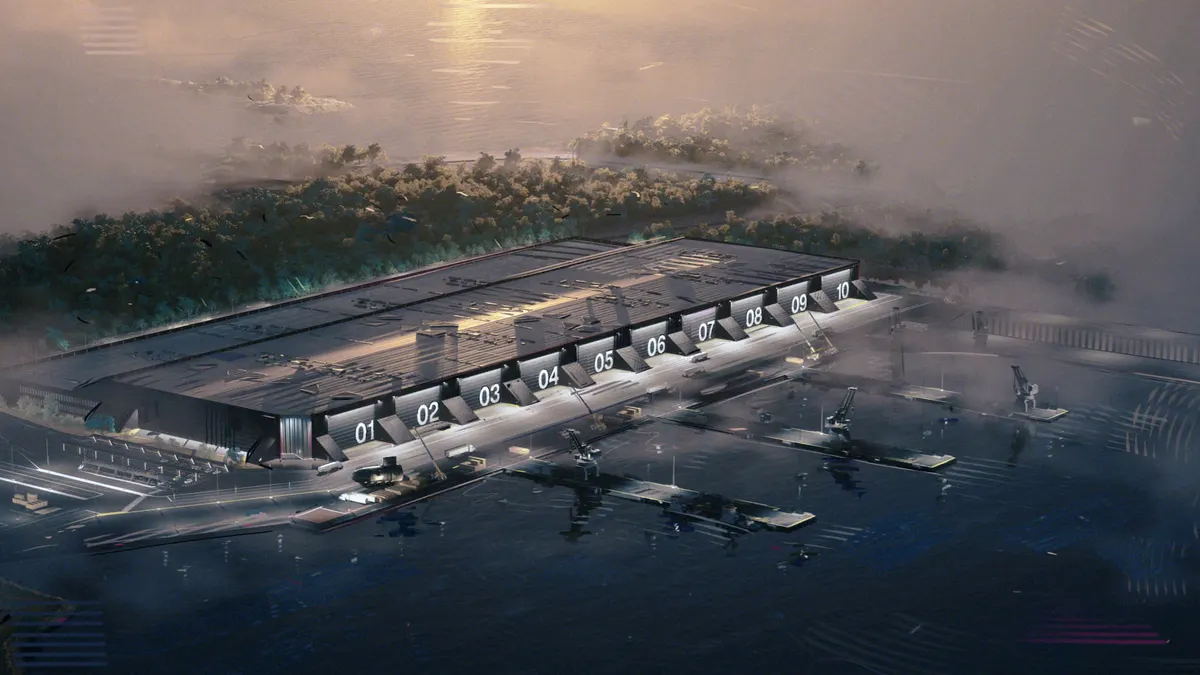
- The shipyard, dubbed Arsenal-2, will span two million square feet and manufacture components for Virginia-class submarines to refit the Navy’s fleet. The site will also create over 3,100 jobs by 2034, according to the press release.
- Permitting and site preparation is set to “begin immediately,” and construction is expected to commence as soon as Anduril receives the required approvals for the shipyard. Operations are anticipated to come online in 2030.
Dive Insight:
Anduril intends to gradually scale production once Arsenal-2 begins operations as the defense systems maker builds its workforce, supplier base, infrastructure and production rate required for submarine output.
Arsenal-2 will be built on a 187-acre site for “high-volume, high-precision production of undersea naval capabilities.” Anduril’s software platform, ArsenalOS, will digitally support the shipyard and production systems, connecting fabrication workflows, outfitting sequences, material movement, inspection protocols and documentation requirements in one system.
The system will enable greater consistency and allow workers and managers to have real-time visibility into Arsenal-2’s manufacturing process.
Anduril will invest $3.7 billion, with the remaining $2.9 billion being funded through a Navy contract, according to the press release. The Navy will issue payments based on production outcomes.
The partners began discussions more than two years ago about whether Anduril could assist the Navy’s submarine enterprise “in a larger way,” company co-founder and CEO Brian Schimpf said Tuesday during a press conference featuring President Donald Trump.
Anduril’s initial answer was no, Schimpf said, despite the company building autonomous aircraft, missiles, and the software to connect them.
“Even our most advanced systems sit at a different order of complexity than the Virginia-class submarine,” Schimpf continued.
Nevertheless, the company kept returning to the “submarine challenge” because its principal problem was too important to walk away from, the CEO added.
“The more time that Anduril spent learning about the industrial-based challenges, the clearer the need became to us,” Schimpf said. “The country requires substantially more places where submarine components can be built.”
Anduril worked with the Navy and other companies throughout the submarine industrial base to understand how the production system operates. Those companies include General Dynamics subsidiary Electric Boat, which has a multibillion-dollar Navy contract for Virginia-class attack submarines, and Huntington Ingalls at its shipyard in Newport News, Virginia.
“We wanted to know where the most persistent constraints exist and where a new industrial player could make a meaningful contribution,” Scimpf said. “We also started testing what we were learning. We stood up a proto factory in California, where our teams are already proving new manufacturing approaches and developing components for the Virginia-class program.”
Anduril’s shipyard announcement comes days after Defense Secretary Pete Hegseth announced six initiatives to shift the agency’s strategy.
One of the initiatives is Project Meridien, which Anduril co-founder Palmer Luckey is involved in. The initiative will work to identify the capabilities required to enhance DOD’s technologies on the battlefield. DOD Chief Technology Officer Emil Michael is overseeing Project Meridian, and the initiative will be co-directed by Luckey, Elon Musk, and Newt Gingrich, according to a memo.