Dive Brief:
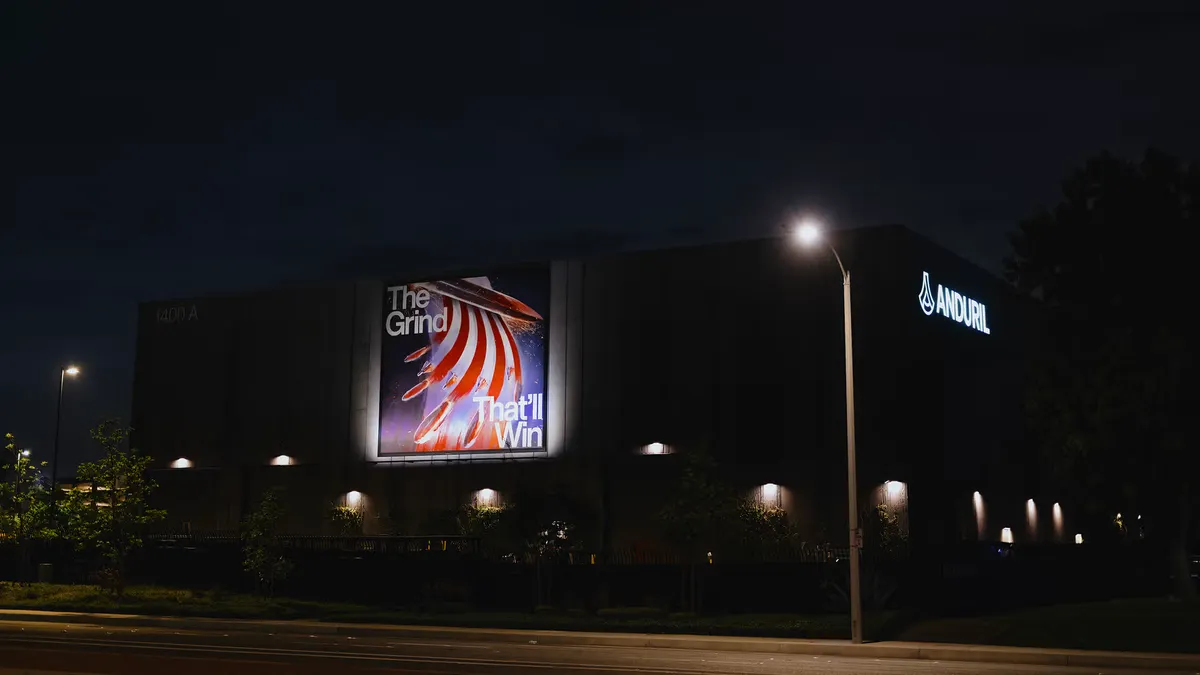
- Defense startup Anduril Industries raised $5 billion in a series H funding, bringing the company’s value to $61 billion, CEO Brian Schimpf announced Wednesday.
- The funding allows the company to continue “investing aggressively in manufacturing capacity, research and development, and the infrastructure required to build and field advanced defense systems at scale,” Schimpf stated in the press release.
- The series H funding was led by venture capital firms Thrive Capital and Andreessen Horowitz. Thrive Capital was founded in 2009 by Josh Kushner, brother of President Donald Trump’s son-in-law, Jared Kushner.
Dive Insight:
In addition to the recent fundraiser, Anduril is one of five weapons makers that signed agreements to supply the U.S. Department of Defense with 10,000 low-cost missiles. The other manufacturers are Leidos, CoAspire, Castelion and Zone 5.
The three-year contracts with Anduril, Leidos, CoAspire and Zone 5, through the Office of the Under Secretary of Defense for Research and Engineering, are part of the agency’s low-cost containerized missiles program, according to the press release.
Anduril’s contract involves supplying a minimum of 3,000 surface-launched Barracuda-500M missiles to the U.S. Army’s Portfolio Acquisition Executive Fires program, according to the company’s press release. The Army’s PAE Fires program manages a portfolio of weapon systems, including long-range precision fires. The program also oversees development, production, fielding and sustainment, according to the Army’s website.
Under the contract, Anduril plans to scale production to deliver at least 1,000 rounds per year, with the first set of deliveries expected in the first half of 2027. The defense startup will also deliver the associated containerized launch system for the SLB-500M, starting with over 60 launchers.
Leidos’ three-year contract involves supplying 3,000 LCCMs, according to the Fortune 500 company’s press release. The company also plans to expand its workforce and upgrade its facilities in Huntsville, Alabama, and McEwen, Tennessee, to meet the contract’s requirements.
The expansion of weapons development and production capabilities reflects Leidos’ North Star 2030 growth strategy. North Star 2030 aims to make the company “faster and leaner” as well as “scale through technology insertion and learning” across its businesses, such defense, CEO Thomas Bell said in a May 5 earnings call.
CoAspire’s three-year contract involves its additively manufactured Ghost missile, a “boosted, ground-launched” variant of its Rapidly Adaptable Affordable Cruise Missile-Extended Range, the company said in a news release. Though CoAspire did not disclose the number of Ghost missiles it will supply.
Castelion’s two-year procurement deal will supply DOD with a minimum of 500 Blackbeard hypersonic strike missiles annually, with the option to extend the contract for up to five years, according to the DOD news release.
The company is self-funding its facility expansion, and DOD is pursuing authorizations and appropriations to purchase more than 12,000 Blackbeard missiles over five years.
No other details on Castelion’s facility expansion were disclosed. However, the company began construction of its $220-million-plus hypersonic manufacturing campus, dubbed Project Ranger, in Sandoval County, New Mexico, in January. The 1,000-acre project is expected to create more than 300 manufacturing jobs and will house 21 buildings, with the first building expected to be completed in the summer, according to the press release. The remaining 20 buildings are scheduled to be completed and ready for production by the end of 2026.
Details about Zone 5’s three-year contract were unavailable.
DOD’s latest contracts support the “Arsenal of Freedom,” a blueprint to rebuild the defense industrial base under DOD’s New Acquisition Transformation strategy, according to the press release.
The contracts come as news reports surface of a U.S. weapons shortage due to the Iran war.
On April 3, the Pentagon released a proposed federal budget for fiscal year 2027, which includes a record $1.5 trillion. The request includes munitions as one of DOD’s “highest funding priorities,” and the agency plans to acquire 12 “critical” munitions. Furthermore, funding would go toward expanding the defense industrial base’s capacity to lay the groundwork for future scalable munitions production.
Defense Secretary Pete Hegseth explained the agency’s reason for the $1.5 trillion request in front of the U.S. House Armed Forces Committee on April 29.
“[It’s] to make sure the greatest companies in the world, which have been falling behind for decades, are running faster than ever before to give us 2X, 3X, 4X of the critical munitions,” Hegseth told the committee.
The big firms’ production rate is mentioned in Schimpf’s letter, which he wrote to Anduril’s investors in January. He noted that prominent defense companies consolidating and offshoring in the 1990s and 2000s “decimated the domestic supplier base, eliminating redundancy and excess capacity in favor of efficiency.”
“Lead times for missiles, ships, and aircraft now stretch across years,” Schimpf said. “Production rates are measured in dozens or hundreds per year, not thousands. The system was built for steady-state sustainment, not surge or mobilization. When conflicts demand magazine depth—when combatants burn through precision munitions in weeks rather than years—any difficulty scaling production becomes a strategic vulnerability.”
He added that the current system was developed for low-rate production of “exquisite platforms” over decades.
“That model made sense when threats evolved slowly and technological superiority could be maintained through small numbers of highly capable systems,” Schimpf said. “It does not make sense today.”