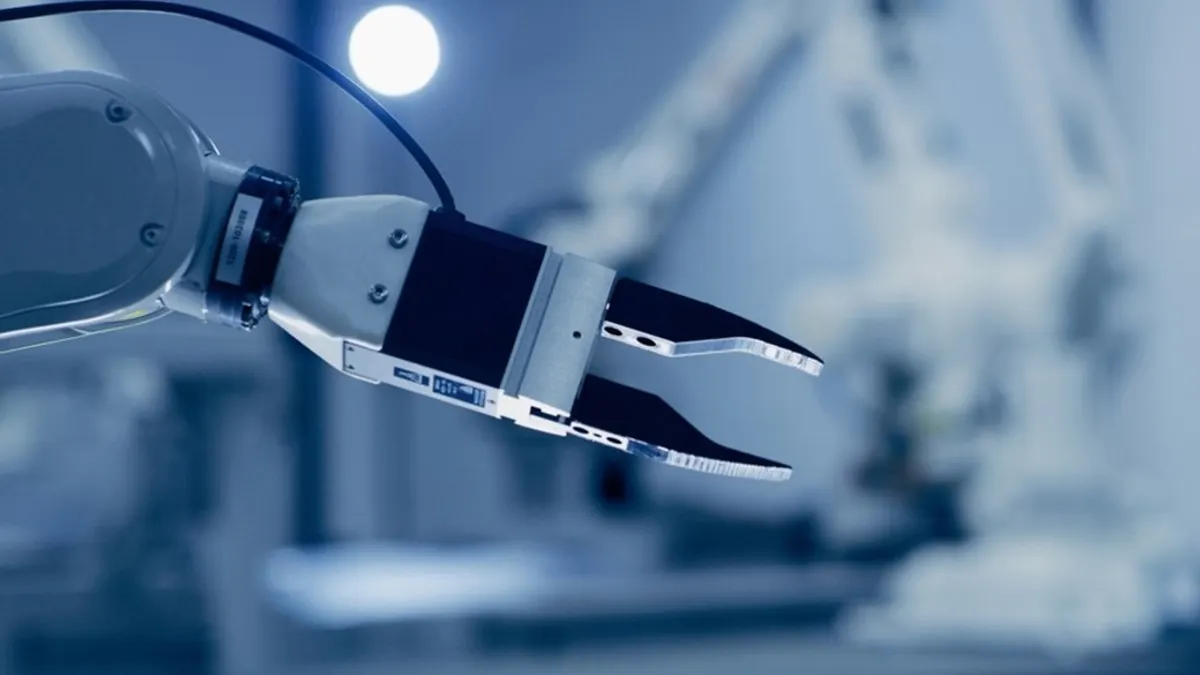

Physical AI is moving intelligence beyond the screen and into the world around us. By enabling machines to perceive, understand, decide and act, it is creating new possibilities across manufacturing, logistics, inspection, mobility and human-machine collaboration.
But when AI operates in the physical world, the rules change. A digital application may be able to tolerate a delay, a temporary loss of connectivity, or a request processed elsewhere. A robot often cannot. For physical AI, where intelligence runs can matter as much as the intelligence itself.
To make that challenge tangible, Capgemini and Intel have created a demonstration built around a deceptively simple task: teaching a robot to play the Tower of Hanoi. It shows how AI, conventional software and edge computing can work together as one complete system, locally and without an internet connection.
 The demonstration was be introduced for the first time at Intel’s booth AI Infra Summit 2026 in Santa Clara, September 15-17, 2026.
A simple game reveals a complex system
Dexterity, the demo, showcases a familiar puzzle, The Tower of Hanoi. A set of pieces must be moved between three pegs, one at a time, without placing a larger piece on a smaller one.
For a person, the rules are straightforward. For a robot, the task brings together multiple capabilities. The system must see the board, locate each piece, understand the current state, choose the next valid move and control the robotic arm. After every move, it must observe the board again and continue.
See > Understand > Decide > Act > Observe
This continuous loop sits at the heart of physical AI. The Tower of Hanoi makes it visible in a controlled setting where the rules, actions and outcomes are clear. The value is not simply seeing whether the robot completes the puzzle. It is understanding how the system works as a whole.
The right intelligence for each task
No single AI model runs the entire demonstration. Instead, the architecture brings together the technologies best suited to each part of the task.
- Computer vision identifies the location of the game pieces.
- Conventional software applies the rules and selects the next valid move.
- A vision language model adds contextual understanding of the physical scene.
- A vision language action model translates the selected move into actions for the robotic arm.
This division of responsibility is deliberate. Deterministic software is the right choice for some problems. AI is better suited to others. Physical AI becomes powerful when these capabilities work together, rather than when one model is expected to solve everything.
The result is a system that turns a visual observation into a physical action, checks the outcome and continues.
Why the edge matters
Sending every camera image to the cloud, waiting for a response and then instructing a robot to move would introduce latency and create a dependency on network connectivity. The demonstration avoids that dependency by keeping the process at the edge.
The Intel® Core™ Ultra 3 platform provides different compute resources for different workloads:
- CPU manages the application and conventional software.
- Integrated GPU runs the AI model responsible for robotic movement.
- NPU supports the model that interprets the scene.
Matching each workload to the most appropriate resource supports fast, consistent movement while allowing scene understanding to operate separately. The robot can perceive, reason and act without relying on a remote service.
From a capable model to a working robot
A model that performs well in development is not yet a complete physical AI system. It must also deliver the responsiveness, coordination and reliability the real-world application requires.
The vision language action model used in the demonstration was developed and trained in a high-performance AI environment, then deployed to the Intel Core Ultra 3 platform without retraining. Intel® OpenVINO™ provides the software foundation for moving the model from development into an optimized edge deployment.
Testing across the available compute resources showed that the integrated GPU delivered the responsiveness needed for robotic movement, while the NPU was well suited to the separate scene-understanding workload. The final architecture reflects the needs of the application, with each form of intelligence running where it makes the most sense.
Making physical AI easier to understand
When an AI system controls a physical machine, visibility matters. If the machine behaves unexpectedly, teams need to understand why.
The demonstration includes a live view of the camera feeds and AI outputs as the robot operates. Observers can see what the system sees and how that information contributes to each action.
This also makes failures easier to investigate. An unexpected move might begin with a misread scene, an incorrect state, an unsuitable action, or a physical constraint. Observability connects those steps, helping teams understand system behavior and improve performance.
Turning physical AI into practical impact
The move from digital AI to physical AI is not simply about putting more capable models into robots. It calls for a different approach to system design.
AI models must work alongside conventional software. Different forms of AI must work together. Compute resources must be matched to the workloads they support. And the complete system must operate reliably in the physical world.
The Tower of Hanoi demonstration brings those requirements to life. A camera observes. Software interprets. AI adds understanding and physical skills. The robot acts. Then the system checks the result and begins again, all locally at the edge.
Through their collaboration, Capgemini and Intel are showing how AI can move from generating information to understanding and interacting with the physical world. That is how physical AI becomes practical, observable and ready to create value in real operations.
Learn more about Capgemini and Intel partnership.
| Kevin Cloutier
Director of Innovation in Robotics and Physical AI Capgemini Engineering Kevin is an experienced engineering consultant and technical leader with 20+ years of experience in the design and development of embedded systems, robotics and physical AI. He specializes in helping organizations transform innovative ideas into robust, real-world products and solutions. His expertise spans systems engineering, embedded software, automation and cross-disciplinary technology teams. He has held technical leadership roles at notable global engineering and consulting firms, where he’s focused on enabling clients to solve complex problems and bring advanced technology concepts to market. He is known for combining deep engineering knowledge with a pragmatic approach to product delivery and innovation. |
 |