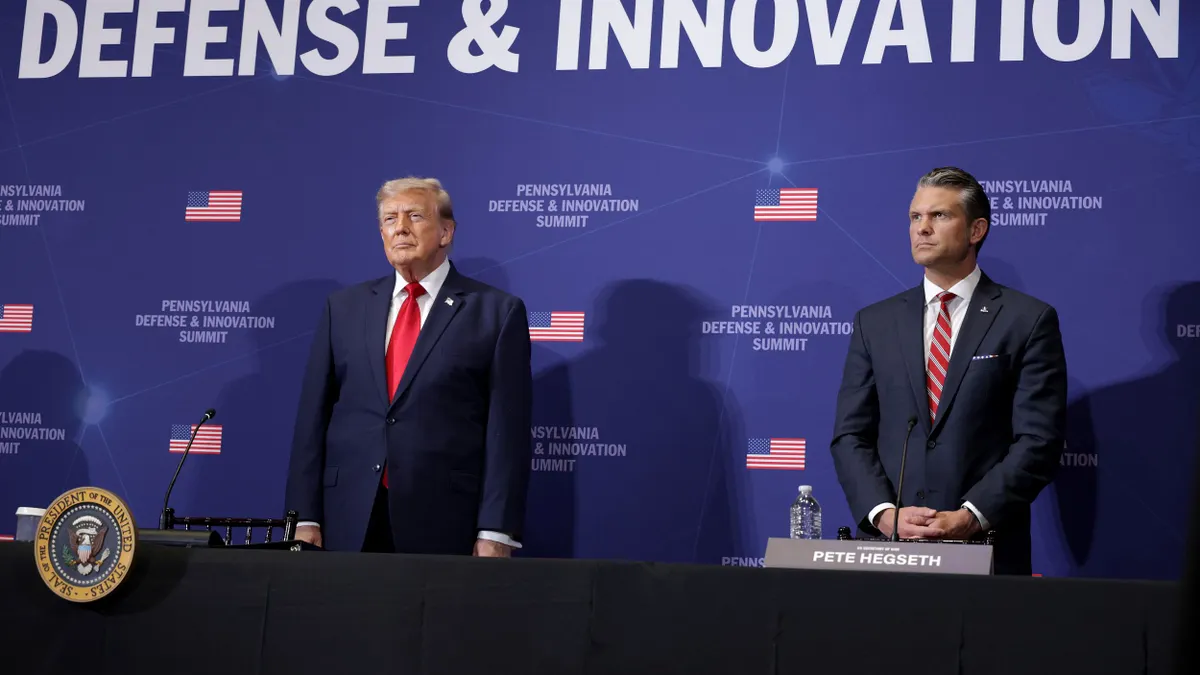
President Donald Trump signed an executive order on Monday limiting defense contractors’ waiver access to procure critical minerals and components from foreign entities of concern such as China, in a bid to safeguard domestic end-to-end supply chains.
Beginning Jan. 1, 2027, the defense secretary and military heads will stop issuing waivers for parts or critical minerals made or processed by those foreign entities.
Under a strategic materials law, the Department of Defense is prohibited from acquiring equipment such as aircraft, weapons, ships and tanks, containing components made from foreign entities of concern such as Russia.
The legislation also bans the DOD and defense contractors from using specialty metals not processed or made in the United States. In addition, the law allows the agency and military leaders to issue waivers to companies and their suppliers for parts or materials that are urgently needed for national security, limited sources or are hard to come by.
The order requires defense contractors to form a mitigation plan that identifies materials required by law without a waiver and document all efforts to obtain components covered by the legislation. They must also detail steps taken to remove non-compliant materials from their supply chains and establish a strict timeline to implement the plan.
In addition, contractors must describe every step of a component’s end-to-end supply chain process, tracing them back to the raw material’s origin, according to the directive. They must also conduct supply chain risk assessments and screen and vet all their suppliers and subcontractors, including financial challenges and materials or components made by foreign entities of concern.
The directive also requires defense companies to find alternative materials made or processed by the U.S. or allies. Failure to find an alternative may lead to contract modification or termination.
Defense companies that fail to find domestically sourced materials will not automatically receive a waiver, according to the order. However, a waiver could be issued if the contractor verifies the money spent on its ongoing efforts to identify domestically sourced materials in their supply chains.
If the DOD determines that a defense contractor committed fraud, misled the federal government or intentionally failed to implement its mitigation plan, the agency will take remedial steps. The DOD may also bring in the Department of Justice to investigate.
The DOD has about six months to submit a report to the national security advisor that includes measurements implemented and remedial actions taken by the companies, according to Trump’s mandate.
The defense agency will also have to review stockpile legislation before purchasing critical electronic devices and identify the domestic availability, if any, before deciding to issue a waiver.
Additionally, the DOD must establish and implement guidelines for mapping out the supply chain process as well as finding any vulnerabilities or bottlenecks in the supply network.
Trump accused defense companies in the order of not prioritizing domestic military equipment production, adding that critical minerals and components must also be sourced from allied nations. It’s one of the steps the president has taken to bring manufacturing and the supply chain back to the U.S.
The mandate mirrors a provision under the National Defense Authorization Act for fiscal year 2026 to strengthen domestic manufacturing and advance technologies across the U.S. defense industrial base. Under the NDAA, the DOD would be prohibited from purchasing batteries for weapons and support systems made with materials from foreign entities of concern, such as China or Russia, beginning Jan. 1, 2028.
Additionally, the DOD released its Acquisition Transformation Strategy in November 2025 that aims to increase and accelerate production capacity for key systems, weapons and munitions for the U.S. military and prioritize the country’s allies and partners.
The supply chain policy impacts
Some defense companies are cheering the Trump administration’s steps to domesticate the defense supply chain.
“Every year, they’re making it more and more difficult, which is good,” Brett Veliocovich, co-founder of drone maker Powerus, told Manufacturing Dive recently. “We got to get that back. Everyone needs a shock to the system to fix that in there.”
However, some think the directive will not change things immediately. The Aerospace Industries Association is working with the White House to reduce the U.S.’ reliance on “adversarial nations,” the trade group’s spokesperson said in a statement Monday. The AIA noted, however, that the mandate will “impede reaching these goals” as domestic sources either do not exist or the U.S. “lacks the capacity, scale, or purity requirements needed to meet demand.”
“There are more workable approaches that will advance supply chain security and avoid unnecessary disruptions on companies that support our national defense, equip our warfighters with critical capabilities, and meet national security requirements,” the AIA spokesperson said.
Still, the order does provide ways on how the White House is working to increase availability, Greg Williams, director of the Center for Defense Information at the Project On Government Oversight, told Manufacturing Dive Wednesday.
“But it's also placing a great deal of responsibility on the shoulders of the individual contractors to make those minerals available, and I'm not sure they have the capacity to do that,” Williams said. “And it’s also leaving in place a number of exceptions that I think will limit the effects of the executive order.”
Taking a component or mineral from certain foreign companies will affect price, quality and time, Williams said.
“And so, either we need to say we are going to have less powerful electric motors, or we’re going to accept shorter battery life in order to reduce our dependence on our potential adversaries,” he added.
Williams observed foreign governments such as Ukraine and Iran have had success in their defense industrial base because they have invested heavily in larger quantities of cheaper and simpler weapons.
“One of the reasons why these these exotic minerals are are so important is because our defense spending has been so heavily focused on so-called exquisite weapon systems that have very high cost and very high very high performance, and it may be that we need to put a greater focus on things that we can build more quickly and more easily at less expense and in greater quantities,” Williams said.
The order comes as DOD is requesting $1.5 trillion for fiscal year 2027 and during the Iran war, which is now costing $37.5 billion, Defense Secretary Pete Hegseth said at a senate appropriations committee hearing on Wednesday.
The military is getting everything they need “in spades and beyond,” Hegseth said.
“It’s ultimately looking into the future,” the Defense secretary said. “Can we invest above and beyond [on] the types of munitions fast enough, as we upgrade and modernize our force? That’s what's at issue here in this $1.5 trillion supplemental and any other additional funding that comes.”
Though, the funding increase won’t make service members safer, Williams noted. The conflict has also increased the deaths and injuries of active duty service members to 18 killed and 500 wounded, ABC News reported.
“[Hegseth] disavowed any notion that failure to provide supplementary funding or otherwise fulfill all of the spending requests that the Pentagon is making will have any effect on our military capacity in the context of Iran,” Williams said.
There is one waiver exception under the strategic materials law still in place that manufactuers can pivot to, and that’s for over-the-shelf products at DOD-backed on-base shopping facilities and nonappropriated federal entities, Williams noted.
“So, to the extent that manufacturers already are making or could make commercially off-the-shelf items that might be useful to the Department of Defense, that’s an avenue to success in that marketplace.”