Dive Brief:
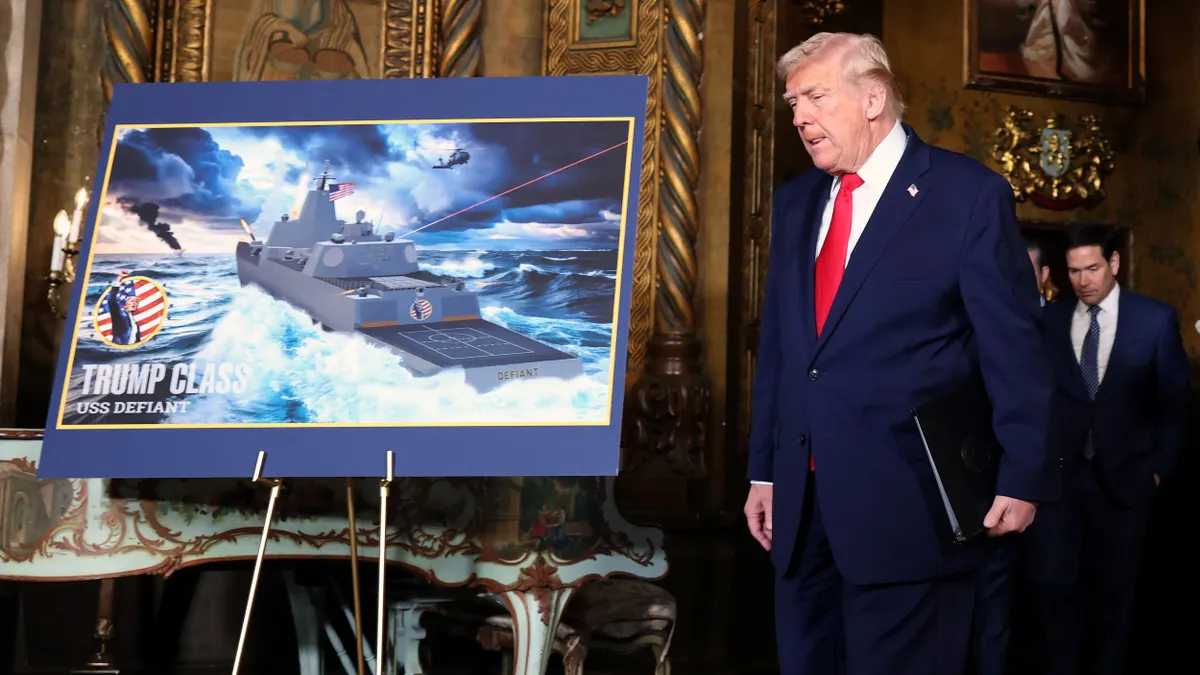
- President Donald Trump signed a memorandum of understanding Aug. 13 temporarily allowing foreign companies to construct up to two vessels in their parent countries’ shipyards to increase the U.S. Navy’s shipbuilding and repair capacity.
- The MOU also orders the Defense Department to seek more foreign direct investments in the U.S. shipbuilding industrial base derived from the “Finland Model.”
- The Finland Model builds on Trump’s October 2025 MOU, which issued a temporary measure authorizing Finland to supply four polar icebreaker Arctic Security Cutter vessels for the U.S. Coast Guard.
Dive Insight:
The MOU also orders DOD to replace the aircraft carrier-based Electromagnetic Aircraft Launch Systems and the Advanced Weapons Elevators with “traditional steam and hydraulic systems” during the construction of the aircraft carrier CVN 81, or the USS Doris Miller.
The U.S. Navy installed its first EMALS on the USS Gerald R. Ford about a decade ago and the innovation was certified for flight deck operations in 2022. China has become the second country to install similar electromagnetic catapults on aircraft carriers, and other countries reportedly are following suit.
Delivery date for the CVN 81 has recently been pushed from 2032 to 2034 due to “construction footprint restraints,” the U.S. Naval Institute News reported in May.
The president’s launch system preferences, which power and help maneuver ships, aim to resemble the systems used during World War II, The Washington Post reported Sunday. The advanced EALS is a carrier-based launch system designed for the CVN 78, or the USS Gerald R. Ford, and other CVNs being built, and has the same traditional steam catapult, according to the website. However, it uses stored “stored kinetic energy and solid-state electrical power conversion.”
The AWEs store and move weapons to the upper deck of the aircraft carrier.
The MOU also ordered DOD to establish a fifth Naval shipyard to increase domestic submarine and aircraft carrier repair capacity and establish a component repair center to hold, repair and refurbish components for major submarine programs. The Navy currently has four public shipyards located in Virginia, Hawai’i, Washington and New Hampshire.
Additionally, the agreement orders the agency to do a full review, reform and reorganization of the Naval Sea Systems Command due to the naval shipbuilding challenges.
The Trump administration and Congress have taken steps to fix the shipbuilding industry over the past couple of years. The president signed an executive order in April 2025 to rebuild the domestic maritime industry and workforce.
In February, the White House released more details on that rebuilding in its “America’s Maritime Action Plan,” which includes increasing domestic shipbuilding capacity, stimulating investments in U.S. shipyards and increasing supplier cooperation with allies and partners.
Trump’s plan also includes establishing “Maritime Prosperity Zones” to improve interagency coordination in a bid to draw domestic and allied investments in the U.S. maritime industries and waterfront communities.
The House bill of the National Defense Authorization Act for Fiscal Year 2027 has a section dedicated to the SHIPS for America Act that would stabilize the maritime supply chain, increase domestic shipbuilding and improve the workforce. The Senate will vote on the bill when lawmakers return from their August recess.
Some shipbuilding trade groups are not content with Trump’s strategy to build vessels overseas. While the passion to accelerate Navy shipbuilding is the “right instinct,” the speed “without sound judgment is not a strategy,” Matthew Paxton, president of the Shipbuilders Council of America, wrote in a July 21 op-ed.
“The Trump administration deserves credit for igniting this early U.S. shipbuilding turnaround,” Paxton said. “What we need now is continued investment in that direction — not a policy signal that suggests American production and workforce is a problem to be solved by going elsewhere.”
He also added that allied shipyards are not a “seamless substitute for American ones.”
“Military shipbuilding is not a commodity,” Paxton said. “It involves classified systems, advanced combat integration, and proprietary technologies that operate at the edge of what is legally and strategically permissible to share with foreign entities — even close allies. The liability exposure alone, should sensitive systems be compromised in a third-country yard, is significant and largely unquantified by proponents of this approach.”