Dive Brief:
- Stanley Black & Decker reported net sales of $4 billion in the second quarter, about the same as last year. The tools maker also benefited largely from tailwinds related to tariff refunds and the $1.8 billion divestiture of its aerospace manufacturing business in April.
- The New Britain, Connecticut-based company saw higher sales volumes of tools and outdoor products driven by U.S. retail, commercial and industrial channels. At the same time, net earnings more than tripled to $351.3 million over the second quarter last year, which included a tariff refund gain that boosted margins by 600 basis points to 33%.
- After completing the sale of its aerospace fasteners business early in the quarter, Stanley Black & Decker paid down its debt by $1.7 billion and repurchased 3.2 million shares valued at $250 million. The company also raised and tightened its 2026 financial guidance.
Dive Insight:
Stanley Black & Decker recognized a pre-tax gain of $118 million during the second quarter related to Phase 1 of the International Emergency Economic Powers Act tariff refund process. The company will “use tariff refunds to accelerate growth investments,” CEO Christopher Nelson said on an earnings call Monday.
U.S. Customs and Border Protection launched its system for IEEPA refunds in April after the Supreme Court invalidated the Trump administration’s tariffs in February. Stanley Black & Decker said it has also submitted claims for Phase 2 refunds.
The company excluded any unrealized, upcoming refunds from its 2026 guidance. The decision was due to uncertainty in timing and amounts, CFO Patrick Hallinan said on the call.
Stanley Black & Decker raised and tightened its adjusted full-year earnings per share to be in the range of $5.20 to $5.80, a projected 18% midpoint increase from the previous year. The company reported adjusted earnings of $357.9 million, or $2.36 per share, in the first half. Hallinan said full-year revenue will be in line with last year.
Regarding the administration’s latest Section 301 tariffs, which went into effect last week, Stanley Black & Decker expects to feel the impacts during the next few months at the same level as the previous IEEPA tariffs, Hallinan said. The sweeping 10% or 12.5% levy targets imports from more than 80 countries, citing forced labor practices.
The company also expects a temporary period of Section 122 tariffs, which were lower than IEEPA. This tariff tailwind is being offset by inflationary pressures from battery metals, tungsten and oil, Hallinan said.
If inflationary pressures remain persistent, “it appears more likely than not a price increase will be necessary by 2027,” he said.
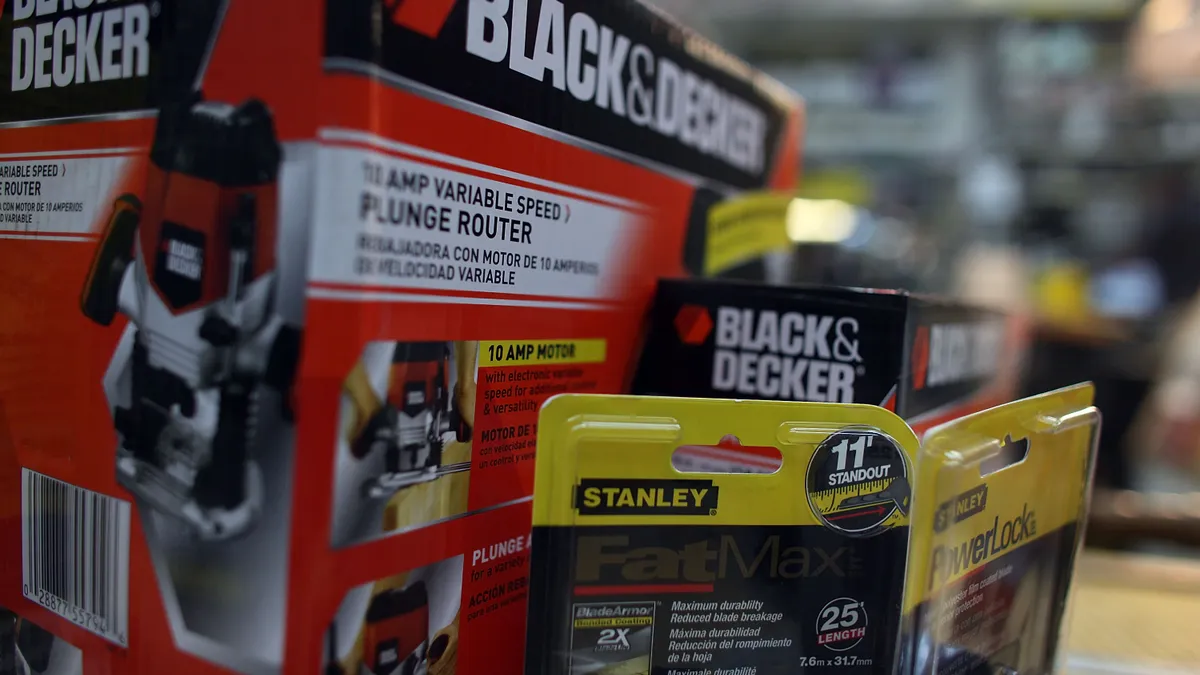
During the second quarter, Stanley Black & Decker’s tools and outdoors segment generated sales of $3.56 billion, up 3% over last year. This was driven largely by strong U.S. power tools demand from brands such as Dewalt, Craftsman and Stanley, according to the report.
The company’s engineered fastening segment saw sales decline 18% to $396 million year over year. This was driven largely by the divestiture of its aerospace manufacturing business to Howmet.
“Through disciplined execution of our strategy, we are delivering profitable organic growth and remain on track to achieve full-year sales and margin targets,” Nelson said. “We are confident in our strategy and in the team’s ability to continue to execute and deliver results.”