Dive Brief:
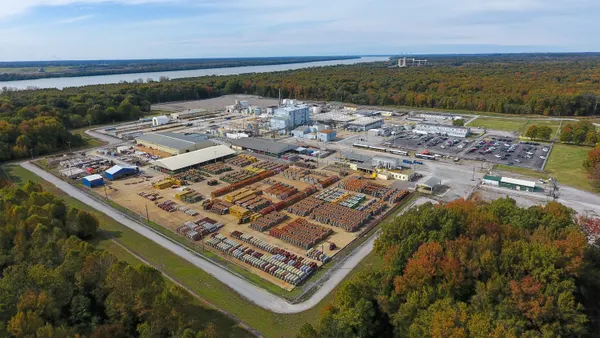
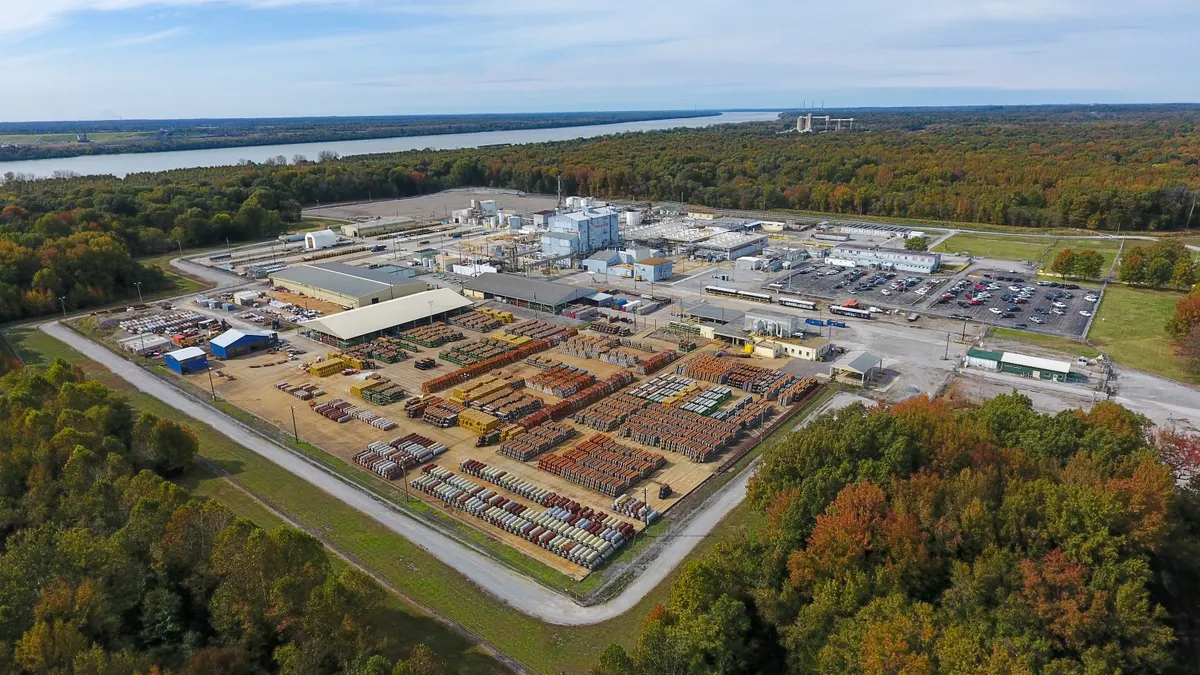
- Specialty chemicals manufacturer Solstice Advanced Materials is expanding uranium hexafluoride production at its facility in Metropolis, Illinois, this year, per a Feb. 11 press release.
- The capacity increase is projected to produce more than 10 kilotonnes of the radioactive substance used to manufacture fuel for nuclear power plants.
- Solstice has spent money on debottlenecking projects at the Metropolis facility since it restarted operations in 2023, resulting in yearly production increases, Jeff Dormo, senior vice president and general manager of refrigerants and applied solutions, said in an email. Dormo declined to disclose “specific investment figures.”
Dive Insight:
The expansion addresses Solstice’s backlog of more than $2 billion in orders through 2030 from long-term customers, many of which are domestic utility companies.
Additionally, the United States government aims to quadruple the country’s nuclear energy capacity by 2050 as part of a “nuclear renaissance.” In May 2025, President Donald Trump signed an executive order to increase nuclear fuel availability and production in the U.S.
Artificial intelligence, data centers and electrification of various industries are creating a surge in power demand that outpaces the global supply, estimating that potential investments in the nuclear value chain will increase to $2.2 trillion, according to an August 2025 Morgan Stanley Research report.
“With robust demand from our customers, Solstice is now actively evaluating further ways to expand our UF6 production to meet this demand, and we are having active discussions with customers about ways to remain their trusted supplier long term,” President and CEO David Sewell said during a Feb. 11 earnings call.
The company has also retained an engineering, procurement and construction company to oversee the engineering analysis for new capacity expansion investment, Sewell said.
The Metropolis plant operates under ConverDyn, a joint venture established in 1992 with defense contractor General Atomic and Honeywell.
The site is also the only commercial uranium conversion plant in the U.S., according to the Nuclear Regulatory Commission. The plant is backed by the Department of Energy and the agency has issued a license to the site that expires in 2060.
However, the facility has been operational since 1958, according to the ConverDyn website. The site remained operational but became idled between 2017 and 2023 due to “poor” market conditions.
During that time period, Honeywell, which co-owned the facility until it completed spinning off the chemical business under Solstice, took on business loans to maintain its customer commitments, Sewell said during the earnings call.
The last of the loan payments, approximately $30 million, is scheduled for the second half of 2026, limiting the amount of product Solstice can sell in the open market, Sewell said.
The Metropolis plant has also seen its share of environmental lawsuits since 2018, according to a November 2025 securities filing. The company settled eight lawsuits in 2024, accusing former site owner Honeywell of radiation exposures and causing cancer.
The company was also dealing with a lawsuit filed by the city of Metropolis and the county of Massac, Illinois, alleging radiation contamination, property damage within a 3-mile radius of the facility and one personal injury. The city and county are seeking damages, medical monitoring and injunctive relief.
Additionally, the Energy Department reached an agreement with Solstice, which the agency intends to provide “sufficient assurance” to continue the Metropolis facility's operations to support existing and future demand for uranium hexafluoride, including reimbursement for certain litigation costs.
Solstice has been expanding its footprint elsewhere in the U.S. as demand for AI and data centers grows. The specialty chemicals maker broke ground in December 2025 on a $200 million expansion and upgrade of its electronic materials facility in Spokane Valley, Washington. The company also announced plans in January to spend more than $220 million to expand production at its ballistic fiber manufacturing facility in Colonial Heights, Virginia.
Editor’s note: This story was updated to include a response from Solstice Advanced Materials.