Robots are coming to the factory and shop floors, but not all deployments go as planned. There are going to be technical mishaps, design challenges and other variables that emerge in practice regardless of how many tests were run, executives said.
“It’s always a little bit sad to plan for failure, but realistically … autonomy, hardware reliability, those are going to take a long time to get to even 99.9% reliable,” Oliver Ortlieb, co-founder and chief technology officer of Ultra Robotics, said during a panel discussion at New York Tech Week on June 4. He and other executives shared anecdotes with tech entrepreneurs and enthusiasts about bringing their robots from prototype to deployment.
“My view is that getting these systems to work for customers involves building systems that let you recover gracefully when there are failures,” Ortlieb said.
One time, he recalled, Ultra Robotics was working with a customer to build a sorting robot that picks up boxes and moves them to another location. The Brooklyn-based startup spent a couple weeks testing the system and “everything was perfect.” However, after the robot was installed at the customer’s site, it reached for the first package and the suction gripper “ripped the shipping label clean off,” Ortlieb said.
“Apparently, shipping labels take a while to actually stick to packages, and if you pull them up too hard, they’ll just pop right off,” he said. “We didn’t see this in the lab because we had boxes that had been labeled two, three, four weeks ago.”
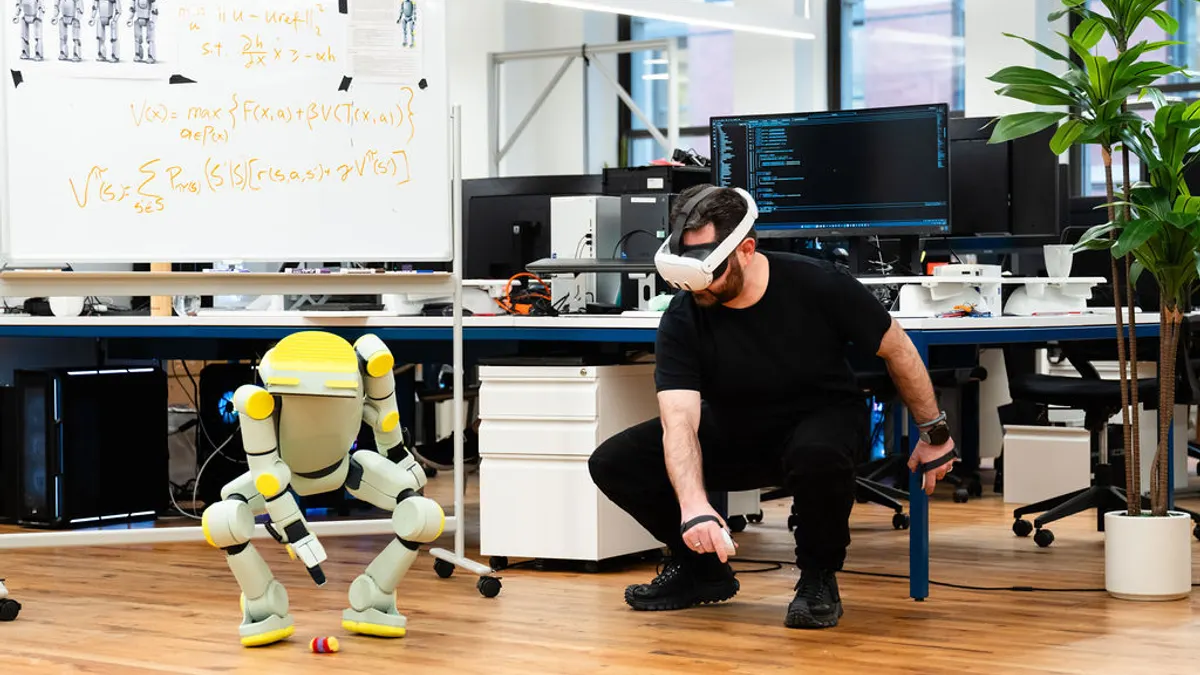
Sometimes what can work at one site, fails at another because of the flooring. Josh Merel, co-founder and CTO of Fauna Robotics, which was acquired by Amazon in March, said the startup had developed a policy using reinforcement learning for its robots to be able to get themselves off the ground and into position for their tasks. In robotics, a policy is a set of rules that tells a robot how to act in a given situation.
“It mostly worked across a bunch of different floor surfaces,” he said. But one of the offices had “extremely high friction, textured carpet,” which interfered with how the robot could get up and move around.
“That motivated us to go back to our office and buy a bunch of carpets” to understand which ones were “more adversarial” than others, Merel said.
Other lessons learned
From prototype to deployment, robotics startups iterate and improve their products along the way.
One of Ultra’s earliest robots was deployed without a KVM, or keyboard, video and mouse system, which meant the startup had to rely on the customer for specific resets, Ortlieb said. Now every robot the company ships out has one attached.
“It’s a very basic thing we didn’t pick up until we were trying to restart the computer,” Ortlieb said.
For Fauna, Merel recommended using batteries that are easy to ship. The startup has been able to travel on planes with their robots or put them in checked bags. However, in most cases, the flight won’t allow batteries.
“We have to mail the batteries and then pick them up elsewhere,” Merel said.
And for Standard Bots, the startup had run into a materials challenge with one of its customers. After the robot was installed, its IP rating had been breached multiple times, CEO Evan Beard said. Rubber-like seals prevent this from happening, but the “acidic compound” that the customer was using had eaten through and interfered with the robot.
“What they’re using, it totally just melts,” Beard said.
Deployment problem in the US
As robots become more technologically advanced and adopted for industrial use cases, deployment is still relatively low in the United States and affecting the country’s global manufacturing competitiveness.
Some parts can cost five to 10 times more to make in the U.S. compared to other countries, Beard said on the panel. He argued that robots should be used as a productivity booster to create a more level playing field.
In 2024, China installed 295,000 industrial robots — nearly nine times what the U.S. deployed that year, according to data from the International Federation of Robotics. Essentially, China is “installing more of the thing that makes them more competitive,” Beard said.
The disparity is partially due to U.S. companies being risk averse, Beard said. There are a lot of customers who either feel like they don’t really know robotics, and if they were to get a “robotics guy” to join the company it would be too expensive, he said. There are also concerns that if a customer’s orders change next month, affecting what they would have to make, they would have to call an integrator and pay more fees to ensure the robots are reoriented for the updated process.
“We’ve tried to make a product where you don’t need a manual, kind of like an iPhone,” Beard said. “You can just pick it up and understand it. It’s intuitive, and so the way we aim to do deployments is make the product really simple, so we can just mail the box and the customer can take it out and install it and do it that way.”