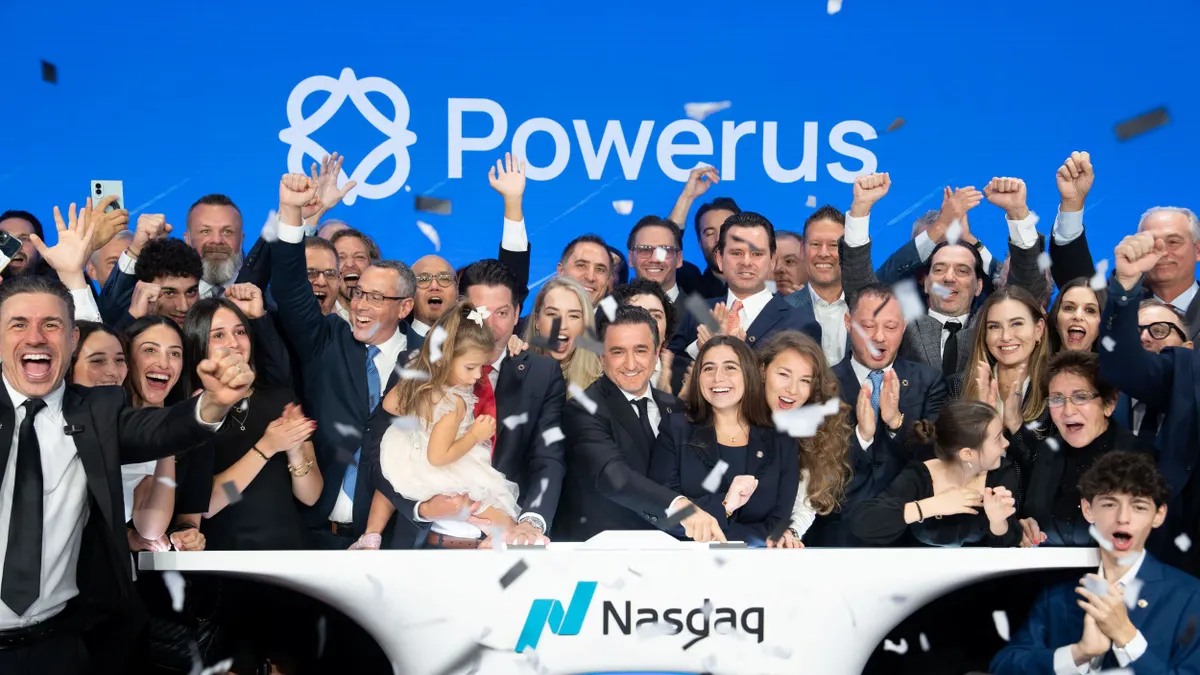
Oct. 1, 2026: Drone manufacturer Powerus and golf course company Aureus Greenway Holdings completed the merger on Thursday.
Powerus will be a new subsidiary of AGH as the surviving entity, while AGH adopted the drone maker’s company name, according to the press release. Shares will trade under Nasdaq under the PUSA symbol.
The deal is a “typical mechanism for doing a reverse merger as a public vehicle that already exists and is already strongly supported by investors, and so it works for us,” Powerus co-founder and U.S. Army veteran Brett Velicovich said in an interview with Manufacturing Dive over the summer.
March 12, 2026: President Donald Trump’s sons, Eric and Donald Jr. have invested in the merger of drone manufacturer Powerus and golf course company Aureus Greenway Holdings, the companies announced Monday.
Investors include drone maker Unusual Machines, for which Donald Jr. is a stakeholder and serves on Unusual Machines’ advisory board. Financial details were not disclosed.
Dominari Securities, a subsidiary of Dominari Holdings, acted as the placement agent for the stock share sale to investors. Trump’s sons have been serving on Dominari’s board of advisors since February 2025.
Powerus and AGH’s pending merger is the latest drone-related move the Trump brothers have backed.
Eric and Unusual Machines were part of a handful of investors backing the $1.5 billion merger agreement between drone manufacturer Xtend and real estate development and construction company JFB Construction Holdings. On Monday, JFB announced that Israel-based Xtend delivered its initial shipment of tactical drones to the Middle East and is rapidly scaling production.
Other investors involved with the Powerus and AGH merger include real estate and investment firm American Ventures and investment firm Agostinelli Group, which also backed the pending JFB and Xtend merger.
Under the definitive merger agreement, Powerus and AGH will combine to form a new subsidiary, Powerus Corp., to be publicly listed on the Nasdaq stock exchange under the ticker PUSA, according to the press release.
The merger, which is expected to close in the summer, will provide Powerus with a public-market platform to scale its operations and manufacturing capacity, CEO and chairman Andrew Fox said in an email.
Fox added that AGH brings the listed company structure “needed for the next stage of growth,” as the new subsidiary will focus on autonomous systems.
“Our strategy focuses on scaling through a distributed manufacturing model,” Fox said. “That includes expanding production capacity with U.S.-based manufacturing partners, improving throughput and equipment where necessary, and strengthening the supply chain required to deliver systems at scale.”
Powerus currently manufactures its drones in North Carolina and California, Fox said. The company also has a “strong relationship” in Ukraine, enabling Powerus to access additional product lines.
Brett Velicovich, Powerus COO and a former U.S. Army Special Operations intelligence analyst, told the Military Times he took U.S.-made defense technology with him to Ukraine after Russia invaded the country, where he spent over a year. The Fox News commentator said that much of the technology failed, particularly U.S. counter-drone systems.
As demand grows, Powerus will evaluate a combination of facility expansion, equipment upgrades and additional manufacturing partnerships, Fox said.
Meanwhile, AGH will continue to operate its two golf courses in Kissimmee, Florida, which Fox said serve as proving grounds for agricultural seeding and land-management drone applications. The golf courses give Powerus a “controlled, real-world environment to test, refine, and demonstrate its technology at scale,” he said.
AGH Interim CEO Matthew Saker said in the press release that Power gives the two companies an opportunity to expand manufacturing across two industrial economies, which Fox said are the United States and South Korea.
Seoul-based private equity firm Korea Climate and Governance Improvement Fund is one of Powerus’ backers and has committed to buying $50 million worth of Powerus stock by April 6. Meanwhile, AGH anticipates receiving aggregate gross proceeds of approximately $9.03 million.
Additionally, KCGI will support Powerus’ access to an “allied-nation” supply chain network to strengthen its domestic manufacturing position, moving the drone company away from depending on “non-allied” nations.
Powerus is looking to “fill a hole” in the drone manufacturing industry after the Federal Communications Commission banned foreign-made drones, the Wall Street Journal reported. The federal agency updated the covered list in December, claiming that relying on foreign-made drones threatens national security.
The FCC’s list aligns with President Trump's signing of an executive order in June 2025 to expedite domestic drone production, strengthen the supply chain and reduce U.S.’ reliance on foreign countries.
Other U.S. policies that aim to boost domestic drone production include updated manufacturing requirements under the National Defense Authorization Act for fiscal year 2026. Under the NDAA, the U.S. Department of Defense would be prohibited from purchasing batteries for weapons and support systems made with materials from foreign entities of concern, such as China or Russia, beginning Jan. 1, 2028.
Trump’s sons involvement raise concerns
Virginia Burger, a senior defense policy analyst at public policy nonprofit Project on Government Oversight and a former active-duty U.S. Marine Corps officer, said in an interview with Manufacturing Dive that the golf company is “essentially a front.” Merging the two companies avoids an initial public offering while still reaping the benefits of a publicly traded company.
“It’s sort of a cheaper way around that accountability to some degree and allows them to take a large stakeholder portion,” she said.
Burger added she would raise concerns about personal interests, conflicts of interest, and corruption of decisions. “If it’s not overtly illegal, it’s certainly questionable,” she said.
Greg Williams, POGO’s director of the Center for Defense Information, pointed out that the president and vice president are excluded from laws intended to eliminate conflicts of interest with other federal employees. One law prohibits federal employees, including staff under the president, from engaging in government affairs that could affect the financial interests of people with whom they have a particular relationship.
“We have, until the Trump administration, relied on a very strong norm that the president and the vice president nevertheless act as though those laws do apply to them,” Williams said in an interview with Manufacturing Dive. “And so it is completely without precedent that the current administration so pervasively not only permits but also leverages these kinds of conflicts of interest to enrich Trump’s own family members.”
“People make money from war, and it certainly seems like his sons are joining that club,” Burger said.