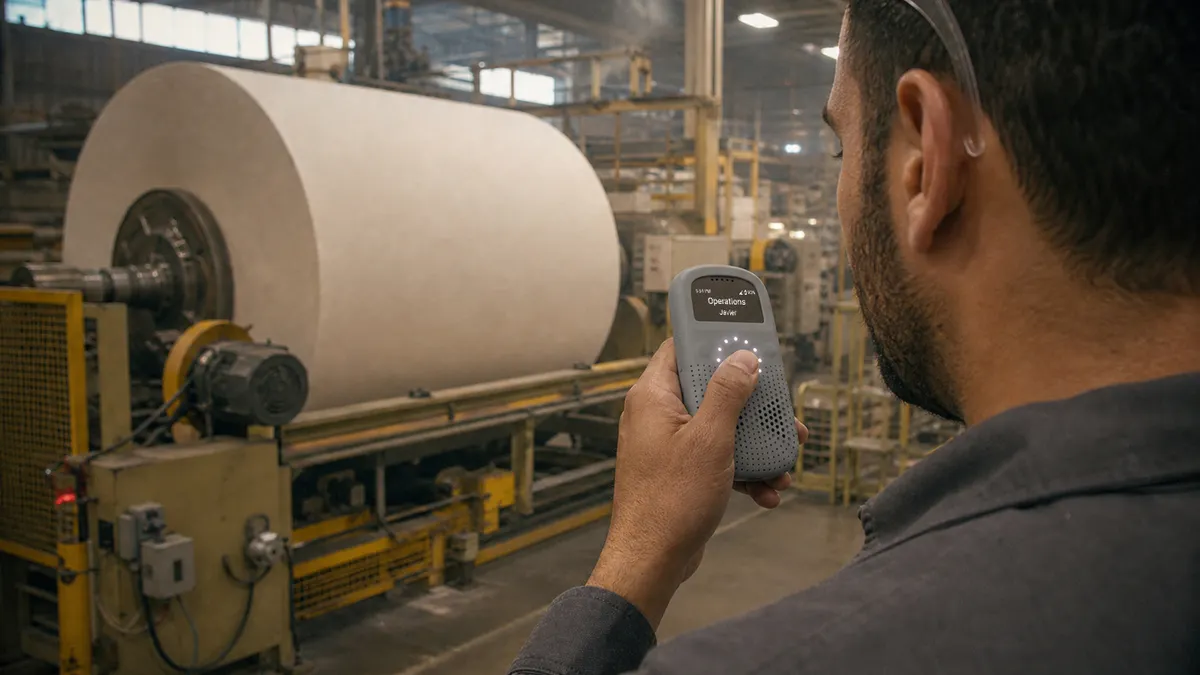

International Paper recently led a $36 million funding round for Relay, a Raleigh, North Carolina-based creator of smart radios for use in loud and rough industrial settings like manufacturing.
With transcription and translation capabilities, Relay seeks to address the evolving needs of paper mills and other sectors whose labor demographics are shifting. These include enabling more efficient communication for multilingual workforces and capturing employees’ patterns and insights, particularly as many reach retirement age and inherently take valuable system knowledge when they exit.
To implement these capacities, “radio was the best form factor because it is something that teams have used for 50 years, so they don't have to change anything,” said Houston Hawley, senior director of industrial sales at Relay, in an interview at Pack Expo. “But then you have this robust software cloud-based data intelligence and action layer that managerial teams and executives have access to.”
The radios can be used within or between sites, or far beyond, as they run on multiple major cellular networks.
Behind the investment
International Paper was first formally introduced to Relay by venture capital firm Touchdown Ventures, which became part of Cerity Partners. Workers at IP sites have largely been using bulkier analog radios, explained Jason Bailey, who is in charge of “box plant of the future” as IP’s program director for disruptive technologies. IP first tried Relay devices at a plant in Tampa, Florida.
IP saw promise with improved audio quality. “But the bigger opportunity that we saw was the fact that you can capture transcripts of conversations with the cloud-based radio,” Bailey said. Looking at the Tampa example, there are more than 4,000 conversation transmissions every day.
“Although we've been able to build in a lot of detection capabilities within our systems,” Bailey said, calling out technologies like digital twins and IoT, “we haven't been able to digitize the human voice and capture the voice of the operator.”
Using the Relay technology has been an opportunity to close that gap, he said. With more frontline information captured, “we can start to use other technologies to kind of summarize, provide insights and ultimately automate some systems just from the voice.”
Bailey said that while there’s extensive public discussion about artificial intelligence, it hasn’t necessarily made it into plants in an obvious way. But Relay is a subtle example of AI implementation at the plant level.
“When you look at something like Relay, you wouldn't necessarily think of it as an artificial intelligence, but it's backed by it,” he said. “Finding ways to provide capabilities that can then pull in some of these really higher-level technologies I think is going to be important. And that's an approach we like to take.”
Safety features are also a key selling point for Relay, whose devices feature a panic button. This year has spotlighted some of the more intense dangers that can occur working at paper mills, including an explosion at an IP site in North Carolina and the deadly tank implosion at Nippon Dynawave Packaging in Washington.
For safety and other reasons, “the benefits are huge and outweigh concerns with transcripts, typically,” Bailey said.
What’s next
It’s typical for IP to prove out products like these prior to investing, Bailey said, and Relay is a growing company.
“They have a good platform behind the product that will provide features that enable the radio to become something much more than the radio,” Bailey said. “It proved to work well in our operations, which are loud and require rigorous equipment. ... It made sense for us to become a shareowner in that business.”
When IP thinks about rolling out newer technologies, it aims to ensure that plants actually want the technology, Bailey said. “And then there is a point of time at which the demand becomes strong enough that it flips to a push, where it becomes obvious we need to roll this across as many locations as possible.”
More than 20 IP sites are now in the process of piloting or scaling Relay radios. “Our intention is to expand that, at least two or three times that, in the next couple of years,” Bailey said.
As Relay looks to scale with other paper and packaging customers, it’s also growing in automotive, hotels and other industries.
The recent fundraising round was also supported by investment firms Cerity, Harmonic Growth Partners, Thayer Investment Partners, G2 Venture Partners and Wind River Ventures, bringing Relay’s total capital raised to over $90 million, according to a Sept. 30 announcement.