Dive Brief:
- The Institute for Advanced Composites Manufacturing Innovation announced plans on Tuesday to expand two workforce development programs funded through the U.S. Department of Defense’s Office of Industrial Base Policy.
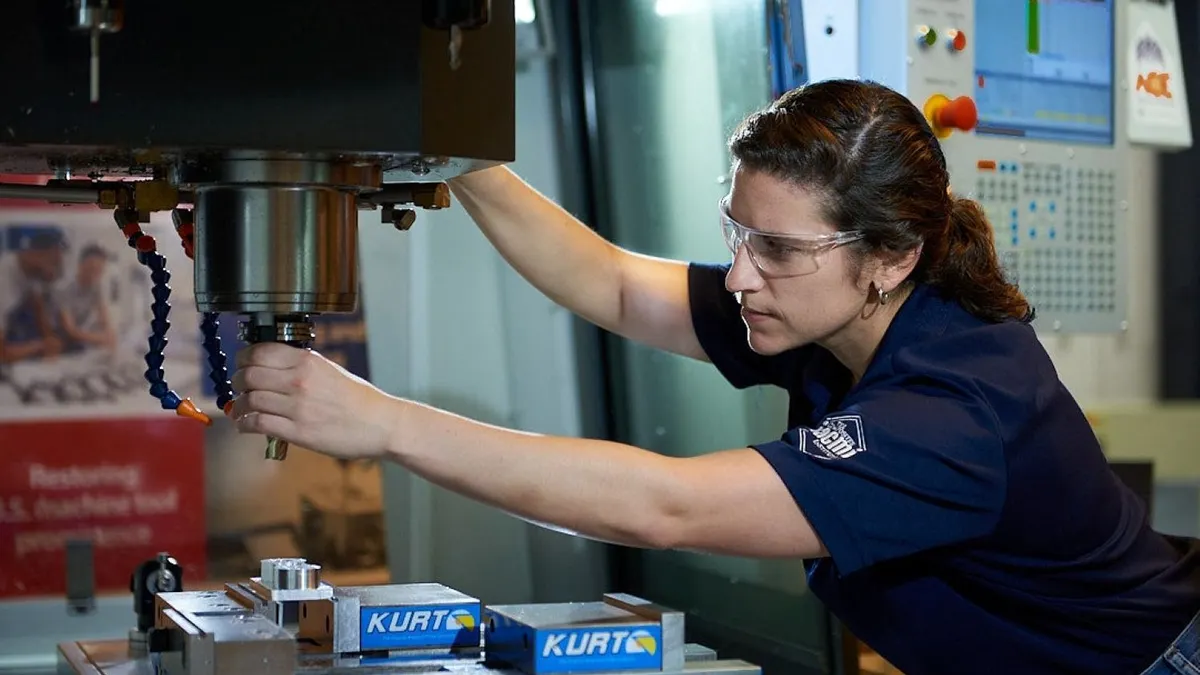
- America’s Cutting Edge, or ACE, is a computer numerical control machine training program. Metallurgical Engineering Trades Apprenticeships and Learning, or METAL, focuses on metallurgy casting and forging training.
- IACMI aims to establish ACE and METAL initiatives at 53 universities, colleges and trade schools by 2030, bringing a total of over 100 sites nationwide, according to the press release.
Dive Insight:
IACMI’s goal is to widen access to manufacturing training and support industries such as electric vehicles and aerospace.
The consortium will also introduce new initiatives to work with over 50,000 students, ranging from kindergarten through 12th grade, as well as provide internship opportunities.
“With this expansion, we seek to further promote awareness of manufacturing careers and provide greater access to training, enabling people everywhere to acquire the skills necessary to join the workforce rapidly,” IACMI CEO Chad Duty said in a statement.
IACMI’s other plans for the ACE program, which was founded in 2020, include implementing an internship program offering six- to eight-week placements connecting students with hands-on experience and industry career paths. Additionally, the internship program will be made available at every ACE site and training partner in IACMI’s consortium.
IACMI also plans to install a new curriculum dubbed ACE METAL Foundations, which will extend to kindergarten through 5th-grade classrooms.
For the METAL program, established in 2023, IACMI’s expansion plans include metallurgy forging bootcamps at other sites and increasing the number of apprenticeships and internships to more than 75 and 350, respectively.
IACMI will also deploy two METAL mobile training units, with one focused on K-12 and the other bringing the METAL bootcamp and learning opportunities to rural areas.
Cast and forged products are critical to the defense industry and are used in almost all platforms, most subcomponents and machine tools and other production equipment, according to a 2022 National Defense Industrial Association presentation. Between 1984 and 2018, the U.S. lost 1,600 foundries and more than 4,400 metal casting facilities, displacing more than 324,000 workers.
The facility closures also threaten the defense supply chain, according to the METAL website. The industry will need an additional 122,000 employees, including skilled tradespeople and engineers, by 2028.
Since its launch, the METAL program has trained about 2,000 people online, enrolled 98 pre-apprentices and apprentices and placed 41 interns throughout the universities and industry.
“Our dependency on foreign sources for essential materials poses a significant risk to our national security. METAL is our answer to this challenge, providing the necessary training and education to build a self-sustaining workforce,” the METAL website says.
IACMI was established in 2015 as the fifth Manufacturing USA institute, comprising 122 companies, nonprofits and universities led by the University of Tennessee-Knoxville. It was also the first to receive renewed funding from the Department of Energy in 2023.
Since its launch, the consortium has grown to more than 170 members and has provided more than 100 internships with industry leaders, according to a handout.
Furthermore, IACMI has provided more than 5,100 students with hands-on training and more than 12,400 students with online training across all 50 states.