Dive Brief:
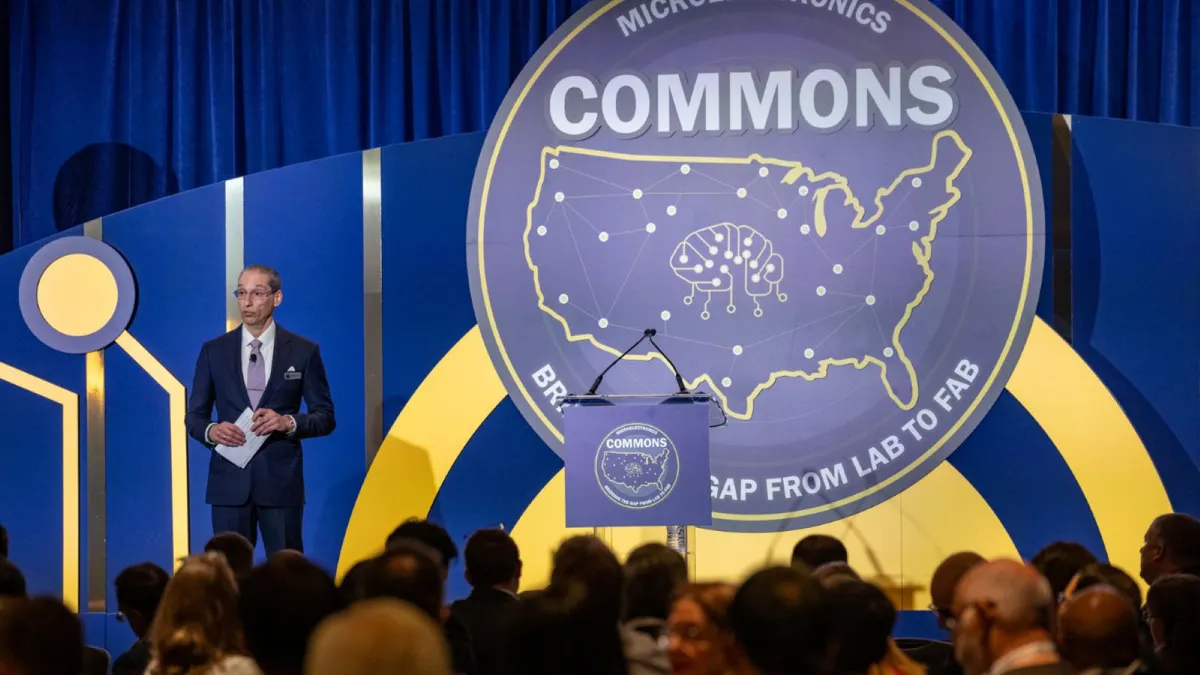
- The Department of Defense awarded more than $200 million in year-two awards to 26 projects across eight regional hubs under its research and development program, Microelectronics Commons, the National Security Technology Accelerator announced Tuesday.
- The awards were funded through the Naval Surface Warfare Center, Crane Division’s Other Transaction Authority contract vehicle, the Strategic and Spectrum Mission Advanced Resilient Systems Other Transaction Authority, or S2MARTS, according to the press release.
- The awards add to the initial funding of about $269 million that the projects received in 2024. The agency has posted a call for projects for year three on April 20.
Dive Insight:
The 26 projects have “demonstrated strong potential to accelerate and strengthen domestic prototyping capabilities,” NSTXL said in the press release.
Microelectronics Commons’ eight regional innovation hubs were established in September 2023 and are located in Massachusetts, Indiana, North Carolina, Arizona, Ohio, New York and California.
The program was established by the National Defense Authorization Act for Fiscal Year 2021 and was launched and initially funded by the CHIPS and Science Act in 2023. The CHIPS Act funding aimed to boost domestic manufacturing, supply chains and national security, per the press release.
The hubs focus on six main technical areas: 5G/6G, artificial intelligence hardware, commercial leap-ahead, electromagnetic warfare, secure edge/Internet of Things computing and quantum technology.
“Microelectronics are the backbone of our modern military,” Assistant Secretary of Defense Mike Dodd said in a statement. “This continued investment in the Microelectronics Commons Program is critical to ensuring that the United States maintains its competitive edge and that our warfighters have access to the most advanced technologies, securing our ‘Arsenal of Freedom’ for the future.”
Since the program’s inception, the Microelectronics Commons program has domestically fabricated more than 61,000 chips and has over 1,500 member organizations across 47 states, according to a March 4 NSTXL press release. The program has also advanced more than 220 technologies through its pipeline and raised $1.2 billion in matched non-CHIPS investment from industry, academia and partners.