

A new bill would amend the California Environmental Quality Act to narrow the existing CEQA exemption for advanced manufacturing, potentially adding significant new compliance costs.
SB 954, introduced by Sen. Catherine Blakespear, would increase the risk that companies delay advanced manufacturing projects, scale them back or move out of state, the California Manufacturing & Technology Association said in a press release.
The CEQA currently requires a lead agency to determine whether a project is exempt from CEQA, or if it must complete an initial study to determine if the project will have significant effects on the environment.
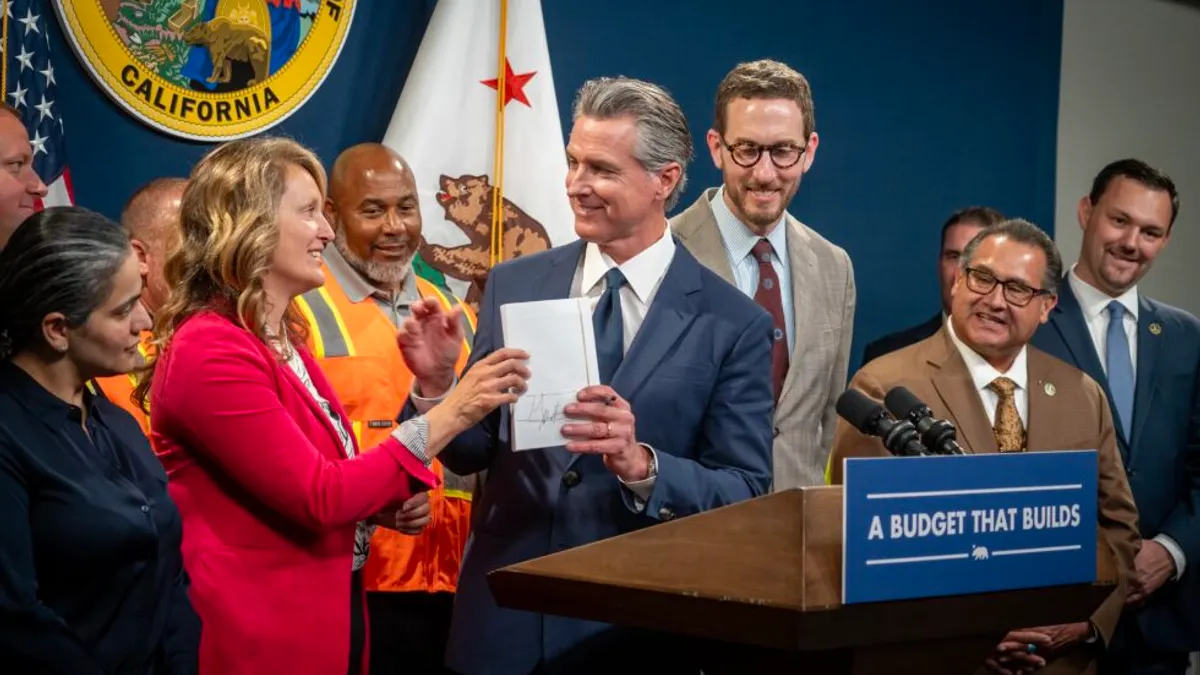
Last June, Gov. Gavin Newsome signed two bills that created new CEQA exemptions to streamline approvals for advanced manufacturing, as well as housing, childcare centers, clean water infrastructure and other projects. Both bills passed with strong support in the Assembly and Senate.
“These streamlined approvals will reduce costs and cut red tape for the projects Californians most need to secure an affordable and thriving future,” Sen. Scott Wiener, who introduced the Senate version of the bill, said in a press release at the time.
However, SB 954 seeks to narrow the CEQA exemption for advanced manufacturing by narrowing the scope of final tier facilities that would be eligible for the exemption. According to the bill, advanced manufacturing means “manufacturing processes that improve existing or create entirely new materials, products, and processes through the use of science, engineering, or information technologies, high-precision tools and methods, a high-performance workforce, and innovative business or organizational models” using specified technologies.
In addition, the bill provides that the exemption only applies if a project meets eight different criteria, such as using zero-emissions backup power generation and enforcing high labor standards.
The legislation would reverse last year’s progress in attracting advanced manufacturing to the state, according to the CMTA.
“California made a clear commitment to attract advanced manufacturing investment, and SB 954 sends the exact opposite message,” CMTA President and CEO Lance Hastings said in a statement. “Manufacturers need certainty. When the state adds new hurdles and changes the rules in such a short timeframe, companies will look to other states or countries where they can build faster and more affordably.”
“Building a facility in California already requires navigating complex environmental, safety, and local approvals that can take years to complete. In industries like clean energy and technology, those delays can determine whether a project is built in California or elsewhere,” the CMTA added.
SB 954 passed out of the Senate Environmental Quality Committee April 15 on a 5-2 vote and is scheduled for consideration by the Senate Labor, Public Employment and Retirement Committee on April 22.
Additional manufacturing-related bills
California has introduced several other bills that could impose additional regulatory costs on manufacturers, discourage them from investing in new technology, or otherwise hurt their businesses, the CMTA said. They include:
Introduced by Sen. Jerry McNerney, this bill would restrict use of automated decision systems in the workplace.
Introduced by Sen. Eloise Reyes, this bill would require 90 days’ advanced written notice before layoffs or contract terminations tied to automation or artificial intelligence technology. The bill would apply to layoffs or contract terminations affecting 25 or more workers or 25% of the workforce, whichever is less.
Introduced by Sen. Scott Wiener, this bill would authorize the California Attorney General to bring civil lawsuits against specified fossil fuel companies for climate-related damages. This would expose manufacturers to “significant liability and costly litigation for global emissions impacts beyond their control,” the CMTA said.
Also introduced by Wiener, this bill would allow agencies to include “offsetting benefits” of a regulation when determining whether it exceeds the $50 million economic impact threshold. According to the CMTA, this would make it easier for the state to justify “costly regulations.”
Introduced by Assemblymember Robert Garcia, this bill would allow the California Air Resources Board to impose new statewide emissions rules on facilities that attract truck traffic. Doing so would increase costs for manufacturers and distribution centers, the CMTA said.
Introduced by Assemblymember Damon Connolly, this bill would prohibit California’s “water’s-edge” election, which applies to corporations that operate in the state but also have foreign subsidiaries. According to the CMTA, eliminating this election would pull more foreign income into state tax calculations and increase taxes on manufacturers operating globally.
Introduced by Assemblymember Isaac Bryn, this bill would ban certain biometric monitoring tools and limit how manufacturers can use technology to ensure workplace safety and compliance. The legislation would create “operational and oversight challenges,” the CMTA said.
Introduced by Assemblymember Nick Schultz, this bill would require manufacturers to notify employees about AI tools used in job decisions and maintain detailed records about their use. It would create “new compliance responsibilities and liability,” according to the CMTA.