.jpg)
Pneumatics is the discipline that describes compressed air flow and how to use the properties of compressed air to transmit energy or convert the same into force and motion. Pneumatic applications use the most widely available resource—air. Pneumatic systems are integral to industrial automation and are especially useful when machines need linear motion or elastic behavior. They also offer a functional way to store energy for subsequent uses.
Pneumatic systems are clean, dependable, and simple to operate, and thus are widely used in the food & packaging, beverage & brewing, automotive, and pharmaceutical industries, to name a few. Pneumatic systems have good power density, low initial cost, and significant reliability. The only significant drawback is their low energy efficiency.
Because of this inherent inefficiency, compressed air is typically one of the most expensive forms of power transmission used in industry, so much so that it is often considered a "third utility." When viewed as an expensive utility, or process variable, proper management is required to minimize the environmental impact.
The duty cycle of any pneumatic machine includes the supply of the compressed air, the mechanical work done by actuators/drives, and air expansion that generates noise. Air expansion—treated as energy loss—has the following sources: leakage through holes and breaks in pneumatic lines, leakage through damaged or mismatched connectors, and internal leakage in directional control valves, linear and rotary actuators, etc.
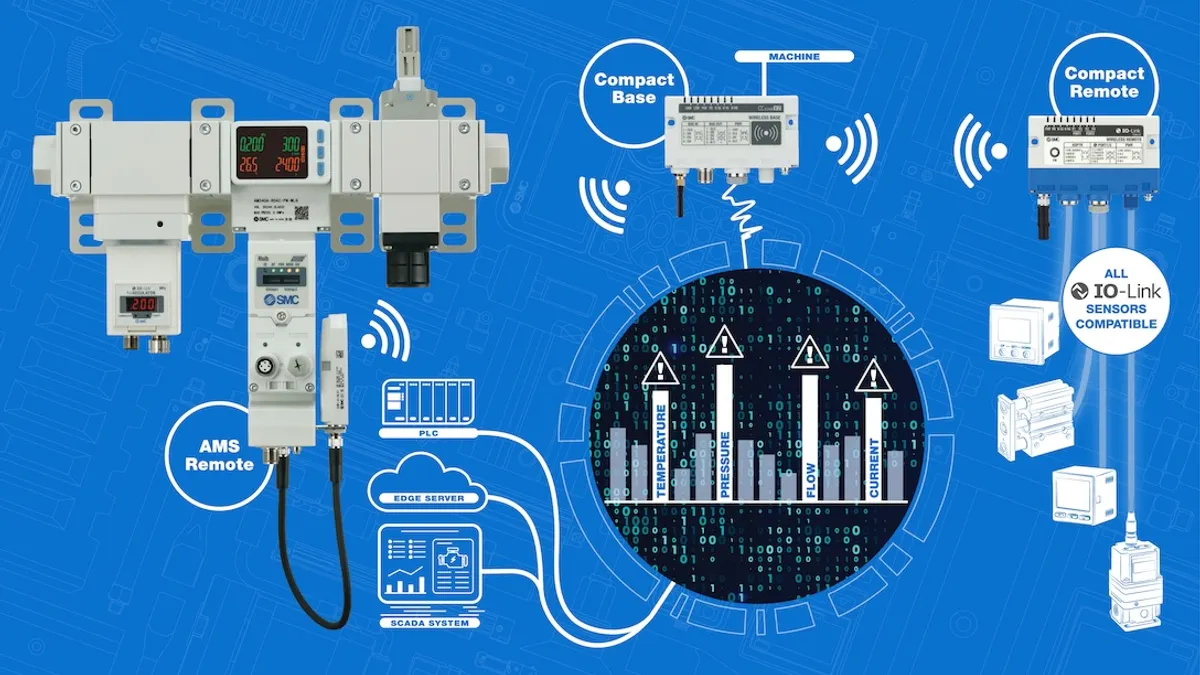
Measuring leaks and other forms of compressed air waste from pneumatically-driven machines is difficult due to the geometry of the leaking components, safety barriers around the machinery, and scheduling enough planned downtime on the machine to perform a leak survey, since planned production always takes precedence. Therefore, calculating the system efficiency is quite challenging, necessitating the use of measuring equipment, trained and skilled professionals, and calculations. The main objective of this paper is to propose a user-friendly method for determining, optimizing, and eventually eliminating compressed air waste, using an affordable and simple monitoring system, hereafter referred to as an Air Management System, or AMS.
It is a widely accepted truth in the pneumatic industry that most pneumatic component failures can be predicted by a leak. A byproduct of monitoring the key performance indicators (KPIs) of pneumatic system performance, namely pressure and flow, will result in improved reliability. Having the data available will assist a production facility in implementing a condition-based maintenance program. Condition-based maintenance (CBM) is a widely followed industrial management philosophy that aims to minimize the total cost of inspection, repairs, and replacements. This is achieved only by continuous monitoring of the operational condition of a critical component or asset.