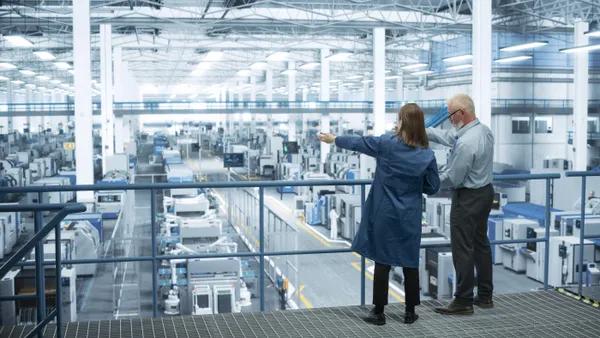

Manufacturers are finding it increasingly difficult to procure grid power for new factories or plant expansions. The problem isn’t just lengthy interconnection queues; it’s that electricity demand growth is outpacing supply growth. Experts predict that the U.S. electricity supply will fall short of anticipated peak demand within two years, and by 2030, demand could surpass supply by 175 GW — enough to power New York City twenty times over.
Even manufacturers that can power growth with the grid are quickly discovering they aren’t immune to the consequences of the supply-demand mismatch. Frequent grid outages, lower-quality power and less predictable pricing are driving up operational costs. For example, five hours of annual power outages (the average for grid customers in the US) could cost a 25 MW facility $4.4 million. For those operating sensitive equipment, harmonics, voltage sags and other power quality issues can cause equipment to trip offline, leading to tens of thousands of dollars in additional losses.
Onsite power solves all of these challenges. Also known as bring your own power (BYOP), this decentralized, distributed strategy for procuring electricity means manufacturers no longer have to rely solely on the grid for their primary or supplemental power. Rather, they can build their own power generation at or near the facility. BYOP is a proven approach that’s been successfully adopted by data centers and large industrial customers, such as Quanta Computer, Walmart and Ferrari.
There are several options for onsite power, and selecting the best technology is a critical, yet complex decision. What follows is a straightforward look at the available options, the tradeoffs that matter and why fuel cells consistently come out on top.
The most common onsite power solutions
Diesel generators and gas turbines
Diesel generators have long provided manufacturers with backup power during grid outages, but the technology is not viable as a facility’s primary or secondary power source. “Diesel generators are not meant for continuous operation,” said Kaushal Biligiri, Senior Energy Transition Champion at Bloom Energy. “Not only is it difficult to store enough fuel onsite to reliably power a manufacturing facility, but they also emit harmful pollutants and are noisy, which complicates the permitting process.”
Natural gas turbines share the same environmental and noise concerns as diesel generators, plus they have a large footprint and are generally cost-prohibitive for all but the largest manufacturing operations.
Solar and energy storage
Solar systems are attractive because they provide manufacturers with clean energy and are increasingly cost-effective. However, with five to seven acres needed to generate 1 MW of electricity, they require considerable space if they are to serve as a primary power source. “Then there’s the intermittency issue,” Biligiri said. “A large battery energy storage system must be connected to ensure manufacturers have the 24/7 reliability they need.” Scaling solar systems is also challenging, given the land requirements.
Fuel Cells
Fuel cells are a proven technology that uses natural gas, hydrogen, biogas or fuel blends to generate power via an electrochemical process. “Because fuel cells don’t burn the gas molecule, they convert it into electricity very efficiently and produce negligible emissions,” said Dan Degan, Enterprise Sales at Bloom Energy. “Plus, they use a minimal amount of water and operate silently, making them significantly easier to permit.”
Fuel cells also have a smaller footprint than other onsite power options — Bloom Energy fuel cell systems can deliver 100 MW on a single acre — and their modularity makes them easily scalable.
How to identify the right primary or supplemental onsite power solution
As you’re evaluating onsite power solutions for your manufacturing facility, here are some key questions to ask:
1. What’s the fuel source?
Consider the availability, reliability and emissions profile of that fuel source.
2. How reliable is the solution?
Ask about uptime rates, maintenance requirements and the ability to deliver clean, stable power.
3. What is the time to power?
Determine if the solution, including interconnection considerations and supply chain shortages, can deliver power when you need it. It’s also critical to understand how easily the solution can scale with your business.
5. Is the solution community-friendly?
Solutions that offer lower emissions, water use and noise pollution will ease community concerns, be easier to permit and will advance your organization’s sustainability goals.
6. What are the lifetime power costs?
Solutions that offer predictable costs and minimize exposure to price volatility make it easier to plan for the future.
Fuel cells are the reliable onsite power choice
When evaluating onsite power options, it quickly becomes clear why fuel cells are the solution of choice for manufacturers. Highly reliable, they can be configured to deliver up to five nines of uptime (99.999%) with just 9% overbuild and they produce minimal noise, emissions and water use. They also deliver high-quality, clean and stable power in months, not years.
Bloom Energy’s Solid Oxide Fuel Cell (SOFC) Energy Server® power systems are flexible solutions that can be deployed behind or in front of the meter through a variety of contracting models. Bloom’s SOFC systems provide ultra-resilient, highly scalable onsite electricity for Fortune 500 customers around the world, including data centers, large utilities and other commercial and industrial sectors.
To learn more, download Bloom Energy’s playbook “Onsite Power: A Decision Playbook for Manufacturers”. The playbook includes checklists for planning each key dimension of onsite power. Download it today to start planning your onsite power strategy.