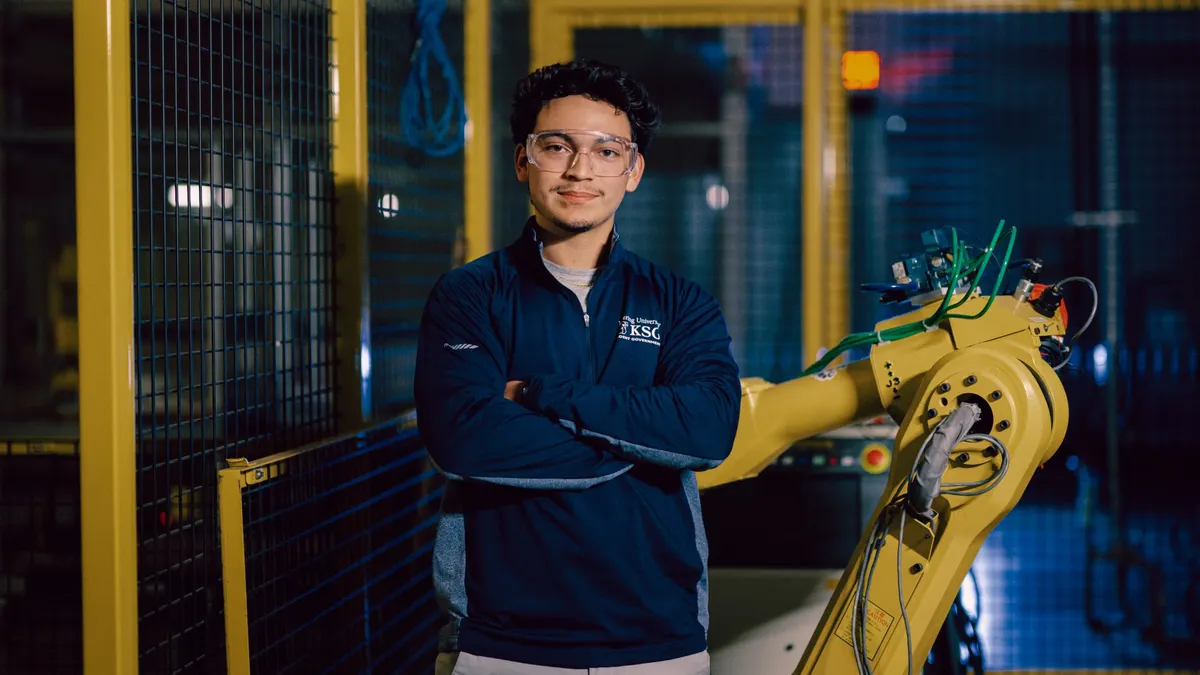

For many engineering students, impactful professional experiences can be few and far between. They land a summer internship and gain a useful introduction to a company, but by the time they encounter any responsibility or technical depth, the assignment is often over.
Kettering University graduate Christian Lopez '25 had a chance to take his experience further.
Through Kettering's Co-op program, he worked with BorgWarner and PHINIA, gaining experience across multiple engineering disciplines. His work eventually led to a proposal for a hydrogen injector production line that he presented to PHINIA engineering teams for consideration.
From Michigan to Europe
Lopez began at BorgWarner's technical center in Auburn Hills, Michigan, working in test engineering and validation. Over subsequent Co-op terms, his assignments included:
- Product and prototype engineering in Ithaca, New York
- Electric-vehicle battery cells, quality and industrial engineering in Hazel Park, Michigan
- Industrial engineering involving battery packs in Dearborn, Michigan
- Remanufacturing and CAD work in Troy, Michigan
"I was extremely grateful for this because I could see the automotive industry from various angles," he said. "Within America, I was able to work in different cities, states and see the differences between office work in technical centers and manufacturing work in production plants."
In winter 2024, his work shifted overseas. Lopez spent two Co-op terms in Blois, France, supporting hydrogen injector-related work. He also traveled to Iași, Romania and Izmir, Turkey for professional training with PHINIA.
"Working all over Europe allowed me to really step out of my comfort zone and experience life and work in a completely different culture," he said. "I moved to France knowing only basic words and phrases like 'merci' and 'bon appétit.' But by the end of my trip, I was immersed in learning the culture and language."
Overall, Lopez spent nine months in Europe. Beyond adapting to daily life in new countries, he gained experience working with colleagues across PHINIA's international operations.
"One of the biggest things I learned was how to communicate and connect with people from different parts of the world," he said. "PHINIA is a global company, and networking and working with different groups allowed me to broaden my horizons professionally and personally."
Designing for the whole system
In Luxembourg, where he also completed a Co-op assignment, Lopez developed a proposal to design and implement a hydrogen injector production line as part of his undergraduate thesis.
The work required more than laying out equipment. He had to determine how machines and labor would be arranged, estimate the total cost of the line and evaluate whether existing machinery could be reused. Each decision affected the others, forcing him to consider production, efficiency, labor and cost as parts of the same system.
"I was not only proud of the work I had completed, but also grateful for the opportunity to present my work for consideration," Lopez said. "I can eventually see my work come to fruition in years to come."
The thesis also connected his academic work with the engineering problems he was being asked to solve. He drew on coursework in Lean Work Design, Lean Six Sigma and Supply Chain to address the practical challenges of designing a production line.
"My time at Kettering has allowed me to take what I have learned in the classroom and apply it to real-world applications in the workplace," he said. "Now, I know that because of my experiences working for PHINIA, I can speak on my strengths as an employee and that I can provide valuable work to my company in any setting."
At Kettering University, Co-op is built into the academic experience. Students alternate between classroom study and paid professional assignments, returning to industry with new knowledge and taking on increasingly complex responsibilities. By graduation, they can accumulate as much as two and a half years of professional experience.
Learn more about Kettering University's Co-op program.