

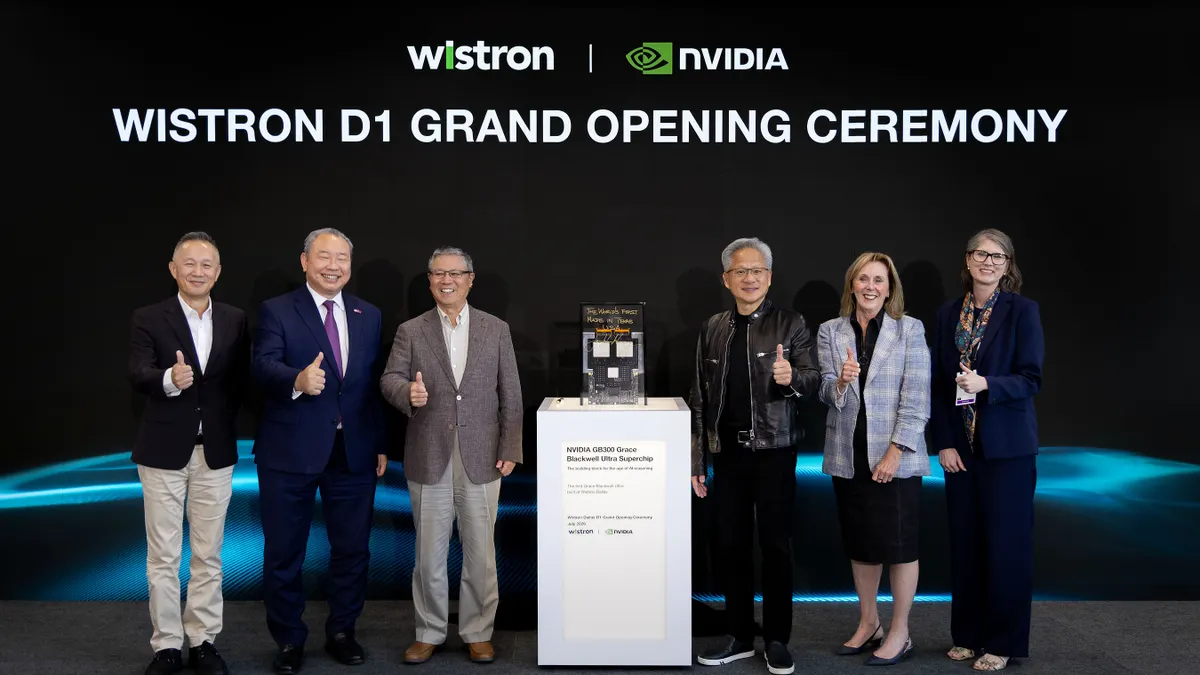
Taiwan-based electronics maker Wistron on Tuesday announced the opening of its first U.S. manufacturing plant in Fort Worth, Texas, which will produce Nvidia “superchips” geared toward powering artificial intelligence applications.
The $700 million, 324,000-acre facility is “a key hub in Wistron's global AI infrastructure manufacturing network” and “strengthens a critical upstream layer” of the company’s AI infrastructure supply chain by expanding its ability to assemble and test Nvidia AI systems in the U.S., according to a news release.
The Fort Worth plant will “serve as the core engine of Wistron's U.S. manufacturing operations, connecting its global production network with ecosystem partners as it scales advanced AI manufacturing,” the company said.
Nvidia said in a news release that the plant has already created 500 new jobs, with plans to expand to 1,000 by the end of the year.
“Manufacturing is an essential pillar for every economy and every country,” Nvidia founder and CEO Jenson Huang said in a statement. “Building chip plants, packaging plants, computer system plants like this, and AI factories all over the United States, has allowed the United States to really reindustrialize for the first time in a long time.”
According to Wistron, the new facility runs on Nvidia accelerated computing and integrates Nvidia’s Nemotron and Cosmos open frontier models, as well as its Omniverse and Metropolis libraries. The facility uses “digital twin technology to optimize factory design, production workflows, and operational efficiency,” Wistron said.
“The operation here is not typical manufacturing,” Wistron Chairman Simon Lin said in a statement. “It is new, very comprehensive, and high-tech.”
The facility currently produces the Nvidia GB300 Grace Blackwell Ultra Superchip and will soon produce the Nvidia Vera Rubin Superchip. Both are “critical to powering the next generation of AI computing,” per the news release.
“In the next couple of years, this location will be one of the most important, as we build AI infrastructure here in the United States,” Lin said. “I think this is the reason we say that there will be the next chapter, and we are going to empower AI from Texas.”
Last month, Wistron said it was using Nvidia’s Omniverse DSX blueprint and physical AI technology to enhance AI smart manufacturing technology across its global manufacturing sites, including Taiwan and the U.S. “This initiative comprehensively connects the entire AI server manufacturing process—from initial planning and design to final mass production—ushering in a new era of smart manufacturing,” the company said.
Wistron also announced in June that it had deployed Nvidia’s Cosmos open world foundation models to power AI-driven quality inspection in certain production lines. In addition, the company said it was partnering with Nvidia to build an intelligent factory platform to enhance smart manufacturing.
The partnership with Wistron is only one of Nvidia’s efforts to expand its presence in AI. In May, Nvidia and ABB Robotics announced they were teaming up to help manufacturers deploy industrial robots and physical AI more safely and efficiently.
Last March, General Motors and Nvidia expanded their partnership to deploy AI-powered technology in the automaker’s next-generation vehicles and across production facilities.