Dive Brief:
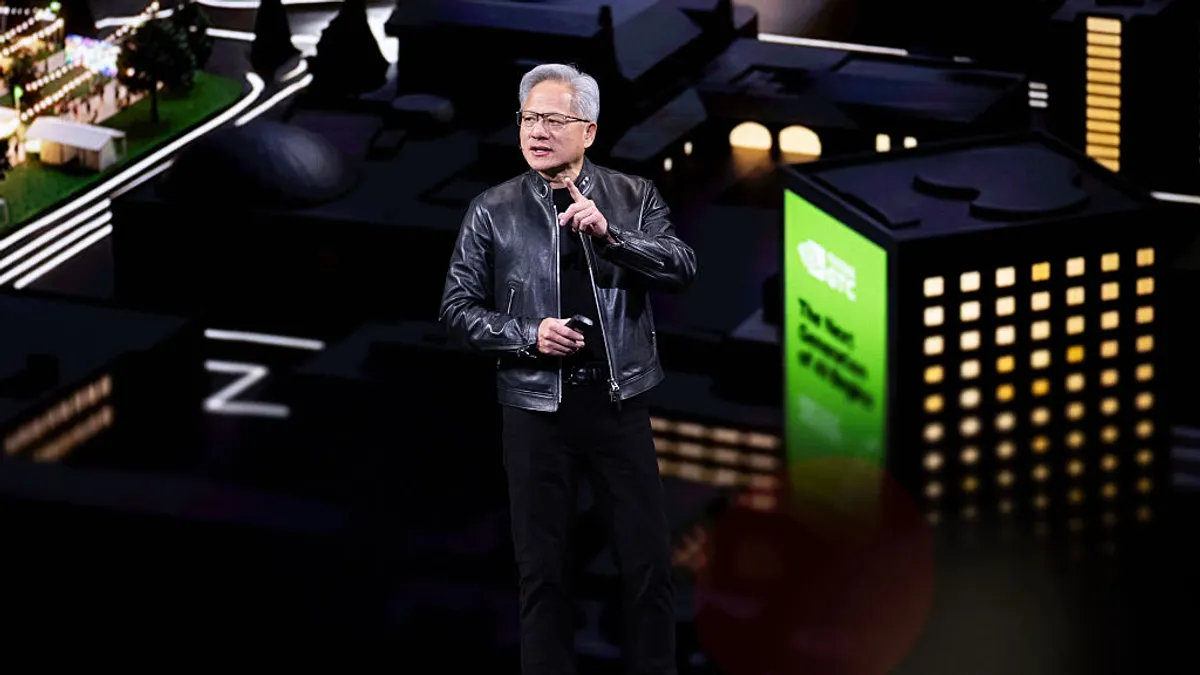
- Nvidia on Monday introduced its latest models and frameworks designed to help the world’s leading robotics companies scale physical artificial intelligence beyond experimentation to real industrial applications at its 2026 GTC conference in San Jose, California.
- The technology giant is rolling out its new Isaac simulation frameworks, as well as its Cosmos and Gr00t open models for the industry to develop, train and deploy the next generation of intelligent robotics.
- Industrial leaders such as ABB Robotics, Fanuc and Yaskawa are integrating Nvidia Omniverse libraries and Isaac simulation frameworks into their systems to validate robots and production lines using digital twins.
Dive Insight:
Nvidia, originally known for its gaming graphics cards, has become the poster child of the AI boom in recent years. In October, the technology giant’s market valuation surpassed $5 trillion, Reuters reported. Its success has been driven by surging demand for premium graphics processing units that power data centers used largely for storage and AI factories, which are built specifically to run AI models.
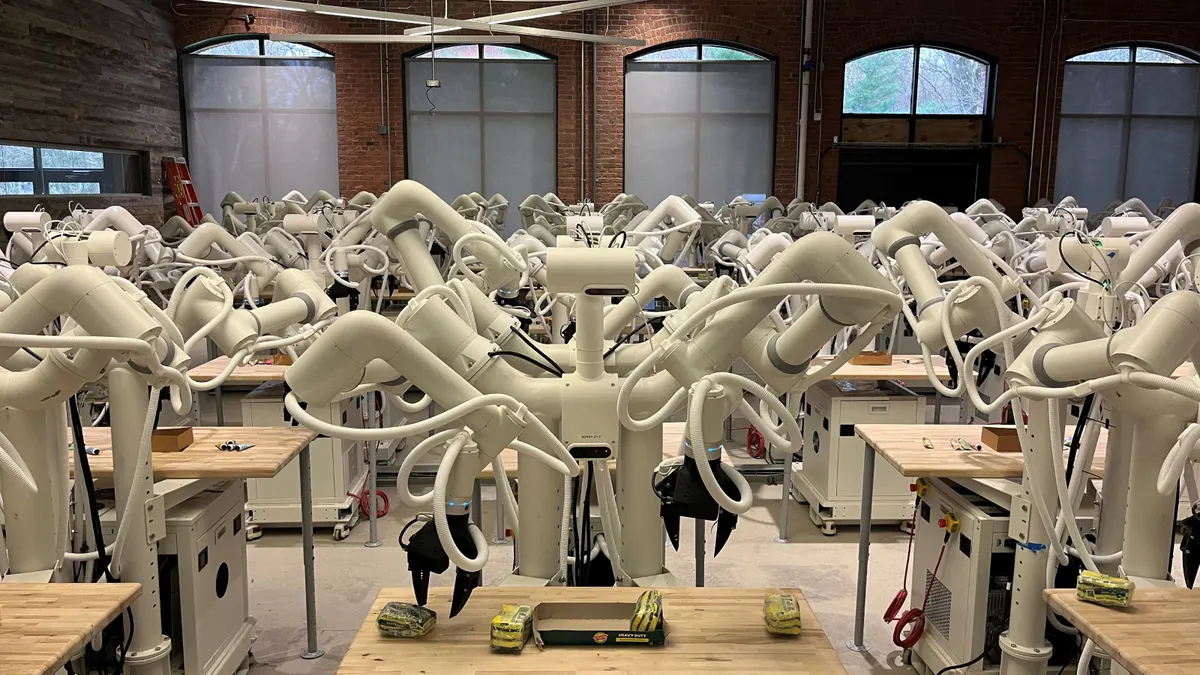
In addition to chips, the company is also expanding its influence in the physical AI space as manufacturers look to make their workflows and production lines more efficient through automation and robotics. As industrial robotics become more AI-driven, manufacturers are looking for software that can accurately emulate what will happen on the shop floor before deployment, according to Nvidia. Developers are leveraging Nvidia’s Omniverse libraries and Cosmos to create more physically accurate simulations, as well as Gr00t to give robots a “human-like” brain.
“NVIDIA’s full-stack platform — spanning computing, open models and software frameworks — is the foundation for the robotics industry, uniting a worldwide ecosystem to build the intelligent machines that will power the next generation of factories, logistics, transportation and infrastructure,” CEO and founder Jensen Huang said in a statement.
Some of the leading robotics companies are using Nvidia’s software to support enhanced simulation, digital twin and sensor processing capabilities, including European-based Universal Robots and Kuka.
“We’re working with them to implement our physical AI models [and] integrate into simulation systems so that we could deploy these robots into manufacturing lines all over,” Huang said Monday during his keynote presentation at GTC.
U.S. developers Field AI and Skild AI are both using Nvidia’s models and frameworks to build robot brains for accelerated training. Pittsburgh-based Skild AI is working with ABB Robotics and Universal Robots to deploy its robot intelligence across different industries, according to a news release. It is also partnering with contract manufacturer Foxconn to enhance its production of electronic devices such as iPhones and Nintendo consoles.
Workr, marketed as a “robotic workforce company,” is leveraging Nvidia’s Omniverse libraries to train robots that can be deployed by small- and medium-sized manufacturers in minutes without programming knowledge. It is also integrating its AI platform ABB Robotics.
Other technology companies, such as Microsoft and Google, are leveraging Nvidia technology to develop their own models and lay the groundwork for physical AI applications. Manufacturers are projected to more than double their use of AI and automation by 2030, according to a recent PwC survey. One of the biggest hurdles for them to overcome is getting their workforce trained and ready for the transition.
Eventually, Huang said, “every industrial company will become a robotics company.”