Dive Brief:
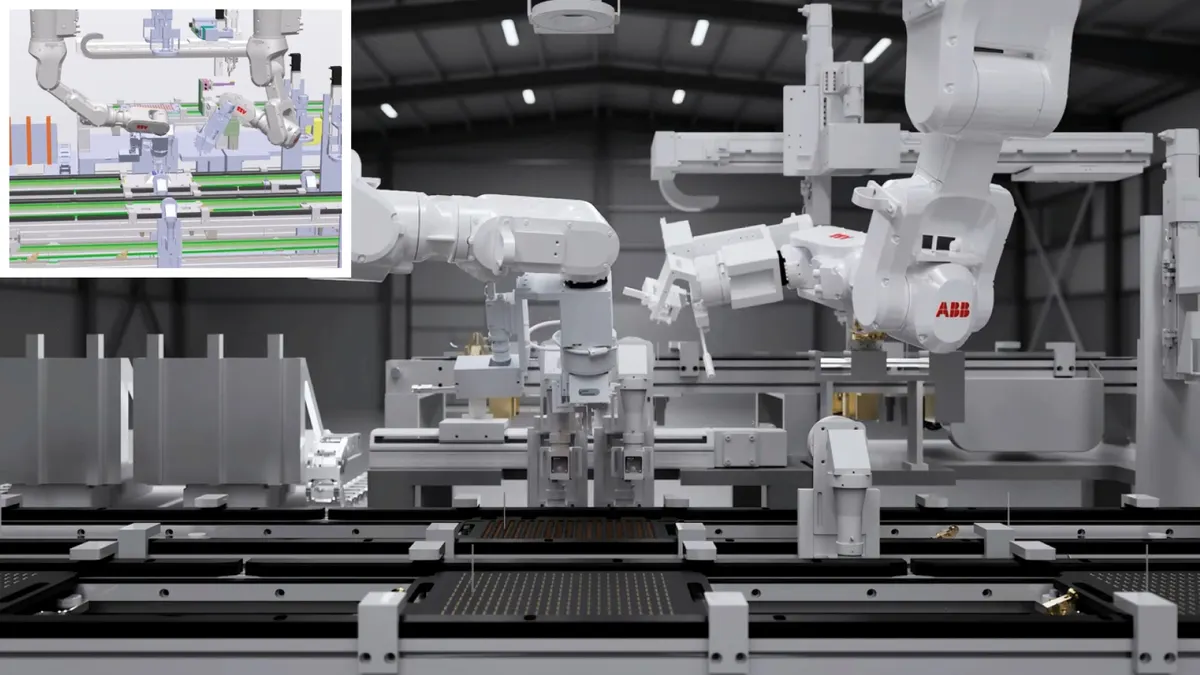
- ABB Robotics and Nvidia are combining their simulation technology in an effort to help manufacturers deploy industrial robots more efficiently across their operations.
- The partners on Monday said they have integrated Nvidia’s Omniverse libraries into ABB Robotics’ existing software, design and simulation platform, RobotStudio, allowing for physically realistic simulations with up to 99% accuracy.
- The collaboration is designed to close the gap between what can be safely tested in a simulation versus what unfolds on the factory floor, reducing costs and quickening time to market.
Dive Insight:
The robotics industry has been constrained by what some call the “sim-to-real” gap, or the discrepancy between simulated testing and real-world applications. For decades, manufacturers have struggled to replicate certain conditions, such as shadows, textures and materials, slowing product innovation and research and development, ABB president Marc Segura said in a press conference Monday.
Nvidia’s accelerated computing is expected to bridge this gap for developers, allowing them to accurately train and test their industrial robotics before shop floor deployment.
“Instead of needing thousands of physical test runs, prototype and expensive parts, robots can see and learn and understand inside a simulation that then translates perfectly into the real world and match precision in both virtual and physical world,” Segura said.
This upgraded software, called RobotStudio HyperReality, is expected to eliminate the need for physical prototypes, cutting setup and commissioning times, as well as reducing costs by up to 40%. It is also expected to accelerate time-to-market for complex products by 50%.
Foxconn, the world’s largest electronics contract manufacturer, is piloting the program to virtually train its assembly robots and find ways to optimize its production lines.
More than 60,000 customers use ABB Robotics’ RobotStudio. The new software is expected to be commercially available in the second half of 2026.
“Precision is everything in consumer electronics manufacturing and until now, this level of accuracy and fidelity just wasn’t possible in simulation and digital twins,” Zhe Chi, Foxconn’s chief digital officer, said in a statement.
In recent years, Nvidia has established partnerships with a growing network of manufacturers to drive industrial automation and simulation with its Omniverse platform, including Hyundai Motor Group, Siemens, Samsung Electronics and others.
Last week, Samsung Electronics announced its strategy to transition all manufacturing operations into “AI-driven factories” by 2030. It plans to leverage digital twin-based simulations, use AI agents to optimize workflows and introduce humanoid and task-specific robots across production lines. The company debuted its strategy at MWC 2026 in Barcelona, about six months after expanding its partnership with Nvidia.
“The next phase of manufacturing innovation lies in building autonomous environments where AI truly understands operational contexts in real time and independently executes optimal decisions,” YoungSoo Lee, EVP and head of global technology research at Samsung Electronics, said in a statement.
Professional services firm Deloitte has also partnered with Nvidia and its Omniverse libraries to create physical AI solutions. In a recent survey conducted by Deloitte, about 58% of companies reported already using physical AI to some extent, with adoption expected to hit 80% within two years.