Robots are rebounding in the United States, driven by increased installations across food production and non-manufacturing areas such as warehousing and logistics, according to the International Federation of Robotics.
Installations grew 11% to reach 38,000 units across the nation as more sectors deploy materials handling, mobile and industrial arm robotics, IFR’s preliminary 2025 data shows. This came after two years of consecutive declines for the U.S. Last year also marked the third strongest on record for the U.S., behind 2018 and 2022.
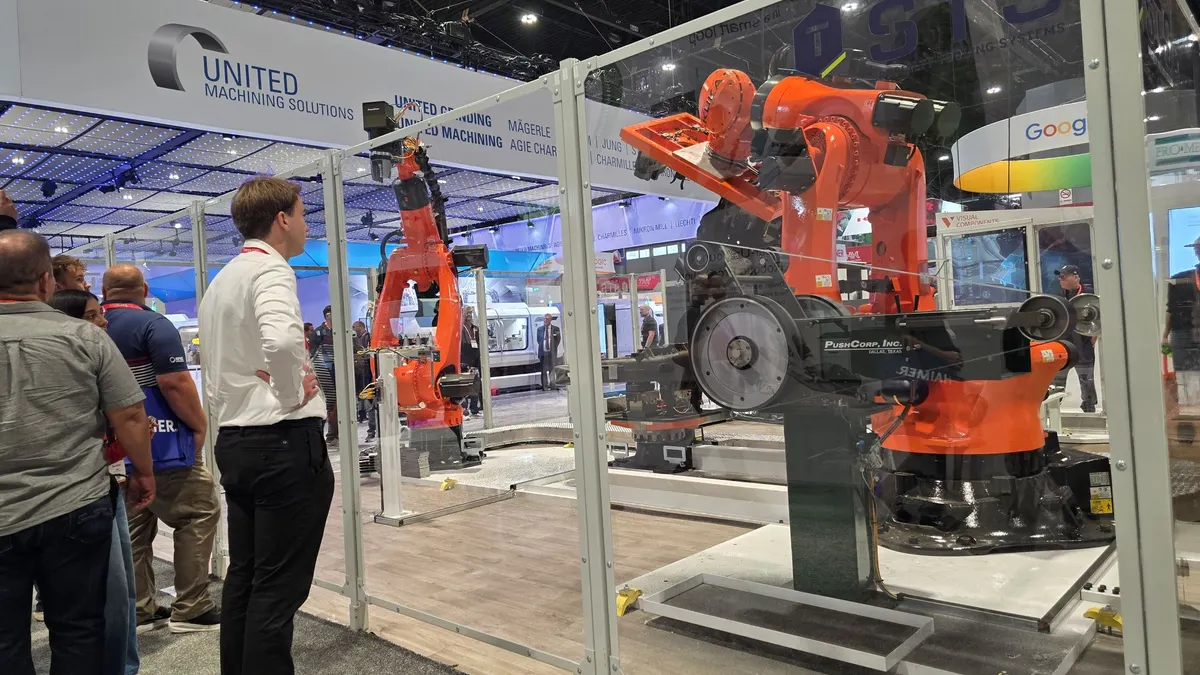
“[It’s] great news for this area of the world,” President Jane Heffner said at Automate 2026 in Chicago on Wednesday.
The automotive sector was the main driver of U.S. robot demand, accounting for more than a third of the units installed last year.
At the same time, the food industry and a segment of unspecified, non-manufacturing areas saw 30% and 41% growth, respectively. Meanwhile, the metal and machinery segment saw a 15% decline over the period. The unspecified group accounted for another third of installments, which Hefner said will likely be broken out for future reports.
“More robots are being used in operations alongside employees, and employees are becoming more comfortable in using robots alongside the work they do, ” she said.
From a global standpoint, industrial robot installations grew 15% to a record 621,000 units last year, IFR data shows. While the U.S. saw double-digit growth, Asia comprised the largest share of installations at 79%, followed by Europe with 13% and the Americas at 9%.
Robot deployments were most dense in South Korea, followed by Germany and Japan, according to IFR data from 2019 to 2024. Density is measured as the number of robots in operation per 10,000 manufacturing employees.
The U.S. ranked 8th at 302 in terms of density, compared to a global average at 132. China, notably, fell several spots from third last year to 22nd after IFR used different data that it felt was “more reliable” for the country, Heffner said.
Much of the global growth came from increased electronics manufacturing, Heffner said, citing the data center boom and renewable energy demand. She also noted strength in the automotive, metal and machinery segments.
Heffner said Mexico saw its third straight year of installation declines as trade uncertainty affected investments and strategic decision making while Canada saw a 6% increase.
Looking ahead, IFR is bullish on robot installations for North America. As reshoring initiatives and worker shortages driven by high turnover and an aging workforce affect the region, Heffner is optimistic about the trajectory of robotics.
“There is a ton of opportunity for us,” she said.
Robots are also becoming less expensive for manufacturers to use. The robotics-as-a-service model, where companies lease hardware or software on a subscription basis, is turning what would be a large capital purchase into a monthly operating cost, Alex Coleman, principal analyst of the market intelligence team at A3, said at a separate session at Automate.
“These ideas matter because this is converting robots from a board-level capital decision into something more akin to a hiring decision or even an equipment rental,” he said.
Additionally, Amazon and other large companies are moving automation in-house and figuring out ways they can take on more of the robotics technology stack. That translates to procurement changes for new clients, Coleman said.
Over the next two years, he said opportunities are going to grow for warehousing as logistics and e-commerce providers continue to acquire material handling robots — which accounted for 60% of all North American orders in the first quarter of 2026.
He also highlighted growth opportunities in life sciences driven by weight-loss drug demand, as well as construction, defense and food processing.
“For decades, the bet in this industry was really long on capability — can the machine do the jobs,” Coleman said. “That is largely resolving in favor of automation.”
On the other hand, humanoid robots are still catching on. In 2025 and 2026, there were virtually no “real-world applications” for them, said Blake Griffin, research manager at Interact Analysis. Most of the units were for academic research and development or entertainment purposes in China, where the country accounted for “almost all deployments,” he said.
“A large-scale deployment is still a ways off,” Griffin said. Interact Analysis is forecasting fewer than 100,000 humanoids globally by 2030, but for that to ramp up over the next ten years.