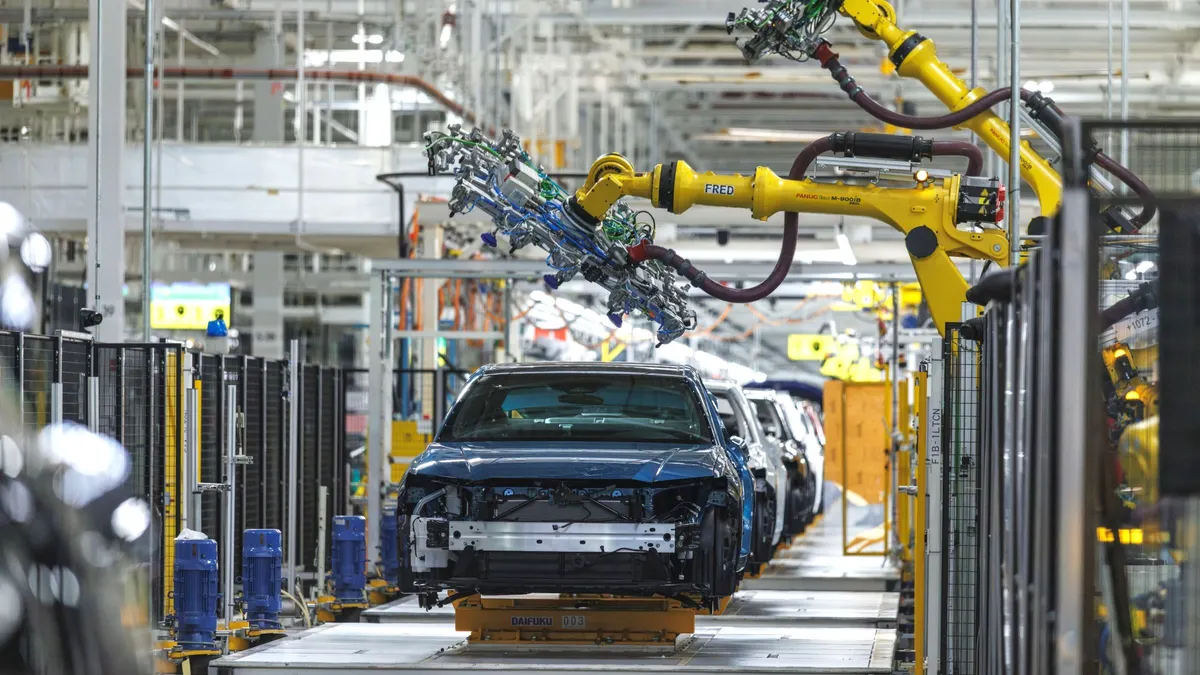
U.S. manufacturers of automation technology and robotics are seeing their sales grow or looking to capture tailwinds as customers upgrade and enhance their facilities. At the same time, some customers are being more cautious of their capital spending amid war disruptions and tariff uncertainty.
Here are a few highlights from Rockwell Automation, Teradyne and Tesla’s latest earnings results.
Rockwell Automation sees double-digit earnings growth
Rockwell Automation, a hardware and software provider focused on industrial automation and digital transformation, reported $2.2 billion in sales during its second fiscal quarter, up 12% from a year ago.
Demand improved across warehouse automation, data center, semiconductor and energy, with earnings results exceeding expectations, CEO Blake Moret said on an earnings call Tuesday. Most of the revenue growth during the quarter, which ended March 30, happened across Rockwell’s intelligent devices and software and control segments.
While manufacturers build out more production capacity in the United States, Rockwell is also starting to see delays in large capital investments from customers in automotive and consumer packaged goods due to “persistent trade volatility and geopolitical uncertainty,” Moret said.
“We’re doing a good job of managing cost increases in areas affected by tariffs, demand for memory and fuel,” he said.
Intelligent devices sales totaled $1 billion during the quarter, up 13% from a year ago. The segment — which accounts for drive, motion, advanced materials handling, sensing and industrial component products — saw operating margins increase more than three percentage points to 20.9% due to positive pricing and higher sales volumes.
Moret said intelligent devices saw strong growth in its motion I/O, safety and sensing businesses. He also noted growing adoption of its autonomous mobile robots across automotive, food and beverage, home and personal care, as well as data center applications.
Software and control sales were $684 million, up 20% from the same period last year. The segment — which accounts for digital twin, simulation and information software, as well as network and security infrastructure — also saw operating margins increase more than three percentage points to 34.9%.
Moret said software and control sales grew in part due to North America and data center customers seeking Logix industrial-grade controllers and software.
“Our data center business was one of the strongest end markets in the quarter, with sales more than doubling year over year,” he said.
The Milwaukee-based company made a net income of $350 million during the quarter. This was an increase of $98 million from a year ago.
Looking ahead, Moret said Rockwell Automation is expecting 2026 sales to grow between 5% to 9% as demand gradually improves through the remainder of its fiscal year, which ends Sept. 30. He also raised its operating margin by 1.5 percentage points to 21.5% as the company takes a more “prudent approach” to navigating an uncertain environment.
Teradyne’s robotics division continues growth trajectory
Teradyne’s robotics division, a maker of industrial-grade collaborative robots for manufacturers, reported $91 million in revenue during the first quarter, up 32% from a year ago.
This marked the fourth consecutive quarter of growth for Teradyne’s robotics division, which is notable because “Q1 is typically down” following the fourth quarter historically, CEO Greg Smith said in an April 29 earnings call.
The company, which makes Universal Robots, saw demand increase across e-commerce, electronics manufacturing and semiconductors, including among data center customers.
“Robotics is a key part of our wafer to AI data center strategy with robotic-assisted assembly, test and data center operations,” Smith said on the call.
The company has sold more than 100,000 Universal Robots worldwide, with deployments at Stellantis, Ford, Schneider Electric, L'Oréal and other manufacturers, according to its website. The cobots are used for industrial applications such as welding, palletizing, assembly and material handling.
The robotics division is a small but growing part of Teradyne’s overall portfolio. The Massachusetts-based company reported nearly $1.3 billion in total revenue for the first quarter, largely driven by semiconductor testing equipment sales.
“It goes without saying AI is the dominant force shaping our business,” Smith said.
Elon Musk teases Optimus as ‘the biggest product ever’
Tesla’s robotics division is on track to start production of its humanoid Optimus at its Fremont, California, facility later this year, co-founder and CEO Elon Musk said on an earnings call April 22.
Musk prefaced that production will be “very slow in the beginning” as Tesla builds out the division’s supply chain and technology, but plans to “ramp up significant numbers next year.”
He said Tesla is constructing a second Optimus factory at its Giga Texas complex in Austin, with plans to start production in the summer of 2027. The bipedal robot will be capable of performing “unsafe, repetitive or boring tasks,” according to Tesla’s website.
Musk said that its latest Optimus design should be ready for demonstration by mid-2026.
“I think Optimus will be our biggest product — not just Tesla’s biggest product ever, but probably the biggest product ever,” he said.