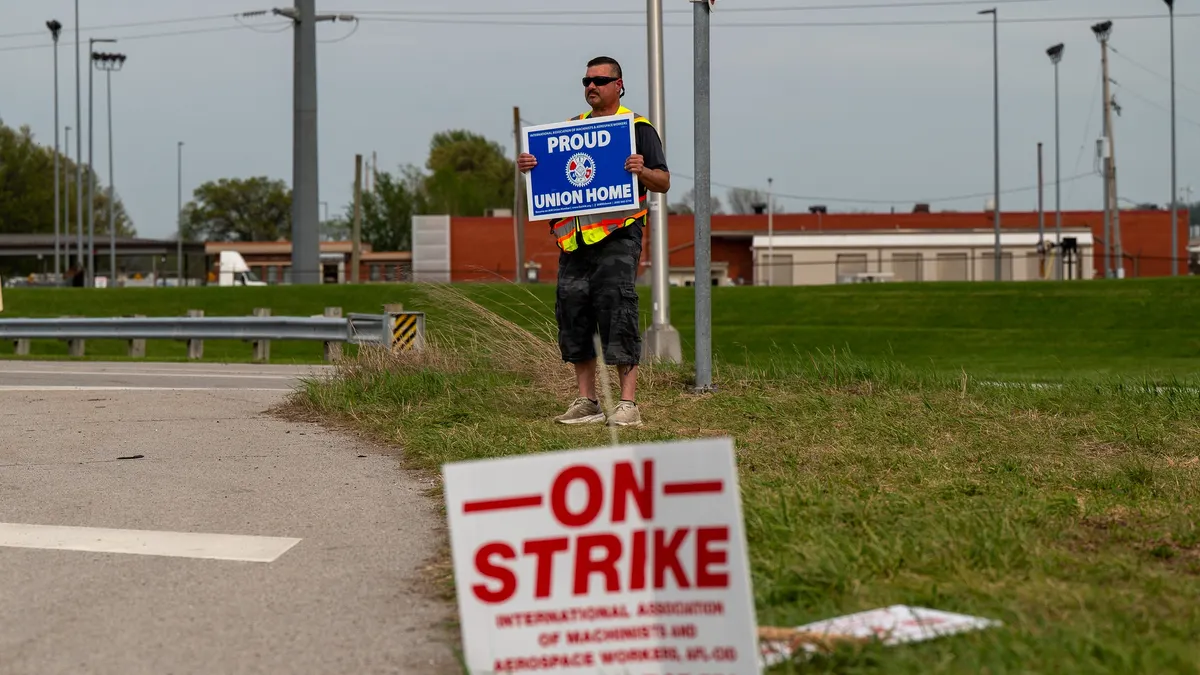
Olin has only met with a local union’s negotiating committee twice since the workers’ strike began April 4 at the company’s Winchester ammunition factory in Independence, Missouri, the International Association of Machinists and Aerospace Workers said during a virtual media roundtable on Thursday.
About 1,350 plant workers represented by IAM Local 778 walked off the job earlier this month at the Lake City Army ammunition facility, which produces small arms cartridges for the U.S. military, with the majority of the rounds supplied for the U.S. Army, Air Force and Marine Corps. Winchester is one of Olin’s three business divisions.
The Machinists union said in an April 9 press release that “very little production” is taking place at the Winchester facility due to “highly trained” workers on strike. Winchester said in an email on Thursday that the Lake City Army facility is still running “safely and reliably.”
“We respect our employees’ right to work and ensure work is available to them, and we are grateful for the hundreds of employees who continue to come to work every day,” Winchester said in a statement. “We have actively engaged with union leadership since the strike began, striving to achieve a fair and sustainable agreement that supports employees and the long-term success of the Lake City facility.”
Olin has been implementing a cost-cutting strategy established in December 2024, which targets $250 million in savings by 2028.The company delivered $44 million in cost savings last year and aims to add between $100 million to $120 million in 2026, CEO and President Kenneth Lane said during the company’s fourth quarter 2025 earnings call on Jan. 30. Part of the cost-savings strategy includes “right-sizing” Winchester’s staffing and operations to reflect lower levels of commercial ammunition demand.
Scott Brown, IAM Local 778 directing business representative, said the company told the union it has offered a package “that’s similar or equal to other areas in the company.”
“They're not looking at the economy that these folks have come out of. They're not looking at how their wages compare to the last five-and-a-half-year agreement they just came off of. They're not looking at the future, the increase of cost of living,” Brown said. “They keep communicating to us that they have offered a fair package, and we seem to be unreasonable for not accepting that.”
“The meetings we’ve had have pretty much been meaningless,” Brown continued. “There’s been a little bit of conversation, some minor movement, but there’s been no offer to even take it back to this group to this point, so we're in it for the long haul.”
Brown said the parties met earlier in the week, but no future meetings have been set, and urged Olin to return to the table so workers can get back to work.
Since the start of the strike, workers and their supporters have been picketing 24/7 in front of the Winchester facility, Brown said.
“We’ve told the company repeatedly, ‘we’re ready to get back to work,’ and consistently, there’s no other offer,” since the factory workers walked out, Brown said.
The union is seeking better work-life balance. Vaughn Cochran, who is on the union’s negotiating committee, said he has worked at the Winchester factory for 10 years. About four years ago, working longer than 40 hours a week became commonplace, according to Cochran.
“It was optional at the beginning, and then it just went to where it doesn’t matter, we're going to force everybody for 60 hours and on,” Cochran said.
Cochran also alleged that if workers took a day off or used some of their paid time off, the company would force employees to work another day.
“There were multiple times that I ended up 13 days in a row, and when you're doing 13s, 12s, it really wears on your body, and we all deserve better than that,” Cochran said. “We're just asking for something where we can go home when our time’s done, we can go home and we can spend time with our family and not worry about, ‘How am I going to pay this bill?’ Because we're not getting what we need and what we deserve.”
Cochran also has “skin in the game.” He has a son currently serving in the Marine Corps.
“I know that everything that goes out of that plant can make it to where he comes home,” Cochran said. “So we're just trying to get back to work so that we can support the warfighter and continue to do what we need to do to make everything function as it should.”